Gold Trading Alert: A fierce clash between cooling inflation and escalating conflict drives gold prices back to around $4050; could the bull market be restarting?
2026-07-15 07:44:11
On Tuesday (July 14), the global gold market experienced a dramatic rollercoaster ride. Spot gold briefly fell to its lowest level since July 1—$3,983 per ounce—with market pessimism seemingly taking hold. However, the situation reversed instantly with the release of the US June Consumer Price Index (CPI) data. Gold prices rebounded strongly from their lows, surging to a high of $4,102.82 per ounce before closing at $4,052.64, a daily gain of 1.3%. US gold futures also performed strongly, with the most active contract settling up 1.6% at $4,069.70. Behind this surge was a fierce clash between two forces: on one hand, unexpectedly weak inflation data cooled expectations of a Fed rate hike; on the other hand, the escalating US-Iran conflict fueled concerns about global energy supply and inflation prospects. Gold, as a special asset possessing both monetary and safe-haven attributes, is at the forefront of this tug-of-war. On Wednesday (July 15) in early Asian trading, spot gold traded in a narrow range, currently around $4053.17 per ounce. 
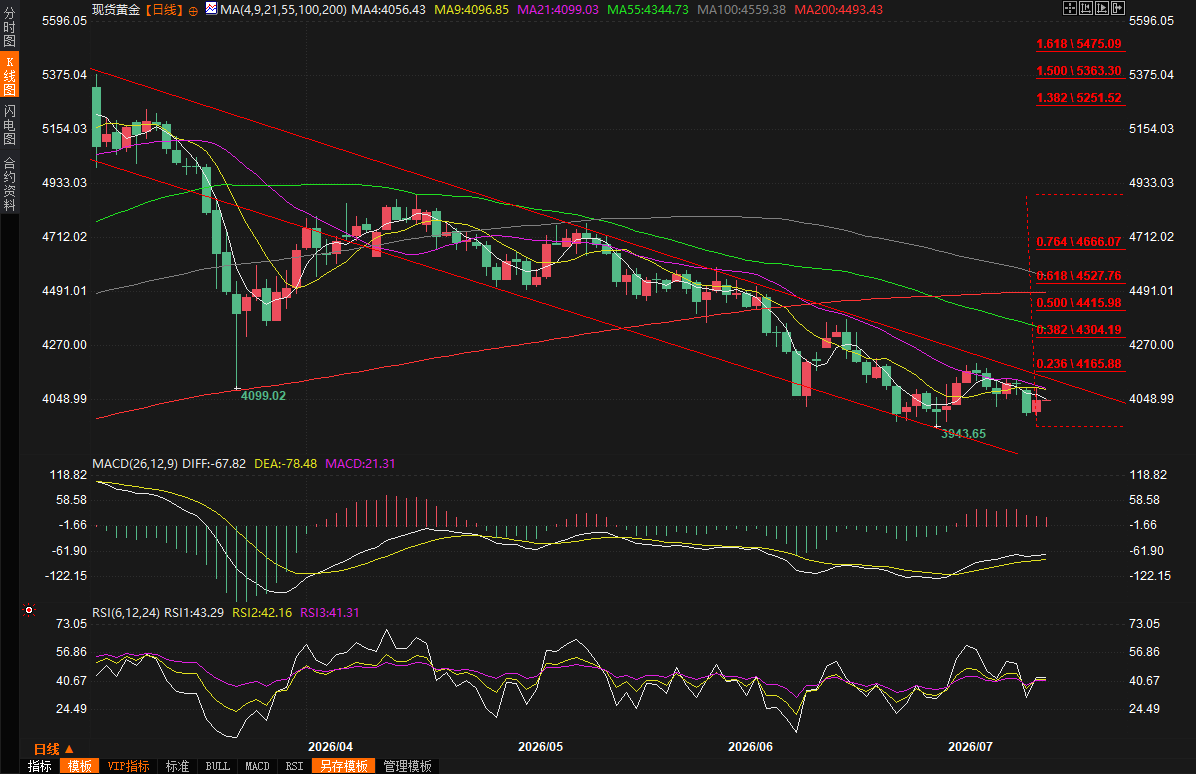 (Spot gold daily chart, source: FX678) At 07:38 Beijing time, spot gold is currently trading at $4053.93 per ounce.
Inflation "cools": Unexpectedly weak CPI data causes interest rate hike expectations to plummet.
Core CPI flat, first negative month-on-month growth in six years Data released by the U.S. Department of Labor showed that the Consumer Price Index (CPI) rose 3.5% year-on-year in June, lower than both May's 4.2% and the market expectation of 3.8%. More notably, the CPI fell 0.4% month-on-month in June, compared to a 0.5% increase in May—the first time the U.S. CPI has experienced negative month-on-month growth since the early stages of the pandemic in 2020. Core CPI remained unchanged in June after rising 0.2% in May. Independent metals trader Tai Wong commented on the report, stating, "Gold prices surged, boosted by the unexpectedly weak CPI report. While the overall CPI fell sharply, more importantly, the core CPI remained flat. This should significantly reduce market expectations for interest rate hikes at the July and September policy meetings." The probability of a rate hike plummeted . The market reaction was immediate. According to the CME Group's FedWatch tool, market expectations for a rate hike of at least 25 basis points at the Fed's July meeting plummeted to 16.6% from 41.7% the previous trading day. For the September meeting, market pricing shows a 59.8% probability of a rate hike, also lower than Monday's 75.1%. Wells Fargo chief economist Tom Porcelli commented in a report, "This is a very encouraging inflation report and should quell the growing calls for a rate hike at the July meeting." Barclays US economist Pooja Sriram also noted that the data "may buy the Federal Open Market Committee time to keep rates unchanged and await further data." A weaker dollar directly boosted gold. The weak inflation data directly pressured the dollar exchange rate. The dollar index closed at 100.93 on Tuesday, down 0.37%. The weaker dollar made dollar-denominated gold more "cheap" for holders of other currencies, providing direct monetary support for the gold price rebound. Meanwhile, the yield on the 10-year U.S. Treasury note fell 3.1 basis points to 4.579%, marking its biggest one-day drop since June 24. Lower interest rate expectations mean a lower opportunity cost of holding gold, further increasing its attractiveness.The conflict escalates: the US-Iran conflict intensifies, and the Strait of Hormuz becomes the global focal point.
From Ceasefire to Full-Scale Engagement: The Situation Deteriorated Rapidly Just as markets were celebrating inflation data, the shadow of geopolitical tensions intensified. The ceasefire that seemed sustainable between the US and Iran in mid-June collapsed completely in July. Iran launched ballistic missiles at a US airbase in Jordan, and the US retaliated with a five-hour-long attack on Iranian targets. This conflict over control of the Strait of Hormuz has pushed international oil prices to their highest point in four weeks. The US Central Command subsequently announced a new round of strikes against Iran, beginning at 3 p.m. Eastern Time on July 14, to "continue to weaken Iran's ability to attack commercial shipping in the Strait of Hormuz." Iranian media reported that multiple locations in southern and southwestern Iran were attacked by US forces. This marked the fourth consecutive night of US attacks on Iran. Strait traffic was nearly paralyzed, and energy supplies were in dire straits . The situation in the Strait of Hormuz is particularly worrying. According to data from PortWatch, the port monitoring agency of the International Monetary Fund, only 34 ships passed through the strait on July 5, compared to a normal daily throughput of approximately 88 ships. Data from trade intelligence firm Kpler is even more alarming—only 14 ships passed through the strait on July 13, of which only four were crude oil tankers, a decrease of about 60% compared to the same period a week earlier. Iran's Islamic Revolutionary Guard Corps has explicitly warned that Iran will not export oil or gas from the region as long as the United States continues to act hostilely. This means that approximately 20% of the global oil supply (transported via the Strait of Hormuz) is at risk of being disrupted at any moment. Oil prices surge, inflation concerns resurface. Brent crude futures rose 1.7% on Tuesday to settle at $84.73 a barrel, marking the second consecutive trading day's highest close since June 12. U.S. crude futures rose 1.5% to settle at $79.34, the highest close since June 15. Analysts at Ritterbusch and Associates stated that military action between the U.S. and Iran escalated again this week, and tensions are likely to persist. The surge in oil prices has created a dilemma for the market: on the one hand, CPI data shows that inflation is cooling; on the other hand, rising energy prices could push inflation back up in the coming months. Uto Shinohara, senior investment strategist at Mesirow Currency Management, pointed out: "Inflation has been above target for several years, and the renewed escalation of geopolitical tensions has led to persistently high risks of energy-driven inflation... Therefore, although the latest CPI report shows that inflation has slowed down, the overall inflation outlook remains uncertain."The Federal Reserve's Dilemma: Warsh's "Declaration of Independence"
"I will continue to fulfill my duties." At a complex time marked by an uncertain inflation outlook and high geopolitical risks, Federal Reserve Chairman Kevin Warsh testified before the House Financial Services Committee for the first time on Tuesday, and his remarks were closely watched by the market. When asked how he would respond if President Trump continued to pressure the Fed, Warsh's answer was resounding: "I will continue to fulfill my duties." He further emphasized: "The Fed's independence is sacrosanct. If we remain independent, and the outside world perceives us as independent, our credibility will be enhanced… so that we can fulfill our duties in the best possible way." This statement was interpreted by the market as Warsh trying to distance himself from the White House. Johns Hopkins University economics professor Jon Faust stated before the hearing: "If anyone had worried that he would become a 'puppet,' those concerns should have disappeared by the first press conference after the Fed decided to keep interest rates unchanged." Inflation target remains unchanged, no signs of rate cuts. Despite weak June CPI data, Warsh showed no signs of easing his hawkish stance. He told lawmakers, “Some people might see this morning’s data and say, ‘Oh, mission accomplished, everything went smoothly.’ But that’s not my view.” He reiterated that his top priority is to push inflation back to the 2% target. Warsh also pledged that the Fed would not “selectively interpret” the data. Regarding policy guidance, Warsh differed from his colleagues; he did not submit interest rate forecasts at the Fed’s June meeting and does not intend to do so in the future—because he opposes this type of “forward guidance.” He made it clear at the press conference that at his first meeting as Fed Chairman, only one policy proposal was on the table, and interest rate cuts were not discussed. The Divergence Between Market Expectations and Policy Reality However, market expectations appear to be more dovish than Warsh’s statements. After the CPI data release and Warsh’s testimony, traders significantly reduced their bets on a July rate hike. Market expectations for a July rate hike have fallen to around 12%, and expectations for a September rate hike have fallen to around 53%. But Warsh showed no signs of an imminent rate cut. This divergence between market expectations and the Fed’s stance is precisely a significant source of future volatility in the gold market.Market Outlook: Three Major Variables to Determine Gold's Direction
Variable 1: US PPI Data to be Released Soon Investors will be closely watching the US Producer Price Index (PPI) data on Wednesday. If the PPI also shows easing inflationary pressures, it will further solidify market expectations that the Federal Reserve will pause interest rate hikes, providing support for gold prices. Conversely, if the PPI unexpectedly rises, it could reignite market concerns about inflation. Variable 2: The Evolution of the US-Iran Conflict Geopolitics is currently the biggest uncertainty. US President Trump has stated that strikes against Iran will continue "until I say 'enough'." He also stated that strikes against Iranian energy facilities will be reserved for last. Meanwhile, the Iranian military continues drone strikes against US military bases in the region. Whether this conflict will escalate into a larger regional war or return to the negotiating table at a certain critical point will directly affect global energy supply and inflation expectations, thus determining the medium-term trend of gold. Variable 3: Warsh's Subsequent Statements Warsh will continue to testify before the Senate Banking Committee on Wednesday. The market will be closely watching whether he releases any further signals regarding the path of monetary policy. Although Warsh has made it clear that he will not provide "forward guidance," any subtle change in wording regarding inflation assessments or interest rate stance could trigger a sharp market reaction.In conclusion, the "golden age" of gold is not over.
Unexpectedly weak inflation data provided monetary support for gold, while the escalating US-Iran conflict provided a geopolitical safe-haven premium. Driven by both "cooling inflation" and "escalating conflict," gold prices staged a dramatic battle around the $4,000 mark. In the short term, gold prices will continue to fluctuate amid the interplay of inflation data, geopolitical tensions, and expectations regarding Federal Reserve policy. From a broader perspective, the medium- to long-term logic for gold remains strong. The major trends of "de-globalization" and "de-dollarization" continue to benefit gold's allocation and safe-haven value. A survey by the World Gold Council shows that 89% of surveyed central banks expect global central bank gold reserves to continue to increase in the next 12 months, and 45% plan to increase their gold holdings in the next 12 months, the highest percentage since the survey began in 2018. Against the backdrop of persistent global inflation stickiness, high geopolitical risks, and continued strong demand for gold from central banks, gold's role as the ultimate store of value is perhaps more irreplaceable than ever before. $4,000 may just be another stop along the way in the long bull market for gold. (Spot gold daily chart, source: FX678) At 07:38 Beijing time, spot gold is currently trading at $4053.93 per ounce.
- Risk Warning and Disclaimer
- The market involves risk, and trading may not be suitable for all investors. This article is for reference only and does not constitute personal investment advice, nor does it take into account certain users’ specific investment objectives, financial situation, or other needs. Any investment decisions made based on this information are at your own risk.