The US dollar fell to a four-week low against the Canadian dollar, with markets focusing on the Bank of Canada's decision.
2026-07-15 13:54:19
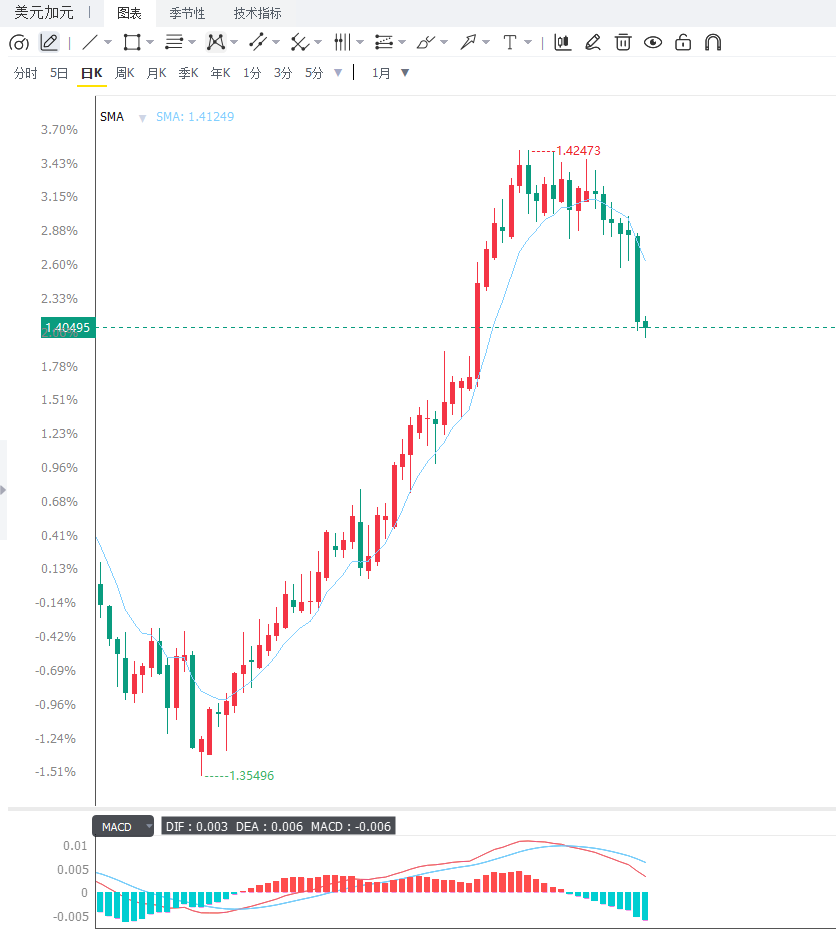
The US dollar (USD/CAD) continued its decline in Asian trading on Wednesday, falling to around 1.4045 , its lowest level in nearly four weeks, and marking its second consecutive day of losses. Current market fundamentals are generally bearish for USD/CAD, with a weakening US dollar and rising international oil prices providing continued support for the Canadian dollar. 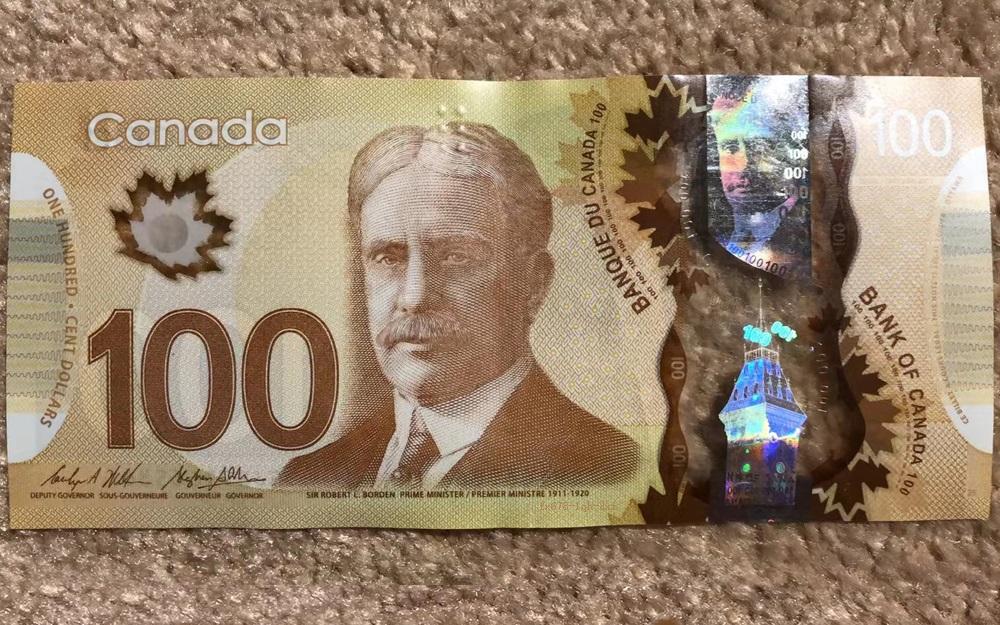 The main factor driving the dollar's decline came from the latest US inflation data. Data from the US Bureau of Labor Statistics showed that the Consumer Price Index (CPI) rose 3.5% year-on-year in June, lower than the market expectation of 3.8% and also lower than May's 4.2% ; month-on-month, it fell 0.4% , exceeding the market expectation of a 0.1% decline and marking the largest monthly drop since April 2020. This indicates a significant easing of US price pressures, further reducing market expectations for continued short-term interest rate hikes by the Federal Reserve. With the release of inflation data, the market readjusted its interest rate expectations, putting overall pressure on the dollar index, and causing US Treasury yields to fall in tandem, resulting in varying degrees of decline against most major currencies. The weakening dollar was one of the key factors driving the decline in the USD/CAD exchange rate. On the other hand, the continued rise in international oil prices further strengthened the Canadian dollar's performance. Recent escalation of tensions between the US and Iran has raised market concerns about the security of energy supplies in the Middle East. The mutual military actions taken by the US and Iran have fueled geopolitical risks, and US President Trump has stated that if Iran refuses to return to negotiations, the US may further expand military operations. These factors continue to push up risk premiums in the international energy market. Meanwhile, the Strait of Hormuz handles approximately 20% of global seaborne crude oil shipments , and concerns about shipping safety have fueled market worries about potential disruptions to global oil supplies, pushing WTI crude oil prices to a near one-month high. As Canada is a major global energy exporter, rising oil prices typically benefit the Canadian dollar; therefore, the continued strength of international oil prices has become a significant factor suppressing the USD/CAD exchange rate. However, the market has not completely ruled out the possibility of a subsequent rebound in the US dollar. While rising international oil prices support the Canadian dollar, they could also reignite global energy inflationary pressures, prompting the Federal Reserve to maintain a restrictive monetary policy for a longer period, which would provide some support for the US dollar. Therefore, the USD/CAD exchange rate will continue to be influenced by both US interest rate expectations and oil price movements in the short term. Investors are currently awaiting several important events, including the Bank of Canada's latest interest rate decision, the US June Producer Price Index (PPI), and Federal Reserve Chairman Kevin Warsh's congressional testimony the following day. If the Bank of Canada maintains a hawkish stance while US PPI continues to show slowing inflation, the USD/CAD pair may further decline; conversely, if the Bank of Canada releases dovish signals, or if US production-side inflation picks up again, the exchange rate may see a technical rebound. Technically, the USD/CAD pair has been declining on the daily chart, breaking below the key support level of 1.4100 , turning the overall trend into a weak, range-bound movement. The pair continues to trade below major moving averages, indicating short-term bearish dominance. A further break below 1.4040 could test the psychological level of 1.4000 and the 1.3950 area; initial resistance is seen at 1.4100 , with further resistance around 1.4160 . Daily momentum continues to weaken, and the bearish trend remains dominant. The 4-hour chart shows the USD/CAD pair trending downwards along short-term moving averages, with the moving average system maintaining a bearish alignment, suggesting limited short-term rebound potential. Although the exchange rate may experience a technical correction after approaching a recent low, the overall weak trend is expected to continue as long as it cannot regain a foothold above 1.4100 . A break below 1.4040 would target 1.4000 and 1.3950 ; a break above 1.4100 could trigger a short-term rebound and test resistance around 1.4160 .
  Editor's Summary: US June inflation fell short of market expectations across the board, prompting further downward revisions to the Federal Reserve's short-term interest rate hike expectations, thus putting continued pressure on the US dollar. Meanwhile, tensions in the Middle East kept international oil prices high, significantly benefiting Canada as a major energy exporter, with the Canadian dollar outperforming most major currencies, causing the USD/CAD pair to fall to a near four-week low. In the short term, the Bank of Canada's interest rate decision, US PPI data, and speeches by Federal Reserve officials will be key factors influencing the exchange rate. If oil prices continue to rise and the Bank of Canada maintains a hawkish stance, the USD/CAD pair may have further downside potential; conversely, if US inflation rebounds or demand for the US dollar as a safe haven increases, the exchange rate may experience a temporary rebound.
The main factor driving the dollar's decline came from the latest US inflation data. Data from the US Bureau of Labor Statistics showed that the Consumer Price Index (CPI) rose 3.5% year-on-year in June, lower than the market expectation of 3.8% and also lower than May's 4.2% ; month-on-month, it fell 0.4% , exceeding the market expectation of a 0.1% decline and marking the largest monthly drop since April 2020. This indicates a significant easing of US price pressures, further reducing market expectations for continued short-term interest rate hikes by the Federal Reserve. With the release of inflation data, the market readjusted its interest rate expectations, putting overall pressure on the dollar index, and causing US Treasury yields to fall in tandem, resulting in varying degrees of decline against most major currencies. The weakening dollar was one of the key factors driving the decline in the USD/CAD exchange rate. On the other hand, the continued rise in international oil prices further strengthened the Canadian dollar's performance. Recent escalation of tensions between the US and Iran has raised market concerns about the security of energy supplies in the Middle East. The mutual military actions taken by the US and Iran have fueled geopolitical risks, and US President Trump has stated that if Iran refuses to return to negotiations, the US may further expand military operations. These factors continue to push up risk premiums in the international energy market. Meanwhile, the Strait of Hormuz handles approximately 20% of global seaborne crude oil shipments , and concerns about shipping safety have fueled market worries about potential disruptions to global oil supplies, pushing WTI crude oil prices to a near one-month high. As Canada is a major global energy exporter, rising oil prices typically benefit the Canadian dollar; therefore, the continued strength of international oil prices has become a significant factor suppressing the USD/CAD exchange rate. However, the market has not completely ruled out the possibility of a subsequent rebound in the US dollar. While rising international oil prices support the Canadian dollar, they could also reignite global energy inflationary pressures, prompting the Federal Reserve to maintain a restrictive monetary policy for a longer period, which would provide some support for the US dollar. Therefore, the USD/CAD exchange rate will continue to be influenced by both US interest rate expectations and oil price movements in the short term. Investors are currently awaiting several important events, including the Bank of Canada's latest interest rate decision, the US June Producer Price Index (PPI), and Federal Reserve Chairman Kevin Warsh's congressional testimony the following day. If the Bank of Canada maintains a hawkish stance while US PPI continues to show slowing inflation, the USD/CAD pair may further decline; conversely, if the Bank of Canada releases dovish signals, or if US production-side inflation picks up again, the exchange rate may see a technical rebound. Technically, the USD/CAD pair has been declining on the daily chart, breaking below the key support level of 1.4100 , turning the overall trend into a weak, range-bound movement. The pair continues to trade below major moving averages, indicating short-term bearish dominance. A further break below 1.4040 could test the psychological level of 1.4000 and the 1.3950 area; initial resistance is seen at 1.4100 , with further resistance around 1.4160 . Daily momentum continues to weaken, and the bearish trend remains dominant. The 4-hour chart shows the USD/CAD pair trending downwards along short-term moving averages, with the moving average system maintaining a bearish alignment, suggesting limited short-term rebound potential. Although the exchange rate may experience a technical correction after approaching a recent low, the overall weak trend is expected to continue as long as it cannot regain a foothold above 1.4100 . A break below 1.4040 would target 1.4000 and 1.3950 ; a break above 1.4100 could trigger a short-term rebound and test resistance around 1.4160 . Editor's Summary: US June inflation fell short of market expectations across the board, prompting further downward revisions to the Federal Reserve's short-term interest rate hike expectations, thus putting continued pressure on the US dollar. Meanwhile, tensions in the Middle East kept international oil prices high, significantly benefiting Canada as a major energy exporter, with the Canadian dollar outperforming most major currencies, causing the USD/CAD pair to fall to a near four-week low. In the short term, the Bank of Canada's interest rate decision, US PPI data, and speeches by Federal Reserve officials will be key factors influencing the exchange rate. If oil prices continue to rise and the Bank of Canada maintains a hawkish stance, the USD/CAD pair may have further downside potential; conversely, if US inflation rebounds or demand for the US dollar as a safe haven increases, the exchange rate may experience a temporary rebound.
- Risk Warning and Disclaimer
- The market involves risk, and trading may not be suitable for all investors. This article is for reference only and does not constitute personal investment advice, nor does it take into account certain users’ specific investment objectives, financial situation, or other needs. Any investment decisions made based on this information are at your own risk.