Why is the pound repeatedly blocked at 1.3450? Is an invisible ceiling forming above it?
2026-07-15 19:00:11
On Wednesday, July 15th, the British pound fluctuated around 1.3390 against the US dollar, rising moderately from the previous trading day. The direct variable for the US dollar was the US June Consumer Price Index, which fell 0.4% month-on-month, with the year-on-year increase slowing from 4.2% to 3.5%, and the core index rising 2.6% year-on-year, thus cooling expectations for a short-term interest rate hike. Meanwhile, the UK entered a key data window, with May's GDP figures to be released on July 16th. 
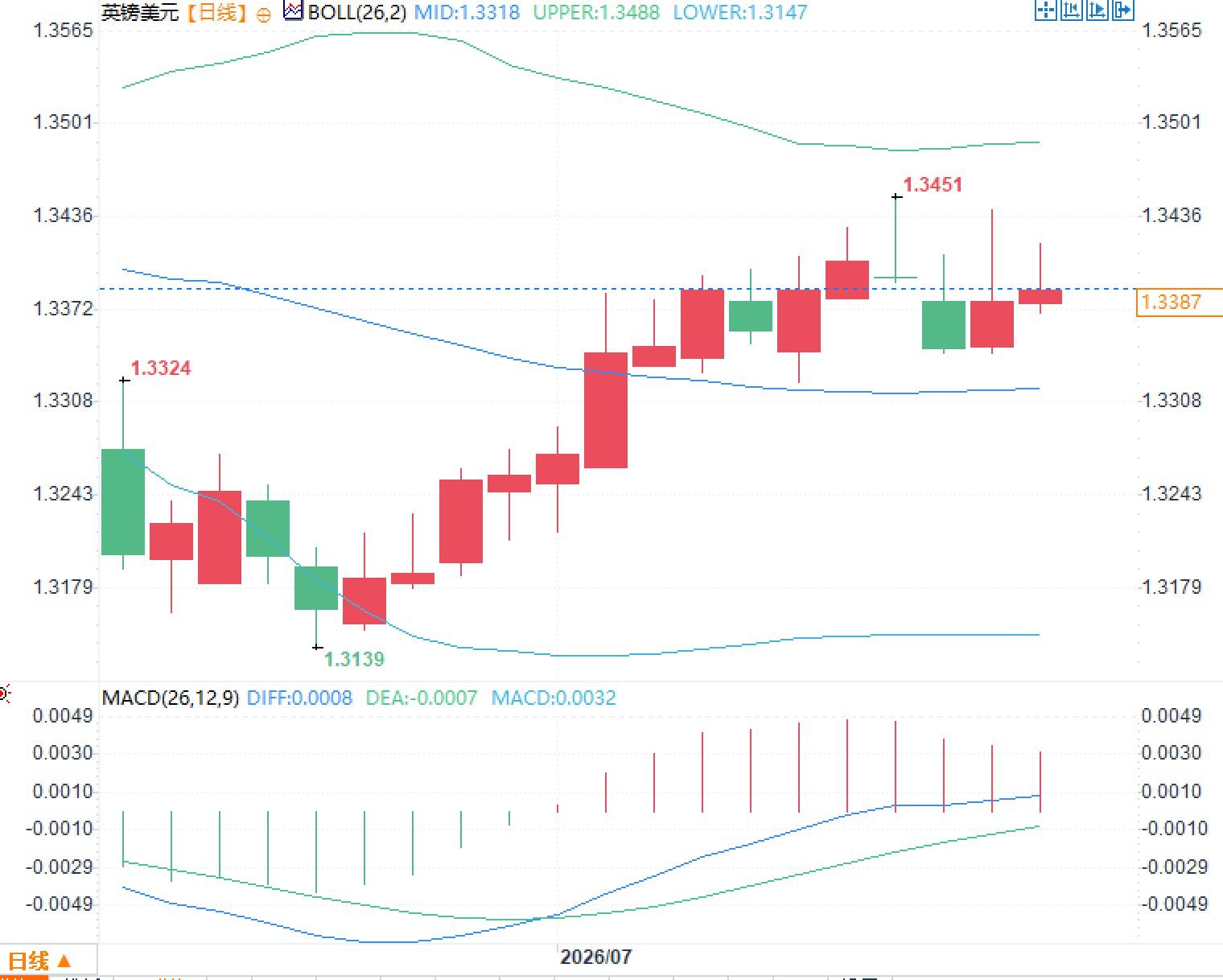 However, the exchange rate previously encountered resistance at 1.3451, with the upper Bollinger Band at 1.3488. The area between 1.3451 and 1.3488 constitutes the most concentrated technical resistance zone. The price action near the upper band resulted in consecutive long upper shadows, reflecting profit-taking, event-driven position reduction, and seller liquidity above 1.34. On the downside, the first support level to watch is the short-term equilibrium zone around 1.3372, followed by the middle Bollinger Band at 1.3318. If GDP growth only meets the 0.1% forecast, the market may continue to price within a range of 1.33 to 1.35. If the data is significantly weaker, the focus will shift to downward revisions to growth and expectations of further easing by the Bank of England. Only if both the aggregate and structural data are stronger than expected will the supply pressure above 1.3451 likely be tested again.
The pound has returned to around 1.34, driven by multiple factors.
The recent rise in the pound primarily reflects a cooling of interest rate expectations on the US side, and secondarily, the fact that UK economic data has not continued to deteriorate. The Bank of England's current policy rate is 3.75%, while the Federal Reserve's target range is 3.50% to 3.75%, resulting in a very limited short-term policy spread between the two. Therefore, the exchange rate is more easily driven by marginal data differences, energy prices, and position adjustments, rather than by absolute interest rate levels. In other words, the pound's rise to around 1.34 does not equate to a strengthening of the UK's growth logic, but rather a combination of a dollar pullback, short covering in the pound, and risk rebalancing before data releases. Unless UK data significantly exceeds expectations, further appreciation of the exchange rate will require further weakening of the US dollar. Conversely, if the UK's service sector or production falls short of expectations, even if GDP is barely positive, it could trigger a repricing of the UK's interest rate path.The key to May's GDP growth lies not in the expected 0.1%, but in the structure of growth.
UK GDP fell 0.1% month-on-month in April, ending several months of expansion. First-quarter GDP grew 0.6%, with the services sector growing 0.8%, indicating that economic momentum is highly dependent on the service sector. Retail sales rose 1.2% month-on-month in May, mainly driven by promotional activities and weather factors, supporting consumption and related service activities, and forming an important basis for market expectations of a slight economic recovery in May. However, for exchange rate pricing, a 0.1% month-on-month increase only indicates that the economy has avoided consecutive contractions, not that demand has entered a sustained expansion cycle. If the growth mainly comes from a rebound in retail sales, a low base, and individual service components, while manufacturing, industrial output, and business investment remain weak, the market is more likely to interpret it as a technical correction. A truly meaningful pricing scenario would be GDP reaching 0.2% or higher, with simultaneous improvement in the services, manufacturing, and industrial output. Only such a combination could drive the market to revise its second-quarter growth forecast. If the overall figures meet expectations but the internal structure is weak, the pound will face typical "realization pressure"—positive data on the surface, but interest rate expectations may not be supported.Pele's remarks dampened expectations for a short-term interest rate hike.
In his speech on July 14, Bank of England Governor Bailey stated that without the energy supply shock, inflation might have returned to near the 2% target in April or May, but the actual decline would have taken longer. He focused on stability, regulatory quality, long-term growth, and productivity, without giving a clear signal of support for a near-term interest rate hike. At the June meeting, the Bank of England voted 7-2 to maintain the interest rate at 3.75%, with only two members supporting a 4% increase. This indicates a tightening stance within the committee to prevent a resurgence of inflation, but not enough to trigger a policy shift. While energy prices have fallen somewhat from the initial stages of the conflict, they remain higher than pre-conflict levels, and the Bank of England expects related costs to potentially push up overall inflation again in the second half of the year. Data also explains this caution. The Consumer Price Index (CPI) was 2.8% year-on-year in May, but service inflation rose to 3.7%; regular wages grew by 3.4% year-on-year from February to April, indicating that nominal wage pressures are decreasing but not completely disappearing. Meanwhile, hourly output grew by only 0.4% year-on-year in the first quarter, and output per worker declined by 0.1% year-on-year, with productivity constraints limiting economic expansion without pushing up unit costs. Therefore, the Bank of England faces not a simple choice between raising or lowering interest rates, but a rebalancing between low growth, sticky service prices, energy costs, and inflation expectations. Bailey's cautious stance means that the pound cannot rely solely on interest rate premiums for continued appreciation; subsequent pricing must be supported by economic data.Technical indicators suggest the rebound will continue, but the upside potential is narrowing.
The daily chart shows that after rebounding from a low of 1.3139, the British pound against the US dollar has regained its position above the Bollinger Band's middle line at 1.3318. The MACD's DIFF is 0.0008, higher than the DEA's -0.0007, and the histogram remains positive, indicating that the short-to-medium-term recovery momentum is still intact. However, the exchange rate previously encountered resistance at 1.3451, with the upper Bollinger Band at 1.3488. The area between 1.3451 and 1.3488 constitutes the most concentrated technical resistance zone. The price action near the upper band resulted in consecutive long upper shadows, reflecting profit-taking, event-driven position reduction, and seller liquidity above 1.34. On the downside, the first support level to watch is the short-term equilibrium zone around 1.3372, followed by the middle Bollinger Band at 1.3318. If GDP growth only meets the 0.1% forecast, the market may continue to price within a range of 1.33 to 1.35. If the data is significantly weaker, the focus will shift to downward revisions to growth and expectations of further easing by the Bank of England. Only if both the aggregate and structural data are stronger than expected will the supply pressure above 1.3451 likely be tested again.
- Risk Warning and Disclaimer
- The market involves risk, and trading may not be suitable for all investors. This article is for reference only and does not constitute personal investment advice, nor does it take into account certain users’ specific investment objectives, financial situation, or other needs. Any investment decisions made based on this information are at your own risk.