Why is the foreign exchange market betting on the pound again when the UK economy is growing by only 0.1%?
2026-07-16 15:22:13
On Thursday, July 16, the pound rose to around 1.3540 against the dollar, having recently touched 1.3557, a new high in about two months. This rise was not driven by a single data point, but rather by a combination of factors: the UK economy avoiding further contraction, the forward shift in expectations of a Bank of England interest rate hike, a cooling of expectations for short-term dollar interest rates, and speculation about fiscal policy ahead of the UK government transition. 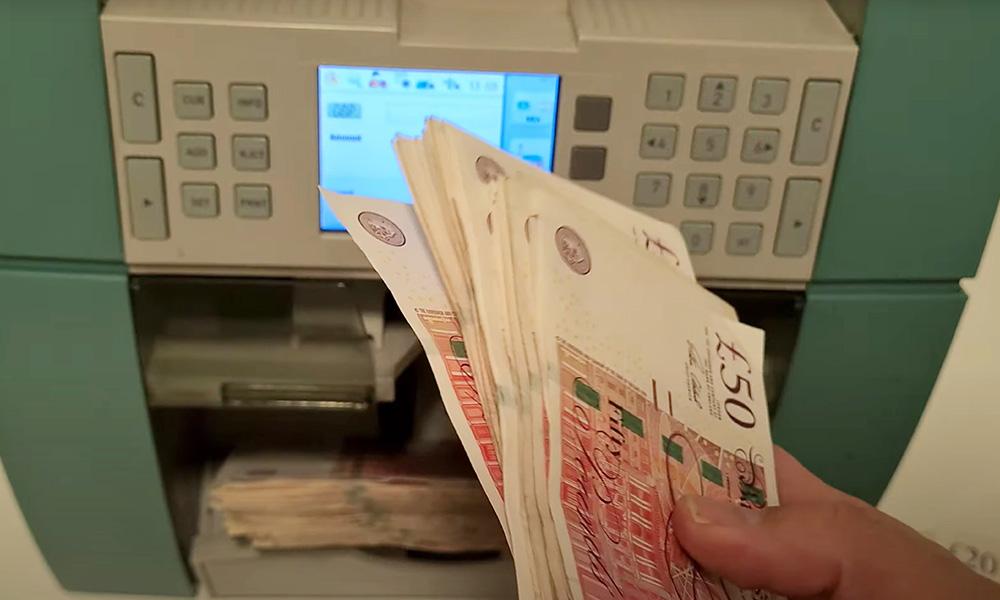
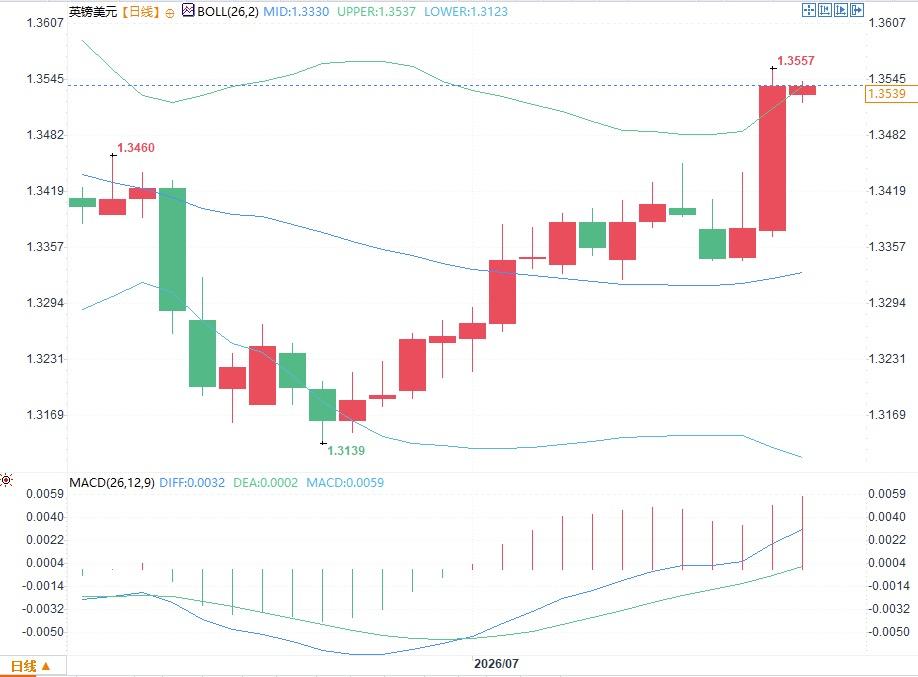 However, the exchange rate is already slightly above the upper Bollinger Band at 1.3537, and the short-term price deviation from the mean has widened significantly. After the previous high of 1.3460 was broken, some trend-following funds and stop-loss orders may have been released in a concentrated manner, causing the upward speed to outpace the improvement in fundamentals. Therefore, the current 1.3530 to 1.3560 area is not only a technical resistance zone but also a location where interest rate expectations, fiscal expectations, and a weakening dollar are concentrated. The dollar index has fallen by approximately 0.8% cumulatively in the previous two trading days, and the rise in the pound also includes contributions from the dollar. Recent inflation and employment data have reduced the market's probability of a Fed rate hike in July, thus providing the pound with support from both rising UK interest rate expectations and cooling dollar interest rate expectations. Whether the exchange rate can maintain its high level will depend not only on whether UK data is better than expected but also on whether the probability of a Bank of England rate hike continues to rise. If energy prices fall and inflation expectations cool, the pound's interest rate premium may narrow; if growth data weakens, the market may reassess the UK economy's ability to withstand a 4% interest rate.
The British economy is barely expanding; the real information lies in the industrial structure.
The UK's GDP grew 0.1% month-on-month in May, reversing a 0.1% decline in April; the economy grew 0.7% in the three months to May, slightly lower than the revised 0.8% of the previous three months. This result was in line with market expectations, so the pound did not experience a significant second surge after the data release. The focus of the currency market was not the 0.1% figure itself, but rather that the UK economy had not yet fallen into a continuous contraction due to the impact of energy prices. However, the growth structure is unbalanced. In May, service sector output grew 0.3%, construction declined 0.8%, and the production sector declined 0.5%. In the three months to May, the service sector grew 0.7%, with computer programming and advertising-related activities performing strongly. This shows that the UK economy is still mainly supported by the service sector, while the real production and investment chains are relatively weak. This structure has a dual impact on the pound. The resilience of the service sector can stabilize employment, wages, and tax expectations, reducing the probability of a rapid economic recession; however, the contraction in the construction and production sectors means that high financing costs have begun to suppress capital expenditure. The current data is closer to a coexistence of slow growth and high inflationary pressures than a comprehensive recovery in demand.With the Bank of England's expectations shifting, interest rate differentials are once again becoming a core factor in exchange rate movements.
In June, the Bank of England voted 7-2 to keep the benchmark interest rate at 3.75%, with two members supporting a rate hike to 4%. The UK's current inflation rate is 2.8%, above the policy target of 2%, and the Bank of England also expects energy cost transmission to potentially push inflation back up this year. The next interest rate decision will be announced on July 30. Previously, market discussion focused on when the Bank of England would cut rates; now it has shifted to whether a rate hike is necessary. Interest rate swap pricing shows that the market expects the Bank of England to raise rates by 25 basis points to 4% before November, an expectation that had been postponed until the first half of next year before energy prices rebound. This means that the pricing logic for the pound has changed. Economic growth of only 0.1% is usually insufficient to drive a currency breakout on its own, but as long as growth does not deteriorate significantly, inflation risks could force the Bank of England to maintain higher interest rates. For the foreign exchange market, marginal policy direction is often more important than absolute growth levels. The more the UK economy can withstand higher interest rates, the longer the pound's interest rate differential may last. The problem is that energy shocks simultaneously compress both household real income and corporate profits. If rising inflation stems primarily from cost-side factors rather than demand expansion, the Bank of England faces a typical policy constraint: insufficient tightening could solidify inflation, while excessive tightening could amplify pressure on the construction, manufacturing, and consumer sectors. The pound currently enjoys a policy premium, not a high-growth premium.Why has the area around 1.3557 become a key pricing zone?
The daily technical chart shows that the British pound against the US dollar has been recovering from a low of 1.3139, successively recovering the Bollinger Band middle line at 1.3330 and the previous consolidation platform, with the latest price reaching 1.3540 and the recent high being 1.3557. The MACD fast and slow lines are above the zero axis, and the positive histogram is expanding, indicating that the medium-term trend is still dominated by bullish momentum. However, the exchange rate is already slightly above the upper Bollinger Band at 1.3537, and the short-term price deviation from the mean has widened significantly. After the previous high of 1.3460 was broken, some trend-following funds and stop-loss orders may have been released in a concentrated manner, causing the upward speed to outpace the improvement in fundamentals. Therefore, the current 1.3530 to 1.3560 area is not only a technical resistance zone but also a location where interest rate expectations, fiscal expectations, and a weakening dollar are concentrated. The dollar index has fallen by approximately 0.8% cumulatively in the previous two trading days, and the rise in the pound also includes contributions from the dollar. Recent inflation and employment data have reduced the market's probability of a Fed rate hike in July, thus providing the pound with support from both rising UK interest rate expectations and cooling dollar interest rate expectations. Whether the exchange rate can maintain its high level will depend not only on whether UK data is better than expected but also on whether the probability of a Bank of England rate hike continues to rise. If energy prices fall and inflation expectations cool, the pound's interest rate premium may narrow; if growth data weakens, the market may reassess the UK economy's ability to withstand a 4% interest rate.Government transitions introduce fiscal variables, and the market focuses on credibility rather than slogans.
The UK is currently undergoing a leadership transition, with Andy Burnham expected to succeed Keir Starmer. Markets have recently focused on the new Chancellor of the Exchequer and their policy stance, with some of the pound's gains stemming from expectations of continued fiscal discipline. The key issue is not the specific personnel appointments themselves, but rather how the new government will handle the conflict between cost-of-living support, public spending, and fiscal space. Rising energy prices may drive increased demands for subsidies, but the public finances are relatively fragile, and any large-scale spending without adequate financing could push up the term premium on government bonds and weaken the pound's support from interest rate differentials. Therefore, the pound currently faces two opposing fiscal transmission paths. If policy emphasizes spending constraints and the credibility of the medium-term budget, the pound may continue to benefit from reduced risk premiums; however, if fiscal expansion exacerbates inflation and debt pressures, even further tightening by the Bank of England may not provide sustained benefits to the exchange rate. In the coming weeks, fiscal credibility may gradually replace monthly economic growth as a crucial variable in pound pricing.- Risk Warning and Disclaimer
- The market involves risk, and trading may not be suitable for all investors. This article is for reference only and does not constitute personal investment advice, nor does it take into account certain users’ specific investment objectives, financial situation, or other needs. Any investment decisions made based on this information are at your own risk.