Escalating conflict between the US and Iran fuels supply concerns, pushing oil prices up for the second consecutive week, but caution remains amid a tight resistance zone.
2026-07-17 13:42:16
International oil prices continued their strong performance in Asian trading on Friday, with WTI crude oil hovering around $79 per barrel , up about 0.7% from the previous trading day, remaining near the near one-month high reached this week. Looking at the overall performance this week, WTI crude oil is on track to record gains for the second consecutive week, as market funds continue to factor in the supply risk premium resulting from the escalating tensions in the Middle East.  The military conflict between the United States and Iran has escalated further recently. Market research indicates that the US military has conducted airstrikes against Iranian targets for the sixth consecutive night, and in a new round of maritime blockade operations targeting Iranian ports, attacked an empty oil tanker bound for Kharg Island. Simultaneously, Iran continues to launch missile and drone attacks on US military facilities in the Middle East. The escalating military actions by both sides have raised market concerns that the situation could revert to a larger-scale regional conflict. Meanwhile, attacks on civilian infrastructure, including power facilities and railway stations, in the southern Iranian port of Bandar Abbas further highlight the complexity of the situation. The Iranian Revolutionary Guard subsequently stated that it would not rule out expanding its strikes to more regional energy transport routes. Market research shows that Iran has requested the Houthi rebels in Yemen to enter a state of combat readiness, prepared to block the Red Sea oil transport route if necessary. This means that after the Strait of Hormuz, another important global energy transport route may also face greater security risks. The continued rise in energy transport risks has become a significant factor supporting international oil prices. The Strait of Hormuz handles approximately 20% of global seaborne crude oil transport , while the Red Sea connects to the Suez Canal and is a crucial energy transport hub between Europe and Asia. If both major shipping routes are affected simultaneously, the global crude oil supply chain could face greater disruptions, pushing international market risk premiums to continue rising. As a result, the number of commercial vessels transiting the Strait of Hormuz has decreased recently, with some shipping companies adopting alternative routes. Transportation costs and insurance expenses have continued to climb, further strengthening market expectations of tighter future crude oil supply. Although global crude oil inventories remain relatively stable and major oil-producing countries have not yet seen significant production cuts, uncertainties in the transportation sector have become a significant driver of rising oil prices. Meanwhile, the market is also paying attention to the impact of the global macroeconomic environment on crude oil demand. Recent US economic data, including employment and manufacturing figures, have been generally robust, indicating that energy consumption demand in the world's largest economy remains resilient, which has alleviated market concerns about a slowdown in demand to some extent. At the same time, the market expects energy consumption in major global economies to continue to grow in the second half of the year, providing some fundamental support for international oil prices. However, from a market trading perspective, WTI crude oil has recently remained within a consolidation range formed over the past few days, with both bulls and bears remaining cautious. Investors continue to monitor whether the situation in the Middle East will escalate further, while also waiting for oil prices to break out of the recent consolidation range to release a clearer directional signal. If the situation continues to deteriorate and energy transportation risks escalate, oil prices may still have room to rise further; if the situation eases, some risk premium may be gradually given back. From a technical perspective, WTI crude oil maintains a slightly bullish trend on the daily chart, with prices trading above the medium- and long-term moving average system, and the overall upward trend remains intact. The MACD indicator maintains a golden cross structure, and the red bars continue to expand, indicating that bullish momentum still dominates; overall market buying power remains stable. Currently, the first resistance level to watch is around $80.50/barrel ; a successful break above this level could lead to a further challenge of $82.30/barrel . On the downside, initial support is around $77.80/barrel , with more significant support around $76.20/barrel . As long as this area holds, the medium-term bullish trend is likely to continue. Looking at the 4-hour chart, WTI crude oil continues to consolidate at high levels, with short-term moving averages maintaining a bullish alignment. Although the MACD red bars have narrowed somewhat, they are still above the zero line, indicating that short-term bullish momentum has slowed but has not yet weakened. If the price can break through the resistance area of $80.50 with increased volume, it may open up new upside potential in the short term; if a technical pullback occurs, as long as the support around $77.80 can be held, it is expected to attract bargain hunters, and the overall pullback space may be relatively limited.
 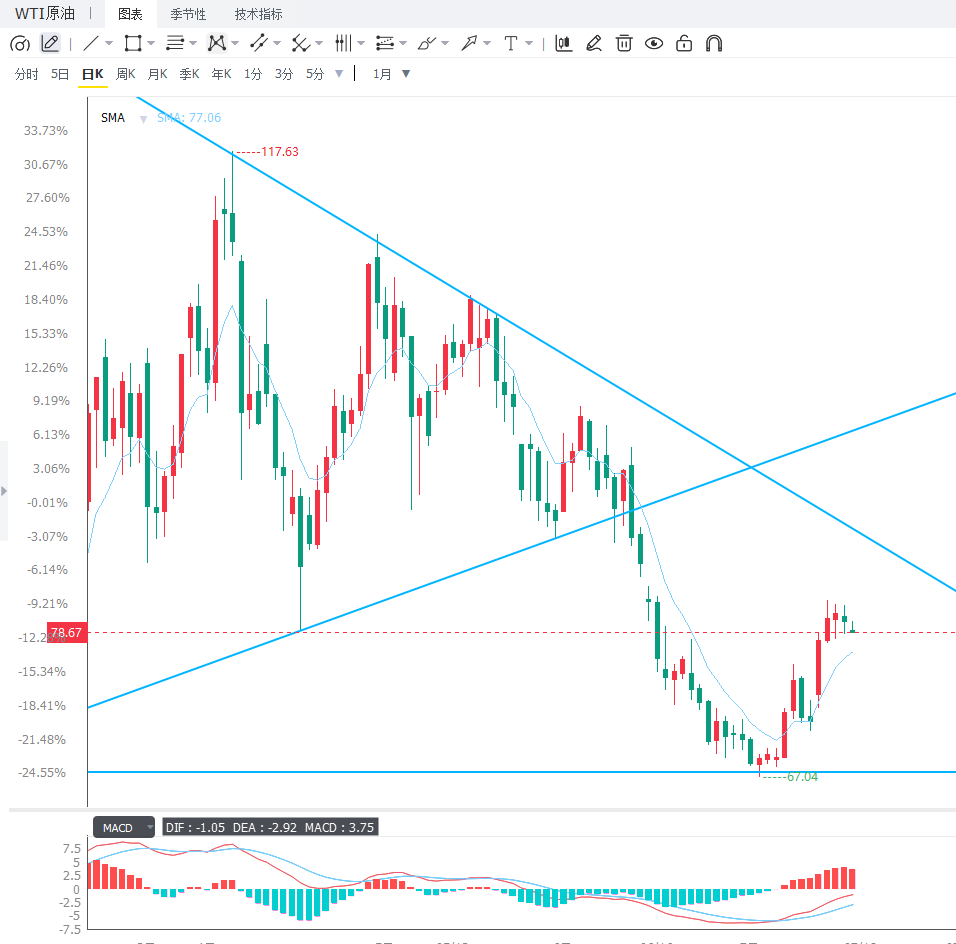 Editor's Summary : In summary, the escalating conflict between the US and Iran is increasing global energy transport security risks. Uncertainty surrounding the Strait of Hormuz and the Red Sea shipping routes continues to push up market risk premiums, providing solid support for international oil prices. Meanwhile, the resilience of the US economy also helps stabilize global oil demand expectations. Although WTI crude oil is currently in a consolidation phase, the fundamentals remain bullish. As long as the situation in the Middle East does not show significant easing, oil prices are expected to maintain a generally strong trend. Going forward, investors should pay close attention to regional developments, international shipping dynamics, and global crude oil inventory and demand data from major economies, and be wary of further market volatility caused by geopolitical factors.
The military conflict between the United States and Iran has escalated further recently. Market research indicates that the US military has conducted airstrikes against Iranian targets for the sixth consecutive night, and in a new round of maritime blockade operations targeting Iranian ports, attacked an empty oil tanker bound for Kharg Island. Simultaneously, Iran continues to launch missile and drone attacks on US military facilities in the Middle East. The escalating military actions by both sides have raised market concerns that the situation could revert to a larger-scale regional conflict. Meanwhile, attacks on civilian infrastructure, including power facilities and railway stations, in the southern Iranian port of Bandar Abbas further highlight the complexity of the situation. The Iranian Revolutionary Guard subsequently stated that it would not rule out expanding its strikes to more regional energy transport routes. Market research shows that Iran has requested the Houthi rebels in Yemen to enter a state of combat readiness, prepared to block the Red Sea oil transport route if necessary. This means that after the Strait of Hormuz, another important global energy transport route may also face greater security risks. The continued rise in energy transport risks has become a significant factor supporting international oil prices. The Strait of Hormuz handles approximately 20% of global seaborne crude oil transport , while the Red Sea connects to the Suez Canal and is a crucial energy transport hub between Europe and Asia. If both major shipping routes are affected simultaneously, the global crude oil supply chain could face greater disruptions, pushing international market risk premiums to continue rising. As a result, the number of commercial vessels transiting the Strait of Hormuz has decreased recently, with some shipping companies adopting alternative routes. Transportation costs and insurance expenses have continued to climb, further strengthening market expectations of tighter future crude oil supply. Although global crude oil inventories remain relatively stable and major oil-producing countries have not yet seen significant production cuts, uncertainties in the transportation sector have become a significant driver of rising oil prices. Meanwhile, the market is also paying attention to the impact of the global macroeconomic environment on crude oil demand. Recent US economic data, including employment and manufacturing figures, have been generally robust, indicating that energy consumption demand in the world's largest economy remains resilient, which has alleviated market concerns about a slowdown in demand to some extent. At the same time, the market expects energy consumption in major global economies to continue to grow in the second half of the year, providing some fundamental support for international oil prices. However, from a market trading perspective, WTI crude oil has recently remained within a consolidation range formed over the past few days, with both bulls and bears remaining cautious. Investors continue to monitor whether the situation in the Middle East will escalate further, while also waiting for oil prices to break out of the recent consolidation range to release a clearer directional signal. If the situation continues to deteriorate and energy transportation risks escalate, oil prices may still have room to rise further; if the situation eases, some risk premium may be gradually given back. From a technical perspective, WTI crude oil maintains a slightly bullish trend on the daily chart, with prices trading above the medium- and long-term moving average system, and the overall upward trend remains intact. The MACD indicator maintains a golden cross structure, and the red bars continue to expand, indicating that bullish momentum still dominates; overall market buying power remains stable. Currently, the first resistance level to watch is around $80.50/barrel ; a successful break above this level could lead to a further challenge of $82.30/barrel . On the downside, initial support is around $77.80/barrel , with more significant support around $76.20/barrel . As long as this area holds, the medium-term bullish trend is likely to continue. Looking at the 4-hour chart, WTI crude oil continues to consolidate at high levels, with short-term moving averages maintaining a bullish alignment. Although the MACD red bars have narrowed somewhat, they are still above the zero line, indicating that short-term bullish momentum has slowed but has not yet weakened. If the price can break through the resistance area of $80.50 with increased volume, it may open up new upside potential in the short term; if a technical pullback occurs, as long as the support around $77.80 can be held, it is expected to attract bargain hunters, and the overall pullback space may be relatively limited. Editor's Summary : In summary, the escalating conflict between the US and Iran is increasing global energy transport security risks. Uncertainty surrounding the Strait of Hormuz and the Red Sea shipping routes continues to push up market risk premiums, providing solid support for international oil prices. Meanwhile, the resilience of the US economy also helps stabilize global oil demand expectations. Although WTI crude oil is currently in a consolidation phase, the fundamentals remain bullish. As long as the situation in the Middle East does not show significant easing, oil prices are expected to maintain a generally strong trend. Going forward, investors should pay close attention to regional developments, international shipping dynamics, and global crude oil inventory and demand data from major economies, and be wary of further market volatility caused by geopolitical factors.
- Risk Warning and Disclaimer
- The market involves risk, and trading may not be suitable for all investors. This article is for reference only and does not constitute personal investment advice, nor does it take into account certain users’ specific investment objectives, financial situation, or other needs. Any investment decisions made based on this information are at your own risk.