Gold Trading Alert: With the ongoing US-Iran conflict causing oil prices to soar and the looming threat of a Fed rate hike, will gold prices see a summer rebound or plunge into a deeper abyss?
2026-07-20 07:26:14
Spot gold weakened slightly in early trading on Monday (July 20), briefly falling below the $4,000 mark. As of 7:15 AM, it had touched a low of $3,990.67 per ounce, a drop of approximately 0.6%. This volatility was not an isolated event, but a direct reflection of the escalating conflict between the US and Iran over the weekend. Oil prices jumped more than 3%, with Brent crude breaking through the $91 mark and WTI crude also reaching $84, both new highs since June 11, exacerbating global inflation concerns and reinforcing market expectations that the Federal Reserve will maintain high interest rates or even raise them. The US dollar index strengthened slightly to 100.86, further pressuring gold prices. Under the dual pressure of geopolitical risks and macroeconomic policies, gold, a traditional safe-haven asset, showed a clear downward trend. 
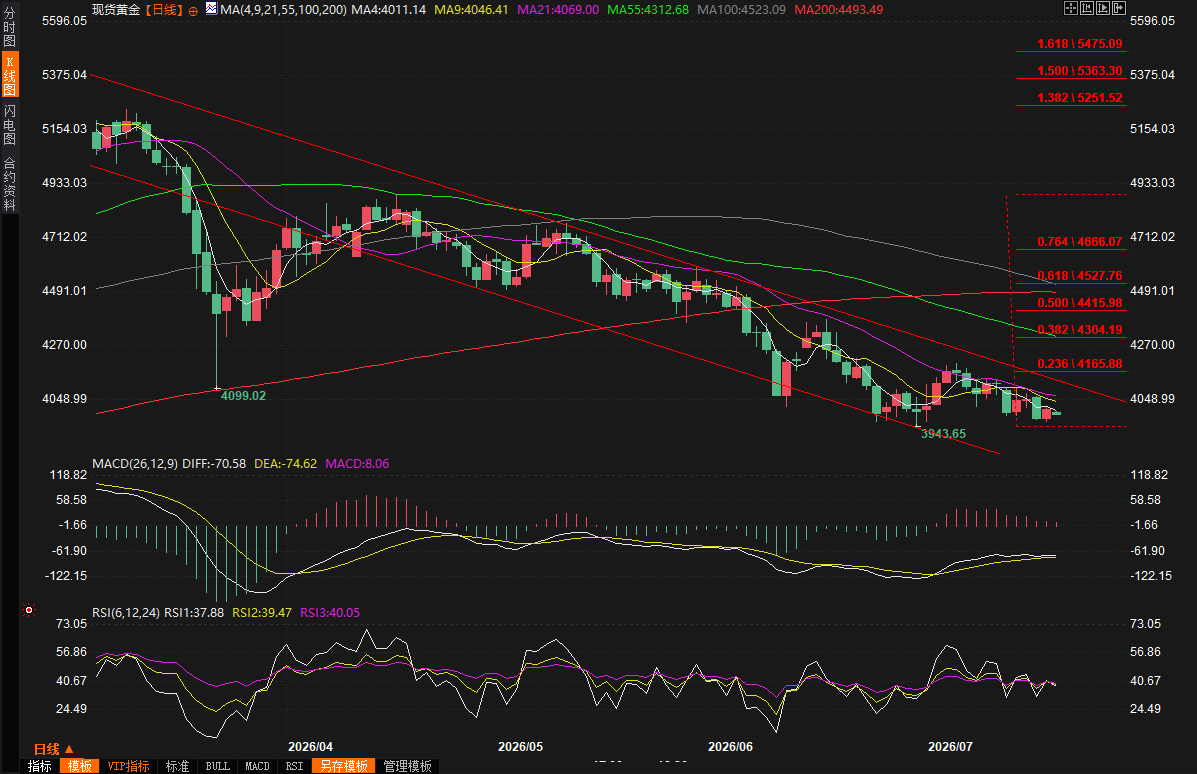 (Spot gold daily chart, source: FX678) At 07:22 Beijing time, spot gold is currently trading at $3991.32 per ounce.
Escalating geopolitical conflicts: Soaring oil prices become the biggest drag on gold prices
Last week, the gold market experienced significant volatility. Although spot gold rose slightly by 1% to $4,016.36 per ounce on Friday, it still recorded a weekly decline of approximately 2.5%, marking its largest weekly drop since early June. August gold futures also rose only slightly by 0.7%, settling at $4,018.80. The focus of the conflict lies in the ongoing confrontation between the United States and Iran in the Middle East: the US launched airstrikes against Iranian targets for several consecutive nights, targeting bridges, airports, air defense facilities, and even nuclear power plant construction sites, while Iran retaliated with drones and missiles, targeting US military bases in Jordan, facilities in Kuwait and Bahrain, and disrupting shipping in the Strait of Hormuz. Since the outbreak of the US-Iran war in late February, gold prices have fallen by approximately 25%. On the surface, the conflict should have boosted safe-haven demand, but the actual effect was the opposite. The sharp rise in energy prices became the core variable. Brent crude oil rose by more than 15% last week and continued to climb at the beginning of this week, directly pushing up global inflation expectations. Chris Gaffney, President of Global Markets at EverBank, pointed out that the strengthening dollar and heightened global inflation concerns were the main drivers of the gold sell-off, which pushed up global interest rates. The instability of the Strait of Hormuz, a vital global energy transport route, directly amplified supply chain risks, causing market anxiety about prolonged high inflation to replace short-term safe-haven demand. Meanwhile, the US economy has shown strong resilience. Retail sales rose slightly in June, the consumer confidence index climbed to a five-month high, and the labor market remained stable. While these data have alleviated recession fears to some extent, they have also given the Federal Reserve more policy space to address inflation. The CME FedWatch tool shows that traders currently expect a 58% probability of a rate hike in September, while the probability of a July rate hike has fallen to around 15%, but the market still expects a cumulative 30 basis point rate hike by the end of the year.The resonant impact of the US dollar and bond markets weakens gold's safe-haven appeal.
The US dollar index was essentially flat at 100.76 on Friday, down slightly by 0.2% for the week, but recovered some losses supported by safe-haven inflows. Elias Haddad, global head of market strategy at Brown Brothers Harriman, analyzed that the global stock market crash led by technology stocks, coupled with shipping disruptions in the Strait of Hormuz, jointly triggered safe-haven sentiment, thus benefiting the dollar. A stronger dollar directly increased the cost for overseas buyers to hold gold, becoming a significant factor suppressing gold prices. The US bond market also reflected complex sentiment. Long-term Treasury yields fell slightly last week, with the 10-year benchmark yield falling to 4.541% and the 30-year yield dropping to 5.064%, both recording weekly declines. The market has largely ruled out the possibility of a Fed rate hike this month, but the expectation of a September rate hike remains around 57%. Recent statements from Fed officials have been both hawkish and dovish: on the one hand, they are concerned about inflationary pressures, and on the other hand, they acknowledge the stability of the labor market. Gennadiy Goldberg of TD Securities in New York stated that a single month's data is insufficient to completely dispel policymakers' doubts, especially against the backdrop of renewed geopolitical risks. It's worth noting that despite rising oil prices, bond yields have fallen, indicating that bonds have, to some extent, acted as a safe-haven asset. This contrasts with gold's traditional role, further diverting funds away from it.Analysts hold differing opinions: Short-term pressure vs. potential for a technically oversold rebound.
In Kitco News' latest gold survey, Wall Street sentiment turned bearish. Of the 14 analysts surveyed, only one predicted a rise in gold prices this week, 79% predicted a fall, and 14% expected sideways movement. Main Street retail investor sentiment was slightly better, with 40% bullish, but overall remained cautious. The pessimism primarily stemmed from short-term macroeconomic pressures. Commerzbank's Thu Lan Nguyen pointed out that the risk of rising energy prices due to escalating conflicts in the Middle East would sustain interest rate hike expectations for some time, limiting gold's upside potential. InvestingLive's Adam Barton warned that a sell-off in tech stocks could trigger a widespread "sell everything" movement. However, some senior strategists saw technical support. Sprott Inc.'s Paul Wong stated that gold prices are severely oversold, with multiple indicators showing levels two to three standard deviations below the 200-day moving average. The $4,000 support level has been repeatedly tested below the 200-day moving average, and increased holdings in Chinese ETFs have partially offset outflows from Europe and the US. Seasonal factors also offer clues: gold typically bottoms out in the summer (especially early August), and historically, similar corrections have often been followed by catalyst-driven rebounds, such as the Jackson Hole symposium or unexpected events. Rich Checkan of Asset Strategies International believes the $4,000 level will continue to provide strong support, and new buying interest is building. Adrian Day holds a neutral view, believing that gold is unlikely to see sustained gains until the Federal Reserve clearly signals a shift away from raising interest rates, but central bank buying provides solid bottom support.Looking ahead: Conflict catalysts could be key to a turning point in gold prices.
In summary, the gold market is currently caught in a tug-of-war between multiple forces. While the escalating US-Iran conflict has temporarily boosted oil prices and inflation expectations, suppressing gold prices, a further expansion of the conflict to a wider area could trigger severe disruptions to global supply chains, potentially reigniting safe-haven demand. Conversely, if the situation shows signs of easing, coupled with continued resilience in US economic data and a clearer path for the Federal Reserve's policy, gold prices may continue to face downward pressure. This week's market is relatively quiet, with only the European Central Bank's decision and some US economic data worth noting, which could amplify the sensitivity to news headlines and geopolitical events. For investors, the $4,000 level has become a key psychological and technical level. Short-term volatility may continue, but from a medium- to long-term perspective, gold's intrinsic value as a hedge against inflation and uncertainty has not disappeared. Historical experience shows that in oversold conditions, any positive catalyst—whether a policy shift or an evolution of geopolitical events—could ignite a retaliatory rebound. The summer lows for gold may be quietly brewing, and investors need to closely monitor developments in the Middle East and the latest statements from Federal Reserve officials to find the best entry point while balancing risk and opportunity. (Spot gold daily chart, source: FX678) At 07:22 Beijing time, spot gold is currently trading at $3991.32 per ounce.
- Risk Warning and Disclaimer
- The market involves risk, and trading may not be suitable for all investors. This article is for reference only and does not constitute personal investment advice, nor does it take into account certain users’ specific investment objectives, financial situation, or other needs. Any investment decisions made based on this information are at your own risk.