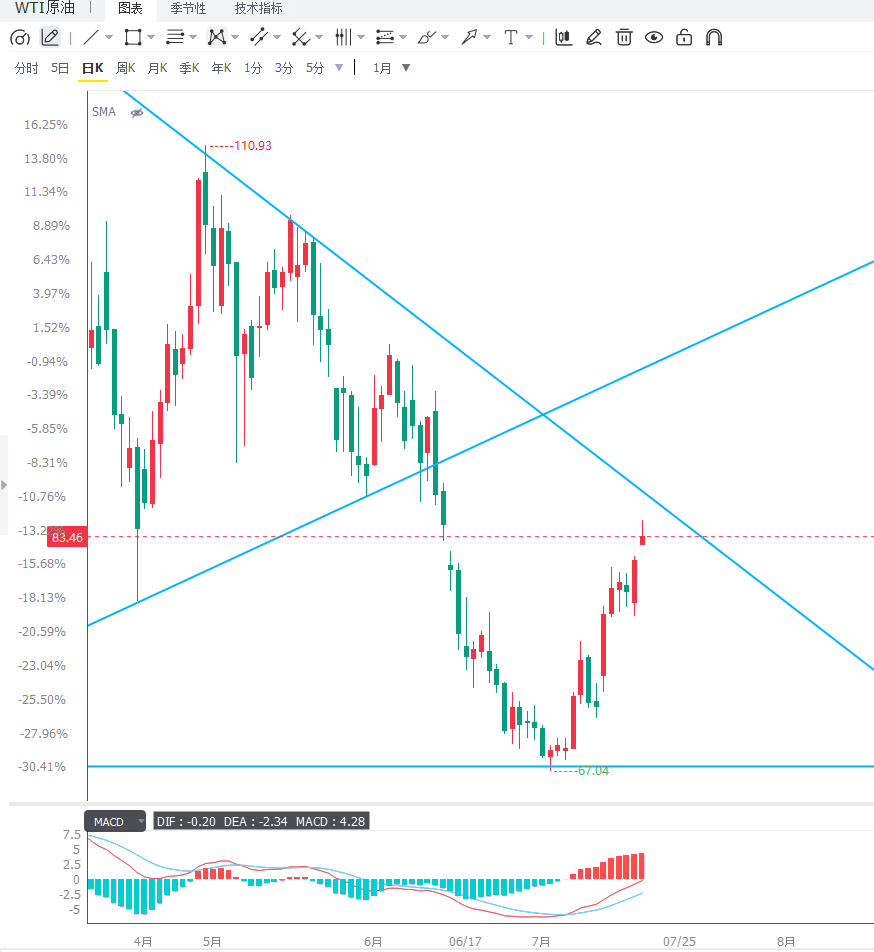
Crude oil trading alert: Geopolitical tensions drove oil prices higher at the open, and they are approaching a short-term downtrend line, awaiting a directional move.
2026-07-20 09:20:13
International crude oil markets saw a significant rise on Monday, with West Texas Intermediate (WTI) crude oil gapping up at the open of Asian trading, briefly trading around $83.50 per barrel. The main driver of the price increase was the further escalation of tensions between the United States and Iran, with renewed market concerns about potential disruptions to oil supplies from the Middle East.  Over the past few weeks, risk sentiment in the crude oil market has continued to rise. As the previous de-escalation agreement between the US and Iran gradually weakens, the US has reinstated restrictions on Iranian ports, while regional shipping security risks have increased, leading investors to price in supply disruptions. To date, WTI crude oil has risen nearly 20% in July, making it one of the strongest performing commodities recently. Investors are currently most concerned about whether Middle Eastern energy transport routes will be further affected. The region plays a crucial role in global crude oil supply transportation, and any shipping disruptions could quickly escalate market expectations of supply shortages. Especially with global crude oil inventories at relatively sensitive levels, supply-side uncertainty can amplify oil price volatility. The US has launched military operations against Iranian targets for the ninth consecutive night, while Iran has stated that the previous ceasefire has effectively failed, raising concerns about a further escalation of the conflict. As actions by both sides escalate, risk aversion in financial markets has significantly increased, with energy assets becoming a focus of investment. Meanwhile, regional tensions have expanded from military targets to infrastructure. Recent disruptions to some bridges, power facilities, and port facilities have further increased market concerns about the stability of the energy supply chain. Kuwait Oil Corporation confirmed over the weekend that one of its oil facilities had been attacked, further intensifying market concerns about crude oil supply risks. From a global market perspective, rising oil prices are re-influencing inflation expectations. As a significant component of energy costs, persistently high crude oil prices could increase imported inflationary pressures in some economies and influence the future monetary policy paths of major central banks. Previous market optimism regarding declining inflation and interest rate adjustments may be challenged by a rebound in energy prices. Regarding the US dollar, geopolitical risks typically drive funds to safe-haven assets, but if oil prices continue to rise and exacerbate inflation concerns, the market may readjust its assessment of the Federal Reserve's policy path. Investors are currently focusing on US energy inventory data, changes in global crude oil supply, and whether there are any new developments in the Middle East situation. For the crude oil market, the core short-term issue has shifted from demand expectations to supply risks. If regional conflicts continue to escalate and affect major transportation routes, oil prices may continue to receive risk premium support. However, on the other hand, rapid price increases could also weaken fuel demand in some regions and prompt oil-producing countries to adjust their supply strategies; therefore, the market still needs to pay attention to the dynamic balance between supply and demand. From a daily chart perspective, WTI crude oil has recently formed a clear upward trend, with prices rising rapidly after breaking through the previous consolidation range, indicating a significant increase in bullish momentum. Currently, oil prices are trading around $83, with short-term focus on the support level of the $82-$80 area. This area is both a crucial support level after the recent breakout and a key defensive position following the strengthening market sentiment. If prices can stably hold above the resistance area around $85, it could open up further upside potential, challenging the $87 or even $90 psychological level. Technically, the daily MACD continues to expand upwards, and short-term moving averages remain in a bullish alignment, indicating that market momentum remains biased towards buyers. However, after continuous gains, profit-taking pressure should be watched out for. From a 4-hour chart perspective, WTI prices maintain a strong upward structure, with short-term moving averages continuing to provide support. The RSI indicator is in a high zone, reflecting active buying, but also implying some overbought risk in the short term. If oil prices retrace to around $82 and find support, it could create a new upward opportunity; if it breaks below the key support of $80, it could trigger a technical correction, retesting the $78-$79 area. The current 4-hour chart still favors the bulls, and the market is mainly focused on whether geopolitical news will continue to drive a breakout.
  Editor's Summary: The core drivers of the current crude oil market have shifted to geopolitical risks and supply security issues. Continued tensions between the US and Iran, coupled with disruptions to key energy infrastructure, have caused the market to re-indulge in supply disruption risks, driving a rapid rise in WTI crude oil prices. However, the short-term price increase has been substantial, and future price movements will depend on whether the conflict escalates further and the actual extent of supply impact. If regional risks continue to escalate, crude oil prices may remain high, further fueling global inflation expectations; however, if the situation eases, market risk premiums may fall rapidly, and oil prices will face significant downward pressure. Going forward, investors need to pay close attention to changes in crude oil transportation routes, supply policies of major oil-producing countries, and US energy inventory data to determine whether this price increase will develop into a long-term trend.
Over the past few weeks, risk sentiment in the crude oil market has continued to rise. As the previous de-escalation agreement between the US and Iran gradually weakens, the US has reinstated restrictions on Iranian ports, while regional shipping security risks have increased, leading investors to price in supply disruptions. To date, WTI crude oil has risen nearly 20% in July, making it one of the strongest performing commodities recently. Investors are currently most concerned about whether Middle Eastern energy transport routes will be further affected. The region plays a crucial role in global crude oil supply transportation, and any shipping disruptions could quickly escalate market expectations of supply shortages. Especially with global crude oil inventories at relatively sensitive levels, supply-side uncertainty can amplify oil price volatility. The US has launched military operations against Iranian targets for the ninth consecutive night, while Iran has stated that the previous ceasefire has effectively failed, raising concerns about a further escalation of the conflict. As actions by both sides escalate, risk aversion in financial markets has significantly increased, with energy assets becoming a focus of investment. Meanwhile, regional tensions have expanded from military targets to infrastructure. Recent disruptions to some bridges, power facilities, and port facilities have further increased market concerns about the stability of the energy supply chain. Kuwait Oil Corporation confirmed over the weekend that one of its oil facilities had been attacked, further intensifying market concerns about crude oil supply risks. From a global market perspective, rising oil prices are re-influencing inflation expectations. As a significant component of energy costs, persistently high crude oil prices could increase imported inflationary pressures in some economies and influence the future monetary policy paths of major central banks. Previous market optimism regarding declining inflation and interest rate adjustments may be challenged by a rebound in energy prices. Regarding the US dollar, geopolitical risks typically drive funds to safe-haven assets, but if oil prices continue to rise and exacerbate inflation concerns, the market may readjust its assessment of the Federal Reserve's policy path. Investors are currently focusing on US energy inventory data, changes in global crude oil supply, and whether there are any new developments in the Middle East situation. For the crude oil market, the core short-term issue has shifted from demand expectations to supply risks. If regional conflicts continue to escalate and affect major transportation routes, oil prices may continue to receive risk premium support. However, on the other hand, rapid price increases could also weaken fuel demand in some regions and prompt oil-producing countries to adjust their supply strategies; therefore, the market still needs to pay attention to the dynamic balance between supply and demand. From a daily chart perspective, WTI crude oil has recently formed a clear upward trend, with prices rising rapidly after breaking through the previous consolidation range, indicating a significant increase in bullish momentum. Currently, oil prices are trading around $83, with short-term focus on the support level of the $82-$80 area. This area is both a crucial support level after the recent breakout and a key defensive position following the strengthening market sentiment. If prices can stably hold above the resistance area around $85, it could open up further upside potential, challenging the $87 or even $90 psychological level. Technically, the daily MACD continues to expand upwards, and short-term moving averages remain in a bullish alignment, indicating that market momentum remains biased towards buyers. However, after continuous gains, profit-taking pressure should be watched out for. From a 4-hour chart perspective, WTI prices maintain a strong upward structure, with short-term moving averages continuing to provide support. The RSI indicator is in a high zone, reflecting active buying, but also implying some overbought risk in the short term. If oil prices retrace to around $82 and find support, it could create a new upward opportunity; if it breaks below the key support of $80, it could trigger a technical correction, retesting the $78-$79 area. The current 4-hour chart still favors the bulls, and the market is mainly focused on whether geopolitical news will continue to drive a breakout. Editor's Summary: The core drivers of the current crude oil market have shifted to geopolitical risks and supply security issues. Continued tensions between the US and Iran, coupled with disruptions to key energy infrastructure, have caused the market to re-indulge in supply disruption risks, driving a rapid rise in WTI crude oil prices. However, the short-term price increase has been substantial, and future price movements will depend on whether the conflict escalates further and the actual extent of supply impact. If regional risks continue to escalate, crude oil prices may remain high, further fueling global inflation expectations; however, if the situation eases, market risk premiums may fall rapidly, and oil prices will face significant downward pressure. Going forward, investors need to pay close attention to changes in crude oil transportation routes, supply policies of major oil-producing countries, and US energy inventory data to determine whether this price increase will develop into a long-term trend.- Risk Warning and Disclaimer
- The market involves risk, and trading may not be suitable for all investors. This article is for reference only and does not constitute personal investment advice, nor does it take into account certain users’ specific investment objectives, financial situation, or other needs. Any investment decisions made based on this information are at your own risk.