Gold prices have been fluctuating around the $4,000 mark, and are waiting to stabilize at the lower edge of the trading range.
2026-07-20 09:40:14
International gold prices came under pressure on Monday, with spot gold (XAU/USD) falling back to around $4,000 in early Asian trading, having recently fluctuated around this psychological level. Gold previously experienced a significant correction in the second quarter, with a quarterly decline of approximately 14%, marking one of its worst quarterly performances since 2013, and market sentiment gradually shifting from its previous strong upward trend to caution.  The main factor driving the recent pressure on gold is the renewed expectation of rising US interest rates. Although US Consumer Price Index (CPI) and Producer Price Index (PPI) data show some easing of inflationary pressures, the rapid rise in international oil prices is reigniting market concerns about a future rebound in inflation. Rising energy costs could weaken the downward trend in inflation and prompt investors to reassess the Federal Reserve's monetary policy path. Traders currently estimate a 61.4% probability of the Fed adjusting interest rates in September. Market expectations of prolonged high interest rates keep dollar-denominated asset yields attractive while increasing the opportunity cost of holding gold. Since gold itself does not generate interest income, investors' willingness to allocate to gold is usually suppressed in an environment of high real interest rates. Meanwhile, the escalating situation in the Middle East is also a significant factor influencing gold prices. The US has recently launched military operations against Iranian targets for the ninth consecutive night, significantly increasing market risk aversion. Iran has stated that the previous ceasefire has essentially failed, raising concerns that regional tensions could further impact energy transport security. The market's focus has recently been on key energy transport routes in the Middle East. If related conflicts disrupt energy supplies, rising oil prices could further fuel global inflation expectations and increase pressure on major central banks to maintain tight monetary policies. For gold, this creates a dual impact: on the one hand, geopolitical risks typically increase demand for gold as a safe haven; on the other hand, if risk events drive up energy prices and reinforce high interest rate expectations, rising real interest rates could limit gold's upside potential. Furthermore, regional tensions have shown signs of escalation. Recently, air raid sirens have sounded in Bahrain and other regions, and Iran has launched a new round of ballistic missiles and drones targeting multiple areas including Bahrain, Jordan, Kuwait, and Iraq. Markets are concerned that if the conflict persists, risk appetite in financial markets could further decline. However, unlike traditional safe-haven logic, gold is not currently fully benefiting from rising risk sentiment, primarily because interest rate factors dominate. The US dollar index remains relatively strong, and US Treasury yields remain high, causing some funds to continue flowing into yield-generating assets. In the medium to long term, the gold market will continue to be influenced by multiple factors, including global central bank gold purchases, the dollar's performance, changes in real interest rates, and global economic growth expectations. If inflation picks up again in the future, and expectations of a shift in Federal Reserve policy increase, gold may regain upward momentum. However, in the current environment, the market is more focused on interest rate paths and energy price changes. From a daily chart perspective, gold prices are currently in a high-level consolidation phase. The rebound after breaking below the previous upward trend has been limited, and it is currently trading around the psychological level of $4,000. The daily chart shows that short-term moving averages are gradually weakening, and market momentum has clearly decreased compared to before. The key support level to watch is the $3,980 to $3,950 area. If this area can hold effectively, gold may still form a consolidation and correction pattern; if it breaks below $3,950, it may open up room for a correction towards the $3,900 area. The first resistance level to watch is around $4,050. If it can regain this position, it is expected to alleviate short-term pressure and test the $4,100 area. From a 4-hour chart perspective, the short-term trend of gold is biased towards consolidation and weakness, with prices repeatedly consolidating around $4,000. The RSI indicator is in the neutral to weak zone, indicating that buying power has not yet recovered significantly. The MACD short-term momentum has weakened, indicating insufficient upward drive. Currently, the market needs to focus on the battle around the $4000 level. If the price can break through and hold above $4020, a short-term rebound towards $4050 is possible; however, a break below $3980 could lead to a further test of the $3950 support area. Overall, the 4-hour chart remains in a consolidation phase, and market direction depends on the dollar's performance and changes in the Federal Reserve's interest rate expectations.
 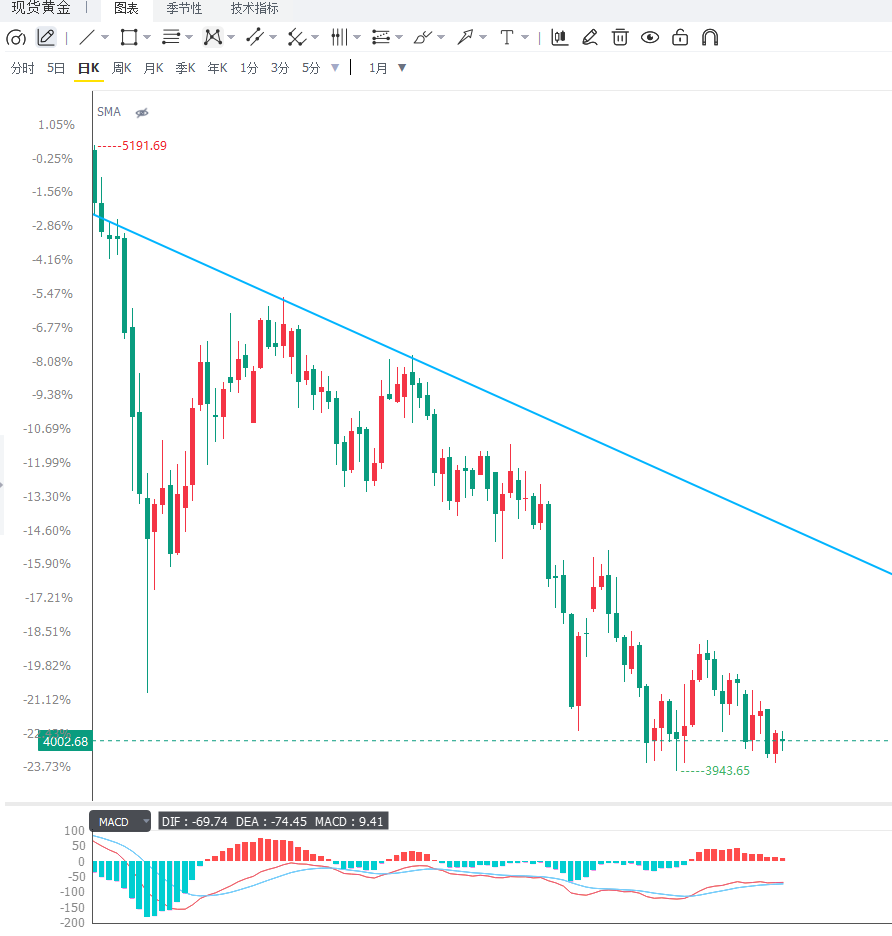 Editor's Summary: Gold is currently in a tug-of-war between safe-haven demand and interest rate pressures. While the escalating tensions in the Middle East have boosted market risk appetite, inflation concerns stemming from rising oil prices and the Federal Reserve's expectation of maintaining high interest rates have limited gold's upside potential. In the short term, whether gold can break above $4,000 again and resume its upward trend will depend on the strength of the US dollar, the performance of US economic data, and the development of global risk events. If energy prices continue to rise and drive inflation expectations back up, gold may gain new support; however, if the market continues to bet on a high-interest-rate environment, gold may still face downward pressure. Investors should pay close attention to Federal Reserve policy signals, US inflation data, and changes in geopolitical risks to determine the next direction for gold.
The main factor driving the recent pressure on gold is the renewed expectation of rising US interest rates. Although US Consumer Price Index (CPI) and Producer Price Index (PPI) data show some easing of inflationary pressures, the rapid rise in international oil prices is reigniting market concerns about a future rebound in inflation. Rising energy costs could weaken the downward trend in inflation and prompt investors to reassess the Federal Reserve's monetary policy path. Traders currently estimate a 61.4% probability of the Fed adjusting interest rates in September. Market expectations of prolonged high interest rates keep dollar-denominated asset yields attractive while increasing the opportunity cost of holding gold. Since gold itself does not generate interest income, investors' willingness to allocate to gold is usually suppressed in an environment of high real interest rates. Meanwhile, the escalating situation in the Middle East is also a significant factor influencing gold prices. The US has recently launched military operations against Iranian targets for the ninth consecutive night, significantly increasing market risk aversion. Iran has stated that the previous ceasefire has essentially failed, raising concerns that regional tensions could further impact energy transport security. The market's focus has recently been on key energy transport routes in the Middle East. If related conflicts disrupt energy supplies, rising oil prices could further fuel global inflation expectations and increase pressure on major central banks to maintain tight monetary policies. For gold, this creates a dual impact: on the one hand, geopolitical risks typically increase demand for gold as a safe haven; on the other hand, if risk events drive up energy prices and reinforce high interest rate expectations, rising real interest rates could limit gold's upside potential. Furthermore, regional tensions have shown signs of escalation. Recently, air raid sirens have sounded in Bahrain and other regions, and Iran has launched a new round of ballistic missiles and drones targeting multiple areas including Bahrain, Jordan, Kuwait, and Iraq. Markets are concerned that if the conflict persists, risk appetite in financial markets could further decline. However, unlike traditional safe-haven logic, gold is not currently fully benefiting from rising risk sentiment, primarily because interest rate factors dominate. The US dollar index remains relatively strong, and US Treasury yields remain high, causing some funds to continue flowing into yield-generating assets. In the medium to long term, the gold market will continue to be influenced by multiple factors, including global central bank gold purchases, the dollar's performance, changes in real interest rates, and global economic growth expectations. If inflation picks up again in the future, and expectations of a shift in Federal Reserve policy increase, gold may regain upward momentum. However, in the current environment, the market is more focused on interest rate paths and energy price changes. From a daily chart perspective, gold prices are currently in a high-level consolidation phase. The rebound after breaking below the previous upward trend has been limited, and it is currently trading around the psychological level of $4,000. The daily chart shows that short-term moving averages are gradually weakening, and market momentum has clearly decreased compared to before. The key support level to watch is the $3,980 to $3,950 area. If this area can hold effectively, gold may still form a consolidation and correction pattern; if it breaks below $3,950, it may open up room for a correction towards the $3,900 area. The first resistance level to watch is around $4,050. If it can regain this position, it is expected to alleviate short-term pressure and test the $4,100 area. From a 4-hour chart perspective, the short-term trend of gold is biased towards consolidation and weakness, with prices repeatedly consolidating around $4,000. The RSI indicator is in the neutral to weak zone, indicating that buying power has not yet recovered significantly. The MACD short-term momentum has weakened, indicating insufficient upward drive. Currently, the market needs to focus on the battle around the $4000 level. If the price can break through and hold above $4020, a short-term rebound towards $4050 is possible; however, a break below $3980 could lead to a further test of the $3950 support area. Overall, the 4-hour chart remains in a consolidation phase, and market direction depends on the dollar's performance and changes in the Federal Reserve's interest rate expectations. Editor's Summary: Gold is currently in a tug-of-war between safe-haven demand and interest rate pressures. While the escalating tensions in the Middle East have boosted market risk appetite, inflation concerns stemming from rising oil prices and the Federal Reserve's expectation of maintaining high interest rates have limited gold's upside potential. In the short term, whether gold can break above $4,000 again and resume its upward trend will depend on the strength of the US dollar, the performance of US economic data, and the development of global risk events. If energy prices continue to rise and drive inflation expectations back up, gold may gain new support; however, if the market continues to bet on a high-interest-rate environment, gold may still face downward pressure. Investors should pay close attention to Federal Reserve policy signals, US inflation data, and changes in geopolitical risks to determine the next direction for gold.
- Risk Warning and Disclaimer
- The market involves risk, and trading may not be suitable for all investors. This article is for reference only and does not constitute personal investment advice, nor does it take into account certain users’ specific investment objectives, financial situation, or other needs. Any investment decisions made based on this information are at your own risk.