The Hormuz crisis remains unresolved, and a heat wave is hitting Europe – an energy shock is attacking the euro from two fronts.
2026-07-20 11:08:14
On Monday (July 20) during Asian trading hours, the euro remained volatile against the US dollar after two consecutive days of decline, currently trading around 1.1440. In addition to continued pressure on the euro from Middle East geopolitical risks, another crisis brewing within Europe—an energy supply shock triggered by an extreme heatwave—may further exacerbate the euro's downward pressure. 
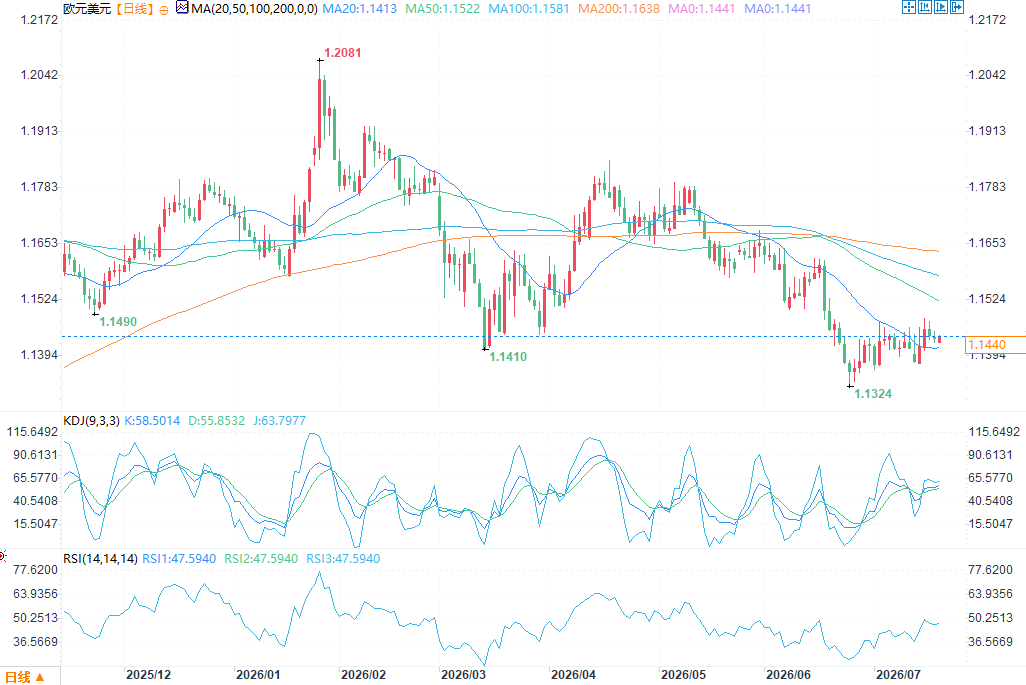 (Euro/USD daily chart, source: FX678) At 11:06 Beijing time on July 20, the euro was trading at 1.1440/41 against the US dollar.
Rhine River navigation is restricted: water levels have dropped to their lowest level in decades, causing transportation costs to surge by more than 50%.
The early summer heatwave in Europe began in June, with record-breaking temperatures recorded for weeks in some of Europe's largest economies, including Germany and France. Severely limited rainfall has hampered navigation on the Rhine River, Europe's most important inland transport corridor, which stretches approximately 800 miles. The Rhine, a major oil product transport corridor, flows northwest from Switzerland through Germany, France, and the Netherlands before emptying into the North Sea. Due to the heatwave and drought, river levels have now dropped to their lowest levels in decades, leaving many barges transporting oil products unable to navigate due to the shallow waters. The inability of barges to maintain full draft has increased transport costs and delayed the transport of coal, fuel, and other goods. The Kaub gauge, located in the Middle Rhine between Koblenz and Mainz, is the shallowest choke point on the entire river, determining the maximum draft and carrying capacity for each barge between the Amsterdam-Rotterdam-Antwerp port and the industrial heart of the Rhine Valley. Previous major crises caused by low Rhine levels occurred in 2022 and 2018. The 2022 low levels coincided with the first energy crisis triggered by the Russia-Ukraine conflict. This summer, low Rhine levels due to scarce rainfall and a heatwave, coupled with the Middle East crisis, are putting additional pressure on industry, energy supply and prices, transportation costs, and even inflation. In the past week, freight rates for transporting diesel from Rotterdam to southern Germany have increased by more than 50%.France cuts nuclear power: High temperatures limit cooling capacity, power generation plummets by 6.4 gigawatts.
Beyond its impact on the German economy and inflation, the heatwave has directly hampered France's electricity supply. Earlier this week, as the heatwave drove up river temperatures and limited the ability of nuclear power plants to use river water to cool reactors, France's nuclear power generation was cut by 6.4 gigawatts, representing approximately 14% of the country's total daily electricity demand. This is not the first time France has been forced to reduce nuclear reactor power generation due to summer heat. Despite the reduced nuclear power production, France continues to export electricity to neighboring countries, but the frequency of these events appears to be increasing—heatwaves are lasting longer and experiencing higher extreme temperatures. For France, nuclear power cuts not only directly affect electricity supply and prices but also weaken its role as a European electricity exporter, potentially triggering ripple effects on the energy markets of neighboring countries.Economic Costs: Germany's daily heatwave losses could exceed €1 billion, with annual losses potentially surpassing €20 billion.
The economic impact of heat waves is being quantified. According to an exclusive analysis by the economic research institute Prognos for the German business daily Handelsblatt, the heat wave at the end of June had already caused the German economy losses exceeding $6.8 billion (approximately €6 billion). Looking ahead, Germany may experience three to four severe heat waves exceeding 35 degrees Celsius (or 95 degrees Fahrenheit) each summer. Prognos estimates that Germany could lose €1 billion for each day the temperature exceeds 35 degrees Celsius. This means that the annual heat wave losses for the German economy could exceed €20 billion (approximately $23 billion). This estimate only considers the direct economic impact of heat waves and does not yet include the indirect impact of low Rhine River levels on industrial production. In November 2018, low Rhine River levels led to a 1.5% decline in German industrial production, which, according to the Kiel Institute for the World Economy, reduced Germany's GDP by 0.4%.The risk of stagflation in the Eurozone is rising due to energy shocks.
If this energy crisis triggered by extreme weather directly impacts the foreign exchange market, it will exert significant downward pressure on the euro against the US dollar. Soaring energy costs and supply chain disruptions will push up core inflation expectations in the Eurozone, potentially limiting the European Central Bank's room for further easing in the short term, while simultaneously exacerbating concerns about economic growth and creating a "stagflation" scenario. As a Eurozone electricity exporter, France's limited nuclear power capacity will weaken the Eurozone's overall energy resilience, while damage to Germany, its economic engine, amplifies pessimistic sentiment regarding regional growth. Against the backdrop of a relatively strong US dollar (supported by the resilience of the US economy and the AI theme), the euro against the US dollar is vulnerable to safe-haven outflows and widening interest rate differentials. If the heatwave persists, the market may price in a higher European energy risk premium, pushing the euro weaker, and the euro against the US dollar is expected to test recent lows and face further downside potential.Summarize
Europe is experiencing a chain reaction that has evolved from a heatwave into an energy crisis. High temperatures and drought have caused the Rhine River's water level to drop to its lowest level in decades, shipping costs to soar by more than 50%, and supply chains for essential commodities such as coal and fuel to be disrupted. Meanwhile, French nuclear power plants have been forced to cut power output by about 14% due to excessively high river temperatures. These effects, coupled with the energy supply shock caused by the Strait of Hormuz crisis, are simultaneously pushing up energy costs and inflationary pressures in Europe, and are substantially dragging down economic growth. According to Prognos analysis, the heatwave at the end of June already caused Germany more than $6.8 billion in losses, and the number of hot days each year could cost Germany an average of more than €20 billion in economic losses annually. The evolution of this crisis will depend on European weather patterns in the coming weeks—if the heatwave continues, the vulnerability of Europe's energy system will be further exposed. (Euro/USD daily chart, source: FX678) At 11:06 Beijing time on July 20, the euro was trading at 1.1440/41 against the US dollar.
- Risk Warning and Disclaimer
- The market involves risk, and trading may not be suitable for all investors. This article is for reference only and does not constitute personal investment advice, nor does it take into account certain users’ specific investment objectives, financial situation, or other needs. Any investment decisions made based on this information are at your own risk.