Rising oil prices supported the Canadian dollar, but the USD/CAD pair rebounded and is approaching a resistance level; caution is advised against a pullback.
2026-07-22 14:36:14
The USD/CAD pair saw a slight pullback during Asian trading on Wednesday, currently trading near the 1.4100 level, ending a two-day winning streak. Despite the short-term decline, market fundamentals remain complex, and investors are not in a hurry to establish large short positions. The recent strength in the oil market has been a significant factor supporting the Canadian dollar. As the Canadian dollar is a typical commodity currency, the Canadian economy and export revenue are heavily influenced by changes in energy prices. When international oil prices rise, the Canadian dollar typically finds some support. 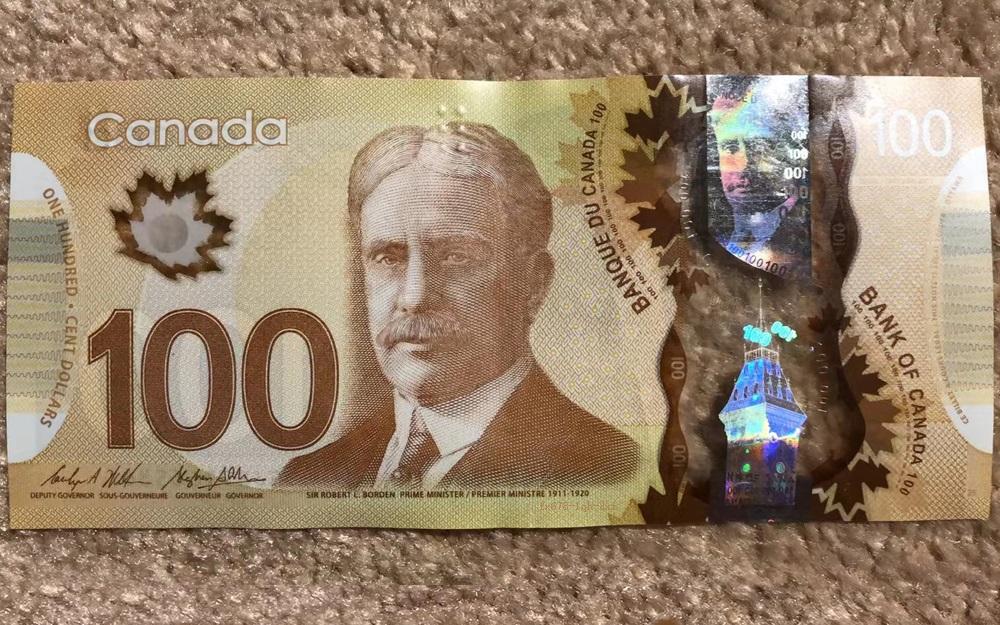 International crude oil prices have risen to their highest level since June 16, primarily driven by escalating tensions between the US and Iran, shipping risks in the Strait of Hormuz, and increased uncertainty in Red Sea shipping. The Houthi rebels in Yemen's threats to restrict Saudi shipping activities have further exacerbated market concerns about the stability of global energy supplies. This heightened supply risk has pushed up oil prices and provided short-term support for the Canadian dollar through its energy export advantage . Meanwhile, the US dollar index, after four consecutive days of gains, has undergone a technical correction, weakening further upward momentum for the USD/CAD pair. However, the safe-haven appeal of the US dollar remains. As global risk events continue to unfold and the market refocuses on trade concerns, the dollar continues to attract some funds. US President Donald Trump's recent announcement of new tariff plans, including significant increases in tariffs on imported pharmaceuticals, coupled with previous higher tariffs on most Canadian goods, has increased market concerns about changes in the trade environment. Trade concerns and global risk events may continue to support safe-haven demand for the US dollar and limit the upside potential of the Canadian dollar . Furthermore, expectations regarding Federal Reserve policy remain a significant factor influencing the USD/CAD exchange rate. Rising energy prices could reignite inflationary pressures, maintaining market expectations of a hawkish Federal Reserve policy and thus supporting the US dollar. In contrast, recent weak Canadian consumer inflation data has further reinforced market expectations that the Bank of Canada will maintain its current interest rates. The market believes that against the backdrop of economic growth pressures and slowing inflation, the Bank of Canada may lack the incentive to further tighten policy in the short term. Investors are currently weighing the support of rising oil prices for the Canadian dollar against the pressure from safe-haven demand for the US dollar and the divergence in US-Canada monetary policy. Overall, the short-term movement of USD/CAD is influenced by multiple factors. Rising oil prices and a US dollar correction have supported a pullback in the exchange rate, but expectations of Fed policy and global risk sentiment may still limit the continued appreciation of the Canadian dollar. From a daily chart perspective, USD/CAD recently rebounded after finding support around 1.4000 and is currently consolidating at higher levels. The price is still trading near major moving averages, and the short-term bullish structure has not been completely broken. The MACD indicator shows that upward momentum has weakened, but no clear reversal signal has yet formed. Resistance is seen at the 1.4150 area, with further resistance at 1.4200 and 1.4250. Support is initially at 1.4050, followed by 1.4000 and 1.3950. A break below 1.4000 could signal the end of the short-term uptrend; a rebound above 1.4150 could lead to a challenge of previous highs. On the 4-hour chart, USD/CAD has experienced a pullback after a continuous rise, consolidating around 1.4100. Short-term moving averages are flattening, and the RSI is declining, indicating a cooling of short-term buying pressure. A break below 1.4080 could test the 1.4050 support; a break above 1.4150 could potentially resume the uptrend. Currently, the 4-hour chart shows a slight advantage for bears, but overall, the movements of oil prices and the US dollar still warrant close attention.
 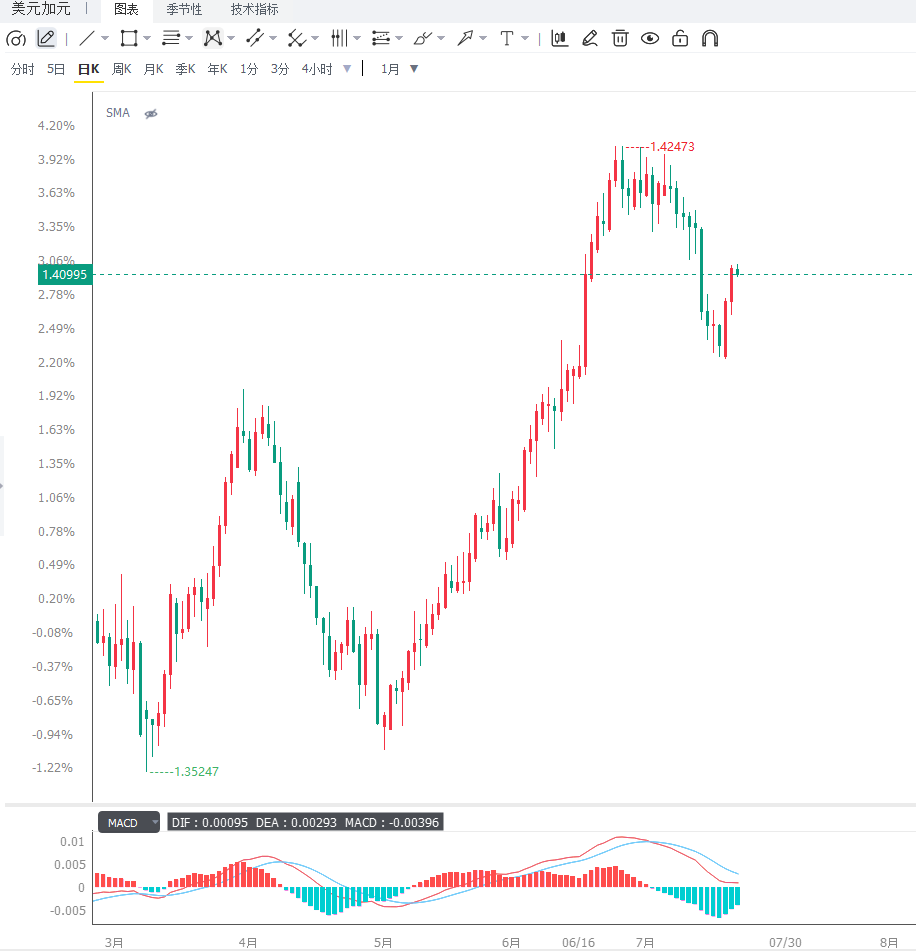 The USD/CAD pair is currently in a tug-of-war between rising oil prices supporting the Canadian dollar and safe-haven demand for the US dollar. Oil supply risks are driving up energy prices, providing the Canadian dollar with a short-term advantage; however, trade concerns, expectations surrounding Federal Reserve policy, and the global risk environment continue to make the US dollar attractive. Future exchange rate movements will focus on changes in international oil prices, Federal Reserve policy signals, and the Bank of Canada's interest rate path. If oil prices continue to rise while the US dollar weakens, USD/CAD may decline further; however, if risk events escalate and drive safe-haven flows to the US dollar, the exchange rate may regain upward momentum. In the short term, the 1.4000 to 1.4150 range will be a key battleground between bulls and bears.
International crude oil prices have risen to their highest level since June 16, primarily driven by escalating tensions between the US and Iran, shipping risks in the Strait of Hormuz, and increased uncertainty in Red Sea shipping. The Houthi rebels in Yemen's threats to restrict Saudi shipping activities have further exacerbated market concerns about the stability of global energy supplies. This heightened supply risk has pushed up oil prices and provided short-term support for the Canadian dollar through its energy export advantage . Meanwhile, the US dollar index, after four consecutive days of gains, has undergone a technical correction, weakening further upward momentum for the USD/CAD pair. However, the safe-haven appeal of the US dollar remains. As global risk events continue to unfold and the market refocuses on trade concerns, the dollar continues to attract some funds. US President Donald Trump's recent announcement of new tariff plans, including significant increases in tariffs on imported pharmaceuticals, coupled with previous higher tariffs on most Canadian goods, has increased market concerns about changes in the trade environment. Trade concerns and global risk events may continue to support safe-haven demand for the US dollar and limit the upside potential of the Canadian dollar . Furthermore, expectations regarding Federal Reserve policy remain a significant factor influencing the USD/CAD exchange rate. Rising energy prices could reignite inflationary pressures, maintaining market expectations of a hawkish Federal Reserve policy and thus supporting the US dollar. In contrast, recent weak Canadian consumer inflation data has further reinforced market expectations that the Bank of Canada will maintain its current interest rates. The market believes that against the backdrop of economic growth pressures and slowing inflation, the Bank of Canada may lack the incentive to further tighten policy in the short term. Investors are currently weighing the support of rising oil prices for the Canadian dollar against the pressure from safe-haven demand for the US dollar and the divergence in US-Canada monetary policy. Overall, the short-term movement of USD/CAD is influenced by multiple factors. Rising oil prices and a US dollar correction have supported a pullback in the exchange rate, but expectations of Fed policy and global risk sentiment may still limit the continued appreciation of the Canadian dollar. From a daily chart perspective, USD/CAD recently rebounded after finding support around 1.4000 and is currently consolidating at higher levels. The price is still trading near major moving averages, and the short-term bullish structure has not been completely broken. The MACD indicator shows that upward momentum has weakened, but no clear reversal signal has yet formed. Resistance is seen at the 1.4150 area, with further resistance at 1.4200 and 1.4250. Support is initially at 1.4050, followed by 1.4000 and 1.3950. A break below 1.4000 could signal the end of the short-term uptrend; a rebound above 1.4150 could lead to a challenge of previous highs. On the 4-hour chart, USD/CAD has experienced a pullback after a continuous rise, consolidating around 1.4100. Short-term moving averages are flattening, and the RSI is declining, indicating a cooling of short-term buying pressure. A break below 1.4080 could test the 1.4050 support; a break above 1.4150 could potentially resume the uptrend. Currently, the 4-hour chart shows a slight advantage for bears, but overall, the movements of oil prices and the US dollar still warrant close attention. The USD/CAD pair is currently in a tug-of-war between rising oil prices supporting the Canadian dollar and safe-haven demand for the US dollar. Oil supply risks are driving up energy prices, providing the Canadian dollar with a short-term advantage; however, trade concerns, expectations surrounding Federal Reserve policy, and the global risk environment continue to make the US dollar attractive. Future exchange rate movements will focus on changes in international oil prices, Federal Reserve policy signals, and the Bank of Canada's interest rate path. If oil prices continue to rise while the US dollar weakens, USD/CAD may decline further; however, if risk events escalate and drive safe-haven flows to the US dollar, the exchange rate may regain upward momentum. In the short term, the 1.4000 to 1.4150 range will be a key battleground between bulls and bears.
- Risk Warning and Disclaimer
- The market involves risk, and trading may not be suitable for all investors. This article is for reference only and does not constitute personal investment advice, nor does it take into account certain users’ specific investment objectives, financial situation, or other needs. Any investment decisions made based on this information are at your own risk.