One chart: Capesize freight rates surge, Baltic Dry Index sees a temporary rebound.
2026-07-22 23:24:14
Latest data shows that the Baltic Dry Index (BDI) reached 2715 points on July 22, 2026, a three-day high, up 1.69% month-on-month (compared to the previous value), marking the largest increase since July 8, 2026. Looking at the short-term charts, the BDI has seen positive growth 6 times, negative growth 5 times, and zero growth 0 times in the last 11 BDI data points. Specifically, the Panamax Freight Index (BPI) was 2120 points, down 2.80% from the previous value; the Capesize Freight Index (BCI) was 4114 points, up 4.68%; and the Supramax Freight Index (BSI) was 1715 points, down 0.87%. For detailed charts of the latest 720-day and 10-year trends of the Baltic Dry Index and its three sub-indices, please refer to the charts specially created by FX678. 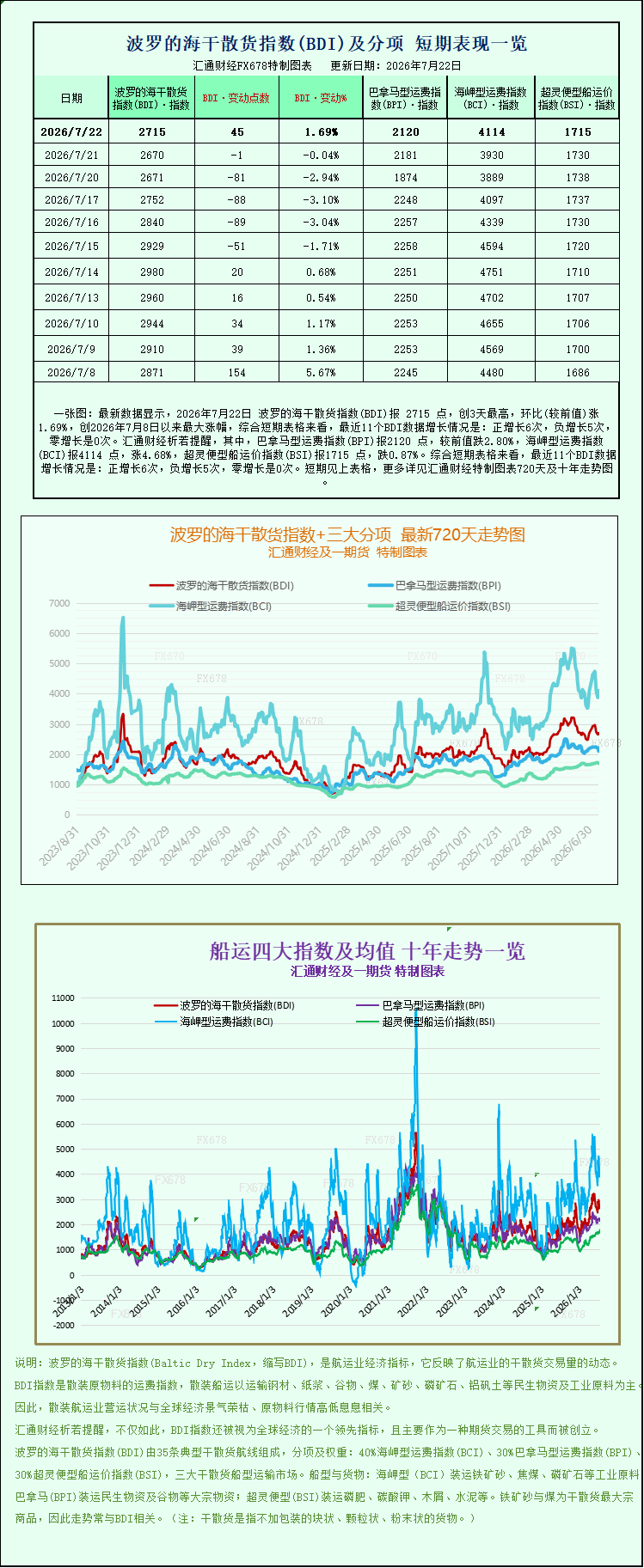 On July 22, 2026, the international dry bulk shipping market saw a key recovery signal. The Baltic Dry Index (BDI) reversed its multi-day decline, achieving its first increase since July 14. This rebound exhibited a clear structural divergence, with freight rates for ultra-large Capesize (VLCC) vessels surging, strongly supporting the overall index, while freight rates for Panamax and Supramax vessels continued to weaken, highlighting a significant market polarization. Data shows that the Baltic Dry Index, which tracks freight rates for the three major vessel types—Capesize, Panamax, and Supramax—rose 45 points, or 1.7%, to close at 2715 points, ending its previous multi-day downward trend and injecting momentum into the recently sluggish dry bulk shipping market. Looking at the performance of specific vessel types, the market's upward momentum was highly concentrated on large ocean-going bulk carriers, with a divergence in price trends between large and small vessels, highlighting the structural differences in global commodity shipping demand. As the core driver of the market rebound, the Capesize shipping market performed exceptionally well. The Baltic Capesize Index surged 184 points in a single day, a significant increase of 4.7%, closing at 4114 points, a new high since July 16th, leading the market across all ship types. Correspondingly, vessel operating revenue also increased substantially. Capesize vessels primarily engaged in 150,000-tonnage ultra-large bulk cargo transportation, mainly carrying core industrial raw materials such as iron ore and coal, saw their average daily charter income surge by $1668 in a single day, reaching a latest daily earnings of $33,805. The profitability of large-scale ore and coal ocean shipping routes has significantly recovered. Industry analysts point out that this rebound in Capesize freight rates is mainly supported by the temporary demand on international ore trading routes. Recently, major international mining companies such as Vale in Brazil have exceeded market expectations in quarterly output, significantly boosting cargo activity on the Brazil-China ocean iron ore shipping route. This, coupled with the seasonal maintenance of some ocean-going vessels, has led to a temporary contraction in the effective capacity of large dry bulk carriers available globally, creating a supply-demand mismatch that has driven up freight rates for large vessels rapidly. Meanwhile, global energy restocking demand continues to be released, and international coal seaborne trade demand remains resilient, further stabilizing the market for Capesize vessels. It is worth noting that while the shipping market is recovering, the upstream commodity spot market is showing a reverse trend, forming a divergence pattern of "shipping rising, spot falling." Affected by weak downstream demand, iron ore futures prices have fallen for the third consecutive trading day, and market concerns about iron ore oversupply continue to intensify. Currently, the pace of demand recovery in the domestic steel industry is slowing, the operating rate of end-user steel industries is lower than expected, and steel mills are cautious about restocking, suppressing long-term iron ore demand and leading to a weakening of commodity futures. However, the concentrated release of short-term ocean-going ore shipping cargoes supported the independent strengthening of ocean freight rates, creating a temporary divergence between the spot market and the shipping market. In stark contrast to the strong rebound of Capesize vessels, the medium-sized Panamax market continued to be under pressure, with prices extending their decline. Data shows that the Panamax index fell 61 points, or 2.8%, to close at 2120 points, a near one-month low since June 29th, indicating a very clear weakness. This vessel type typically has a deadweight tonnage of 60,000 to 70,000 tons and mainly transports bulk commodities such as coal, grain, and cereals, widely used in regional energy and agricultural trade. Its average daily revenue further decreased by $546 to $19,083, with profit margins continuing to shrink. Market analysts believe that the weakness in Panamax vessels is mainly due to the off-season effect of grain trade demand and weak regional coal transportation demand. The global grain trade is currently in its traditional off-season, with a decline in grain exports from North and South America. Simultaneously, the growth rate of regional energy import demand has slowed, leading to a shortage of cargo space on medium-sized vessels. This, coupled with a relatively ample supply of effective capacity for this vessel type, creates a loose supply-demand balance that continues to suppress freight rates, creating a stark contrast with the tight supply of large ore carriers. The small vessel market also continues its weakness, with prices continuing to decline. The Supramax vessel index, which primarily serves short-haul and regional bulk cargo transportation, fell 15 points, or 0.9%, to close at 1715 points. Following Tuesday's first decline since early July, it closed lower for the second consecutive trading day, with the weak market trend continuing to spread. Supramax vessels mainly serve the regional transportation of building materials, small-volume minerals, and agricultural products. Their continued decline reflects a cooling of activity in global regional small- and medium-sized bulk cargo trade, with overall market demand for small- and medium-tonnage transportation being weak. Overall, the current international dry bulk shipping market exhibits a typical structural divergence. The recovery of the overall index is entirely driven by the single category of Capesize vessels, while demand for small and medium-sized vessels remains weak and freight rates are declining, resulting in an uneven recovery. In the short term, Brazilian iron ore exports will continue to support the market for large vessels, and the index may maintain a slightly upward trend. However, in the medium to long term, the strength of the recovery in China's steel end-user demand, the pace of global commodity trade, and the deployment of new dry bulk shipping capacity will determine the sustainability of this rebound. If end-user industrial demand remains weak, and forward trade volumes of iron ore and coal are limited, the shipping market may return to a period of fluctuation and adjustment.
On July 22, 2026, the international dry bulk shipping market saw a key recovery signal. The Baltic Dry Index (BDI) reversed its multi-day decline, achieving its first increase since July 14. This rebound exhibited a clear structural divergence, with freight rates for ultra-large Capesize (VLCC) vessels surging, strongly supporting the overall index, while freight rates for Panamax and Supramax vessels continued to weaken, highlighting a significant market polarization. Data shows that the Baltic Dry Index, which tracks freight rates for the three major vessel types—Capesize, Panamax, and Supramax—rose 45 points, or 1.7%, to close at 2715 points, ending its previous multi-day downward trend and injecting momentum into the recently sluggish dry bulk shipping market. Looking at the performance of specific vessel types, the market's upward momentum was highly concentrated on large ocean-going bulk carriers, with a divergence in price trends between large and small vessels, highlighting the structural differences in global commodity shipping demand. As the core driver of the market rebound, the Capesize shipping market performed exceptionally well. The Baltic Capesize Index surged 184 points in a single day, a significant increase of 4.7%, closing at 4114 points, a new high since July 16th, leading the market across all ship types. Correspondingly, vessel operating revenue also increased substantially. Capesize vessels primarily engaged in 150,000-tonnage ultra-large bulk cargo transportation, mainly carrying core industrial raw materials such as iron ore and coal, saw their average daily charter income surge by $1668 in a single day, reaching a latest daily earnings of $33,805. The profitability of large-scale ore and coal ocean shipping routes has significantly recovered. Industry analysts point out that this rebound in Capesize freight rates is mainly supported by the temporary demand on international ore trading routes. Recently, major international mining companies such as Vale in Brazil have exceeded market expectations in quarterly output, significantly boosting cargo activity on the Brazil-China ocean iron ore shipping route. This, coupled with the seasonal maintenance of some ocean-going vessels, has led to a temporary contraction in the effective capacity of large dry bulk carriers available globally, creating a supply-demand mismatch that has driven up freight rates for large vessels rapidly. Meanwhile, global energy restocking demand continues to be released, and international coal seaborne trade demand remains resilient, further stabilizing the market for Capesize vessels. It is worth noting that while the shipping market is recovering, the upstream commodity spot market is showing a reverse trend, forming a divergence pattern of "shipping rising, spot falling." Affected by weak downstream demand, iron ore futures prices have fallen for the third consecutive trading day, and market concerns about iron ore oversupply continue to intensify. Currently, the pace of demand recovery in the domestic steel industry is slowing, the operating rate of end-user steel industries is lower than expected, and steel mills are cautious about restocking, suppressing long-term iron ore demand and leading to a weakening of commodity futures. However, the concentrated release of short-term ocean-going ore shipping cargoes supported the independent strengthening of ocean freight rates, creating a temporary divergence between the spot market and the shipping market. In stark contrast to the strong rebound of Capesize vessels, the medium-sized Panamax market continued to be under pressure, with prices extending their decline. Data shows that the Panamax index fell 61 points, or 2.8%, to close at 2120 points, a near one-month low since June 29th, indicating a very clear weakness. This vessel type typically has a deadweight tonnage of 60,000 to 70,000 tons and mainly transports bulk commodities such as coal, grain, and cereals, widely used in regional energy and agricultural trade. Its average daily revenue further decreased by $546 to $19,083, with profit margins continuing to shrink. Market analysts believe that the weakness in Panamax vessels is mainly due to the off-season effect of grain trade demand and weak regional coal transportation demand. The global grain trade is currently in its traditional off-season, with a decline in grain exports from North and South America. Simultaneously, the growth rate of regional energy import demand has slowed, leading to a shortage of cargo space on medium-sized vessels. This, coupled with a relatively ample supply of effective capacity for this vessel type, creates a loose supply-demand balance that continues to suppress freight rates, creating a stark contrast with the tight supply of large ore carriers. The small vessel market also continues its weakness, with prices continuing to decline. The Supramax vessel index, which primarily serves short-haul and regional bulk cargo transportation, fell 15 points, or 0.9%, to close at 1715 points. Following Tuesday's first decline since early July, it closed lower for the second consecutive trading day, with the weak market trend continuing to spread. Supramax vessels mainly serve the regional transportation of building materials, small-volume minerals, and agricultural products. Their continued decline reflects a cooling of activity in global regional small- and medium-sized bulk cargo trade, with overall market demand for small- and medium-tonnage transportation being weak. Overall, the current international dry bulk shipping market exhibits a typical structural divergence. The recovery of the overall index is entirely driven by the single category of Capesize vessels, while demand for small and medium-sized vessels remains weak and freight rates are declining, resulting in an uneven recovery. In the short term, Brazilian iron ore exports will continue to support the market for large vessels, and the index may maintain a slightly upward trend. However, in the medium to long term, the strength of the recovery in China's steel end-user demand, the pace of global commodity trade, and the deployment of new dry bulk shipping capacity will determine the sustainability of this rebound. If end-user industrial demand remains weak, and forward trade volumes of iron ore and coal are limited, the shipping market may return to a period of fluctuation and adjustment.
- Risk Warning and Disclaimer
- The market involves risk, and trading may not be suitable for all investors. This article is for reference only and does not constitute personal investment advice, nor does it take into account certain users’ specific investment objectives, financial situation, or other needs. Any investment decisions made based on this information are at your own risk.