While US-Iran negotiations signal a de-escalation, supply risks are quietly building.
2026-07-31 10:26:49
On Friday (July 31) during Asian trading hours, US crude oil futures were under pressure for the second consecutive trading day, currently trading around $82.20 per barrel. Hopes for a diplomatic solution to the US-Iran conflict have been rekindled – a spokesperson for the Pakistani Foreign Ministry confirmed that US-Iran negotiations are underway, aiming to restore stability to the Strait of Hormuz. Meanwhile, the US Navy successfully escorted several oil tankers through the strait, shipping volumes rebounded, and millions of barrels of crude oil were safely transited. Saudi Arabia and 43 other countries discussed forming a maritime coalition to protect key shipping lanes in the Red Sea. However, risks on the supply side continue to accumulate – Kazakhstan's main export terminal on the Black Sea has been closed for the third time this month, and Ukrainian drones attacked ships near Novorossiysk. WTI crude oil is still on track for a monthly gain of over 17%, as the threat of the US-Iran conflict to Middle Eastern energy supplies has not dissipated. 
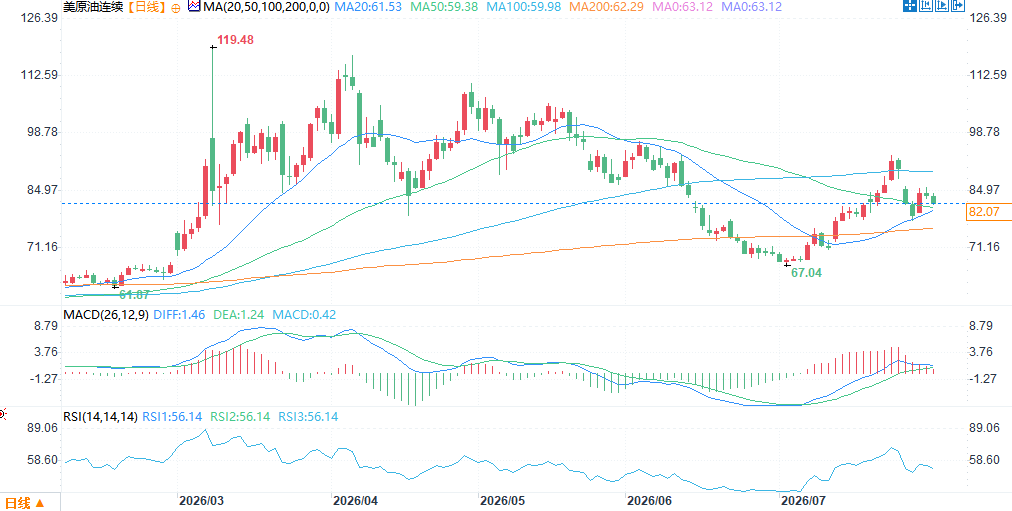 (US crude oil futures daily chart, source: FX678) At 10:24 AM Beijing time on July 31, US crude oil futures were trading at $82.19 per barrel.
Diplomatic hopes and the resumption of shipping put pressure on oil prices
The main driver of the oil price decline was the rising diplomatic hopes between the US and Iran. A spokesperson for the Pakistani Foreign Ministry confirmed that US-Iran talks are underway, aiming to restore stability in the Strait of Hormuz. This news offered a possible diplomatic solution to the five-month-long conflict. Meanwhile, the US Navy successfully escorted several oil tankers through the Strait of Hormuz, and shipping volumes rebounded after a recent slowdown, allowing millions of barrels of crude oil to pass safely—directly alleviating immediate market concerns about supply disruptions. The situation in the Red Sea is also changing. Saudi Arabia held talks with representatives from 43 countries to discuss forming a maritime coalition to protect key shipping lanes. This initiative was proposed after the Houthi rebels imposed a blockade last week threatening regional commerce and trade. Discussions of a maritime coalition indicate that regional countries are actively seeking multilateral solutions to address shipping security challenges.Supply-side risks are still accumulating.
Despite rising diplomatic hopes, risks on the supply side continue to accumulate. Kazakhstan's main export terminal on the Black Sea closed on Thursday, the third such closure this month, suspending crude oil tanker loading after Ukrainian drone attacks on two vessels near Novorossiysk. The Black Sea is a crucial passage for Kazakhstan's crude oil exports, and the repeated closures highlight the fragility of the region's supply chains. The ongoing conflict between Russia and Ukraine in the Black Sea is having a substantial impact on global crude oil trade flows.Geopolitical risk premium still exists
Despite recent pullbacks, WTI crude oil is still on track for a monthly gain of over 18%, reflecting the continued threat of the US-Iran conflict to Middle Eastern energy supplies. The US launched a new round of strikes against Iranian targets in response to Tehran's attacks on US assets in the region. TD Securities points out that the risk backdrop for the crude oil market continues to deteriorate, warning of "accumulating supply risks," even as investors focus on positioning and short-term fund flows. The institution believes that the accumulation of supply disruptions and geopolitical flashpoints is becoming increasingly difficult to ignore, reinforcing its judgment that "tightening physical balances should continue to be a key driver of crude oil prices."Diplomatic détente vs. supply risks
Current oil price movements remain driven by multiple key variables. A substantial breakthrough in US-Iran diplomatic negotiations would significantly alleviate market concerns about supply disruptions in the Middle East. If the two sides can reach a phased consensus on the nuclear issue and related sanctions, Iranian crude oil exports are expected to gradually resume, significantly improving global supply expectations and pushing oil prices further down. The risk premium accumulated previously due to sanctions and geopolitical tensions is expected to be systematically digested as negotiations progress, leading to a rebound in investor risk appetite and sustained downward pressure on oil prices. The recovery of shipping in the Strait of Hormuz is equally crucial. As a vital passage for approximately one-fifth of global crude oil trade, its efficiency directly determines the smoothness of Middle Eastern crude oil exports. If recent traffic conditions continue to improve and insurance rates and detour costs gradually decline, the geopolitical premium previously priced in due to shipping disruptions will be rapidly reversed. Stable and positive shipping data will enhance supply predictability, weaken short-term speculative buying, and further suppress upward potential for oil prices. At the same time, the risk of sudden supply disruptions cannot be ignored. If Kazakhstan's major crude oil terminals close due to technical or external factors, or if the situation in the Black Sea region deteriorates again, affecting export routes to Russia and surrounding areas, temporary supply shortages may occur in some regions. Such events would quickly escalate market concerns about supply security, prompting a temporary rebound in oil prices.Two scenarios for oil prices
Progress in US-Iran diplomatic negotiations and the resumption of shipping in the Strait of Hormuz have provided short-term downward pressure on the crude oil market. However, supply-side risks have not dissipated—Kazakhstan's Black Sea export terminals have closed for the third time this month, Ukrainian drone attacks continue, and the US-Iran military confrontation persists. The fact that US crude oil futures have risen by more than 17% this month indicates that market concerns about Middle East supply disruptions are deeply priced in. In the short term, the direction of oil prices depends on the interplay between progress in US-Iran diplomacy and the risk of supply disruptions—if negotiations achieve a substantial breakthrough, the geopolitical premium may be further eroded; if diplomacy fails or new supply disruptions occur, oil prices may quickly resume their upward trend. TD Securities' warning is worth heeding: "Supply risks are accumulating," and the market may be under-pricing the tightening of the physical balance. (US crude oil futures daily chart, source: FX678) At 10:24 AM Beijing time on July 31, US crude oil futures were trading at $82.19 per barrel.
- Risk Warning and Disclaimer
- The market involves risk, and trading may not be suitable for all investors. This article is for reference only and does not constitute personal investment advice, nor does it take into account certain users’ specific investment objectives, financial situation, or other needs. Any investment decisions made based on this information are at your own risk.