A rebounding US dollar is putting downward pressure on silver prices, which are expected to continue trading in a low-level range in the short term.
2026-07-31 14:04:51
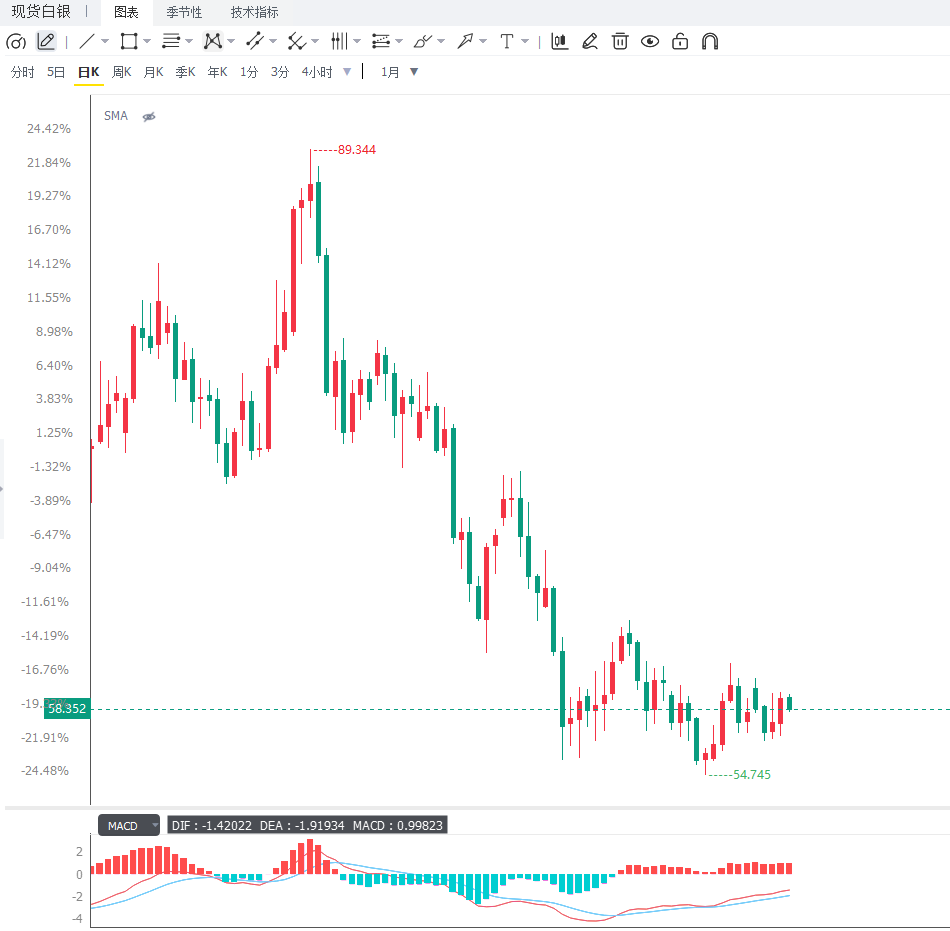
Spot silver (XAG/USD) fell nearly 1% in Asian trading on Friday, retreating to around $58.40. The weakness in silver was mainly due to a short-term rebound in the US dollar, with the dollar index ending a three-day losing streak and regaining some buying support. As of now, the US dollar index (DXY) is up about 0.23%, trading around 100.20. Since silver is priced in US dollars, a stronger dollar typically reduces the attractiveness of precious metals for non-dollar investors, putting short-term pressure on silver prices.  However, the downside for silver remains limited by changes in expectations surrounding Federal Reserve policy. The Fed maintained interest rates at its latest policy meeting and emphasized that future policy will rely less on forward guidance and more on economic data. This policy communication approach has led the market to reassess the future trajectory of the US dollar. The previous sharp decline in the dollar was primarily due to the market reducing its bets on a short-term Fed rate hike, coupled with Fed Chairman Kevin Warsh's failure to fully convince the market with a hawkish inflation statement. Market surveys indicate that some institutions believe the market is reducing its remaining expectations for a July rate hike, while investors are refocusing on whether the Fed will face policy pressure between economic growth and inflation control. This uncertainty surrounding the dollar's trajectory provides potential support for silver. If the market continues to lower its expectations for further Fed tightening, US real interest rates may come under pressure, thereby improving the investment attractiveness of non-interest-bearing assets like silver. However, energy market risks continue to limit silver's upside. Crude oil prices remain volatile at high levels due to the impact of tensions between the US and Iran on global energy supply expectations. Rising oil prices could reignite global inflation expectations and force major central banks to maintain a higher interest rate environment. For silver, while a high-inflation environment can increase demand for the precious metal as a safe haven, if the market believes that central banks will maintain tight monetary policies to control prices for a longer period, it will increase the opportunity cost of holding non-interest-bearing assets, putting pressure on silver prices. Furthermore, silver possesses attributes of both a precious metal and an industrial metal; its price is influenced not only by the US dollar and interest rates but also by changes in global manufacturing demand. If future economic growth expectations improve, a rebound in industrial demand could further strengthen support for silver prices. Currently, market focus is concentrated on the direction of the US dollar index, future policy signals from the Federal Reserve, US economic data, and changes in the energy market. If the US dollar continues to rebound, silver may continue its short-term correction; if the US dollar weakens again, silver prices may resume their upward momentum. From a daily chart perspective, silver currently maintains a short-term weak structure, with prices trading below the 20-day exponential moving average of $58.91, indicating that the recent rebound is still a corrective move. The RSI indicator is around 46, in the neutral zone, indicating that selling pressure exists in the market but has not yet reached a significantly oversold state. The first resistance level to watch is the 20-day moving average around $58.91. If the daily chart can hold above this level, it will alleviate short-term bearish pressure and may push the price to test the resistance around $60.94. Key support levels to watch are the low of July 28th around $56.64, followed by the low of July 17th around $54.77. A break below these support areas could further confirm the short-term correction trend. From the 4-hour chart, XAG/USD is currently in a short-term consolidation phase, with insufficient upward momentum and a stronger dollar putting pressure on the bulls. Short-term moving averages still provide some resistance, and the market is awaiting new fundamental catalysts. If the price breaks above $59.00, it may test above $60 in the short term; if it continues to be resisted and breaks below the $56.60 support, it may fall further to around $55 to find buying support. Currently, the 4-hour chart shows a slight advantage for the bears, but changes in the direction of the dollar could quickly alter the market rhythm.
  Editor's Summary: Silver's recent price movements have been influenced by the US dollar, Federal Reserve policy expectations, and energy market risks. A short-term rebound in the US dollar has put pressure on silver prices, but the Fed's reduced policy guidance and lowered market expectations for interest rate hikes provide potential for a rebound. The biggest uncertainty in the current market lies in the balance between inflation and interest rates. If crude oil prices continue to rise due to supply risks, inflation expectations may resurface, limiting the rise of precious metals; however, if US economic data continues to weaken and Fed policy expectations shift towards easing, silver may attract renewed capital inflows. In the short term, the area around $58.90 is a crucial level for a renewed strengthening of silver prices, while the area around $56.60 is a key defensive zone. Investors need to closely monitor the US dollar index, Fed policy signals, and changes in global energy supply to determine the next direction of silver.
However, the downside for silver remains limited by changes in expectations surrounding Federal Reserve policy. The Fed maintained interest rates at its latest policy meeting and emphasized that future policy will rely less on forward guidance and more on economic data. This policy communication approach has led the market to reassess the future trajectory of the US dollar. The previous sharp decline in the dollar was primarily due to the market reducing its bets on a short-term Fed rate hike, coupled with Fed Chairman Kevin Warsh's failure to fully convince the market with a hawkish inflation statement. Market surveys indicate that some institutions believe the market is reducing its remaining expectations for a July rate hike, while investors are refocusing on whether the Fed will face policy pressure between economic growth and inflation control. This uncertainty surrounding the dollar's trajectory provides potential support for silver. If the market continues to lower its expectations for further Fed tightening, US real interest rates may come under pressure, thereby improving the investment attractiveness of non-interest-bearing assets like silver. However, energy market risks continue to limit silver's upside. Crude oil prices remain volatile at high levels due to the impact of tensions between the US and Iran on global energy supply expectations. Rising oil prices could reignite global inflation expectations and force major central banks to maintain a higher interest rate environment. For silver, while a high-inflation environment can increase demand for the precious metal as a safe haven, if the market believes that central banks will maintain tight monetary policies to control prices for a longer period, it will increase the opportunity cost of holding non-interest-bearing assets, putting pressure on silver prices. Furthermore, silver possesses attributes of both a precious metal and an industrial metal; its price is influenced not only by the US dollar and interest rates but also by changes in global manufacturing demand. If future economic growth expectations improve, a rebound in industrial demand could further strengthen support for silver prices. Currently, market focus is concentrated on the direction of the US dollar index, future policy signals from the Federal Reserve, US economic data, and changes in the energy market. If the US dollar continues to rebound, silver may continue its short-term correction; if the US dollar weakens again, silver prices may resume their upward momentum. From a daily chart perspective, silver currently maintains a short-term weak structure, with prices trading below the 20-day exponential moving average of $58.91, indicating that the recent rebound is still a corrective move. The RSI indicator is around 46, in the neutral zone, indicating that selling pressure exists in the market but has not yet reached a significantly oversold state. The first resistance level to watch is the 20-day moving average around $58.91. If the daily chart can hold above this level, it will alleviate short-term bearish pressure and may push the price to test the resistance around $60.94. Key support levels to watch are the low of July 28th around $56.64, followed by the low of July 17th around $54.77. A break below these support areas could further confirm the short-term correction trend. From the 4-hour chart, XAG/USD is currently in a short-term consolidation phase, with insufficient upward momentum and a stronger dollar putting pressure on the bulls. Short-term moving averages still provide some resistance, and the market is awaiting new fundamental catalysts. If the price breaks above $59.00, it may test above $60 in the short term; if it continues to be resisted and breaks below the $56.60 support, it may fall further to around $55 to find buying support. Currently, the 4-hour chart shows a slight advantage for the bears, but changes in the direction of the dollar could quickly alter the market rhythm. Editor's Summary: Silver's recent price movements have been influenced by the US dollar, Federal Reserve policy expectations, and energy market risks. A short-term rebound in the US dollar has put pressure on silver prices, but the Fed's reduced policy guidance and lowered market expectations for interest rate hikes provide potential for a rebound. The biggest uncertainty in the current market lies in the balance between inflation and interest rates. If crude oil prices continue to rise due to supply risks, inflation expectations may resurface, limiting the rise of precious metals; however, if US economic data continues to weaken and Fed policy expectations shift towards easing, silver may attract renewed capital inflows. In the short term, the area around $58.90 is a crucial level for a renewed strengthening of silver prices, while the area around $56.60 is a key defensive zone. Investors need to closely monitor the US dollar index, Fed policy signals, and changes in global energy supply to determine the next direction of silver.
- Risk Warning and Disclaimer
- The market involves risk, and trading may not be suitable for all investors. This article is for reference only and does not constitute personal investment advice, nor does it take into account certain users’ specific investment objectives, financial situation, or other needs. Any investment decisions made based on this information are at your own risk.