The Australian dollar is finding a balance between risk appetite and uncertainty, supported by expectations of a Reserve Bank of Australia rate hike.
2026-08-03 08:08:51
The Australian dollar strengthened against the US dollar in early Asian trading on Monday (August 3), currently trading around 0.7040. US President Trump canceled a planned military strike against Iran, citing an "imminent agreement" on the nuclear program and the full reopening of the Strait of Hormuz, significantly improving risk appetite and providing support for the Australian dollar. The Reserve Bank of Australia's hawkish stance continues to provide structural support for the Australian dollar, with the market continuing to fully price in at least one more rate hike this year. However, Iranian officials denied Trump's claims, calling them "just a new lie," and uncertainty in the Middle East remains high. 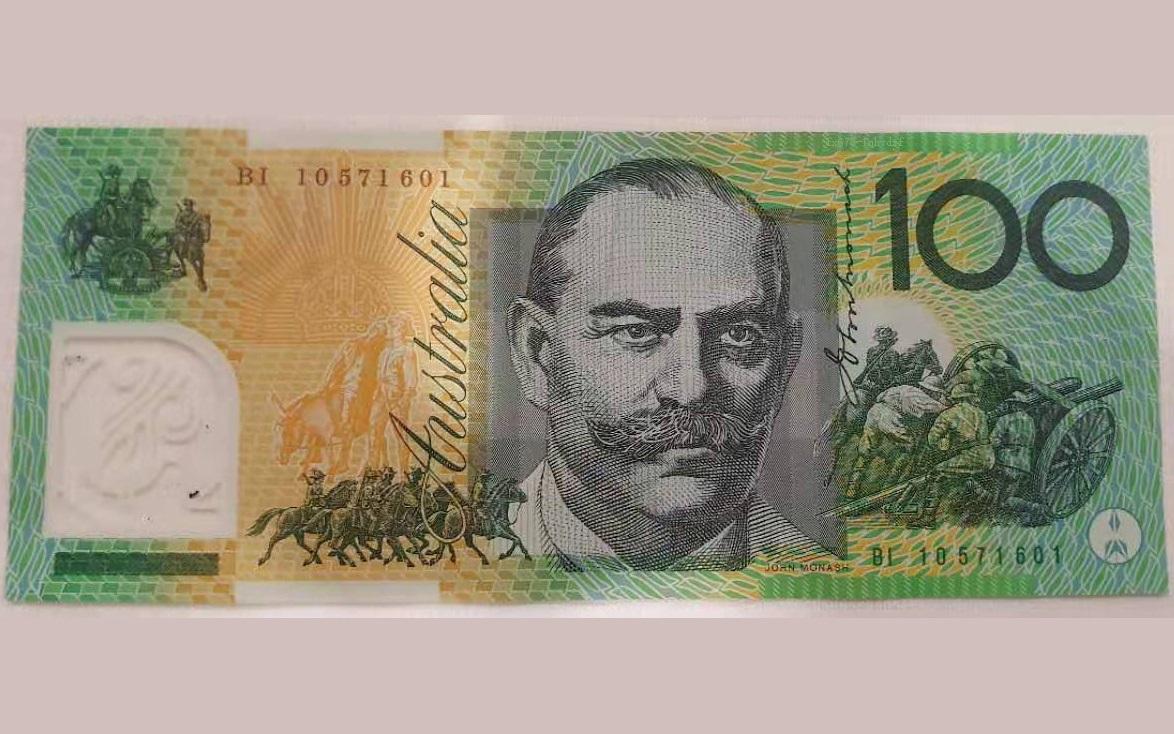
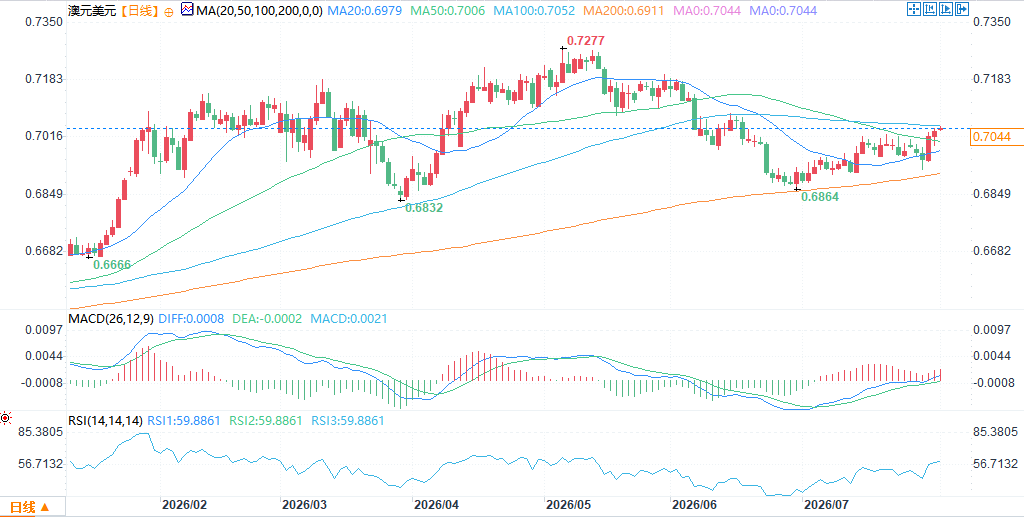 (Australian dollar against US dollar daily chart, source: EasyForex) At 8:03 AM Beijing time on August 3, the Australian dollar was trading at 0.7040/41 against the US dollar.
Trump's cancellation of strikes boosts risk appetite, but Iran denies request for negotiations.
The main driver of the Australian dollar's strength was improved risk appetite. Trump stated on Saturday that the suspension of strikes was based on expectations of an "imminent agreement" and a response to requests from Iran and other regional countries. Traders are closely watching developments between the US and Iran – any positive developments could provide further support for risk assets like the Australian dollar. However, uncertainty remains high. Iranian media reported that Iranian officials called Trump's claim of a "Tehran request for a suspension" "just a new lie" and emphasized that the Iranian armed forces are "on high alert and ready to respond to any situation." Continued tensions in the Middle East could drive safe-haven flows to the US dollar, putting downward pressure on the Australian dollar.The Reserve Bank of Australia's hawkish stance provides structural support for the Australian dollar.
The Reserve Bank of Australia's hawkish stance continues to support the Australian dollar. The market has fully priced in at least one more rate hike this year. Governor Bullock warned last week that core inflation remains too high and may require a further slowdown in domestic demand to curb prices, adding that policymakers are "prepared to raise rates again if necessary." Analysts at BNY Mellon noted that RBA Assistant Governor Hunt reiterated the need to maintain a restrained stance, emphasizing that inflation "remains above the 2-3% target range" and that "pressures on price growth must be maintained to prevent higher inflation expectations from becoming entrenched." On the labor market, Hunt described it as "still slightly tight," with first-half employment growth "holding up well," highlighting the resilience of the job market.The Australian dollar's triple variables
The market's focus regarding the Australian dollar's trajectory is currently concentrated on three key variables. First, the US-Iran situation: if negotiations between the two sides achieve a substantial breakthrough and geopolitical risks significantly ease, global risk appetite will noticeably rebound. Reduced risk aversion will benefit the Australian dollar, potentially pushing it above the upper limit of its recent trading range. Second, China's PMI data is equally crucial. As Australia's largest trading partner, stronger-than-expected Chinese manufacturing and non-manufacturing PMIs will directly boost expectations for commodity demand, benefiting Australian exports and economic growth prospects, thus providing strong support for the Australian dollar. Third, the Reserve Bank of Australia's (RBA) interest rate hike expectations cannot be ignored. If the market continues to price in subsequent rate hikes, the interest rate differential will strengthen the Australian dollar's attractiveness, attracting capital inflows and providing medium-term support. In summary, if these variables converge, the Australian dollar's upward potential is likely to be further unleashed.The Australian dollar seeks a balance between risk appetite and uncertainty.
The Australian dollar strengthened to around 0.7040 against the US dollar, driven primarily by improved risk appetite, following Trump's decision to withdraw sanctions against Iran. The Reserve Bank of Australia's hawkish stance provided structural support for the Australian dollar, with the market continuing to fully price in another rate hike this year. However, Iran's denial of its willingness to negotiate and persistent geopolitical uncertainty limited the Australian dollar's upside potential. In the short term, the Australian dollar is likely to consolidate within the 0.6980-0.7060 range. If substantial progress is made between the US and Iran and Chinese PMI data is strong, the Australian dollar could break through the 0.7060 resistance level; conversely, if geopolitical risks escalate again, the Australian dollar may retest the 0.6980 support level. The medium-term direction of the Australian dollar still depends on the dynamic interplay between the Reserve Bank of Australia's policy path and global risk appetite, as well as the evolution of the US-Iran situation. (Australian dollar against US dollar daily chart, source: EasyForex) At 8:03 AM Beijing time on August 3, the Australian dollar was trading at 0.7040/41 against the US dollar.
- Risk Warning and Disclaimer
- The market involves risk, and trading may not be suitable for all investors. This article is for reference only and does not constitute personal investment advice, nor does it take into account certain users’ specific investment objectives, financial situation, or other needs. Any investment decisions made based on this information are at your own risk.