Carry trade fueled joint US-Japan intervention, causing the US and Japanese yen to plunge 800 points.
2026-08-03 19:52:52
The yen recently hit a multi-decade low, triggering a policy convergence between the two countries. The US, in an unprecedented move, coordinated with Japan to intervene by purchasing yen. While this intervention provided a short-term boost to the exchange rate, interest rate differentials remain the core constraint. The market is heavily betting on a September rate hike by the Bank of Japan, which will be crucial in determining the medium- to long-term trend of the USD/JPY exchange rate. On August 3rd, the market continued to review last week's major events: the US and Japan completed a rare joint foreign exchange market intervention, working together to curb short selling and support the continuously weakening yen. USD/JPY plummeted from its year-to-date high of 163.98, hitting a low of 155.22, a new low since May 6th, a drop of over 800 points in just a few trading days. This round of coordinated intervention was not a spur-of-the-money decision, but a significant action following months of communication, coordination, and consensus between the two countries. In the past, Japanese authorities had repeatedly intervened alone to buy yen, which only temporarily slowed the decline and failed to reverse the yen's downward trend. However, this year the situation has changed significantly, with the US Treasury publicly expressing support for a stronger yen, adding strong leverage to Japan's intervention. Officials from both countries have communicated online and offline more than ten times on the issue of exchange rates. In May, Japanese Finance Minister Satsuki Katayama and U.S. Treasury Secretary Bessenter met in Japan and held a 3.5-hour meeting that focused on exchange rate coordination, laying the groundwork for subsequent joint intervention. 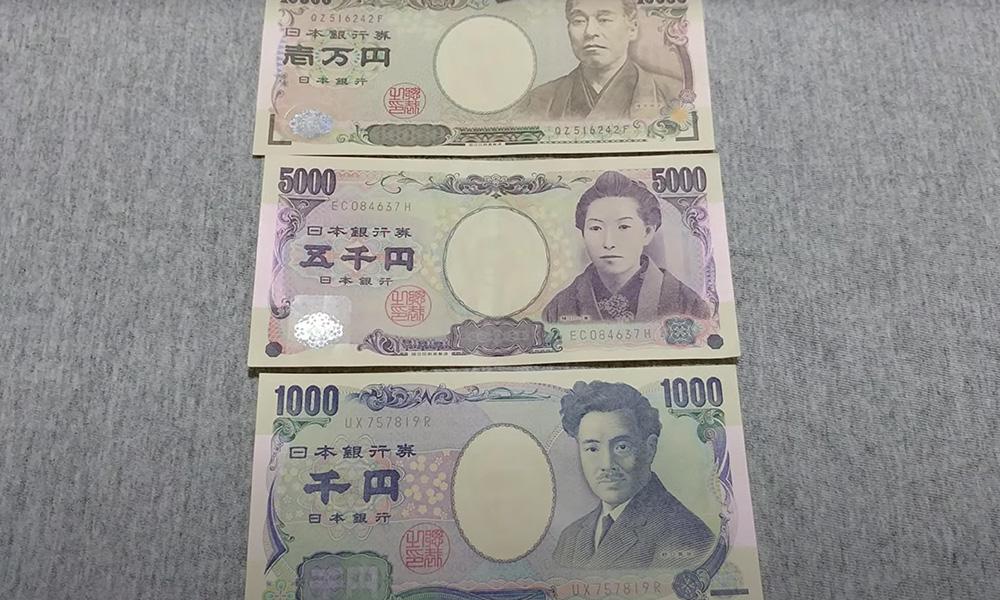
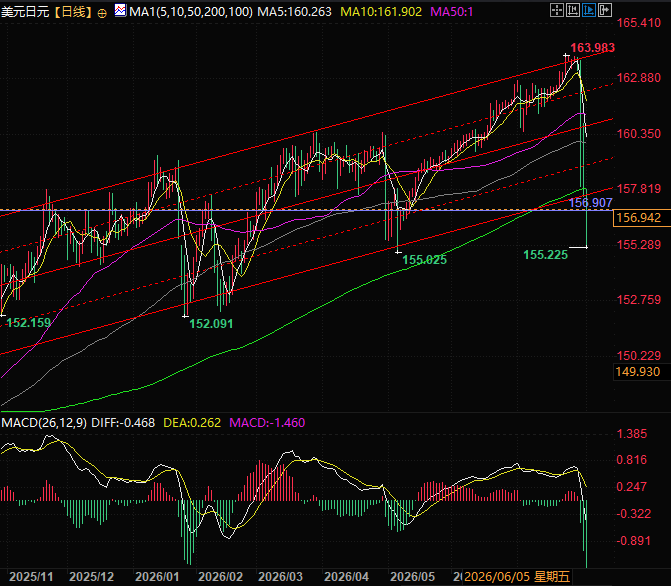 (USD/JPY daily chart, source: FX678) At 19:49 Beijing time, USD/JPY is currently trading at 156.94/95.
The US and Japan reached a consensus: their respective core demands
Japan's problem lies in the weak yen impacting people's livelihoods, forcing policy tightening. Former Japanese Prime Minister Shigeru Ishiba has repeatedly stated that yen depreciation will lead to inflation, which is why he has consistently refused to lower the consumption tax. As a country with government debt exceeding 200% of GDP, Japan's tax revenue capacity directly determines whether the yen will depreciate. With Kaohsiung City lowering the consumption tax and high domestic energy costs, the yen's continued weakness pushes up imported goods prices, exacerbating domestic cost-of-living pressures and directly dragging down the approval rating of the Kaohsiung City Sanae cabinet. Atsukazu Mimura, the foreign exchange chief at the Japanese Ministry of Finance, has shifted from his previous pattern of frequently issuing verbal warnings about speculative funds to working closely with the US behind the scenes, waiting for the right moment to intervene. Market estimates suggest that the Japanese authorities' first round of intervention amounted to approximately 8.45 trillion yen; with the second round of intervention last Friday and US involvement, the total amount of intervention funds used by Japan this time may reach as high as $36.58 billion.Two core concerns in the United States have prompted the US to make rare intervention.
Concerns are growing that Japan will sell off its US Treasury bonds. Japan is the largest foreign holder of US Treasury bonds, with holdings exceeding $1.14 trillion, and these holdings have been declining steadily since their February peak. If the yen continues to plummet, Japan may accelerate its reduction of US Treasury holdings to withdraw funds and intervene in the foreign exchange market, further pushing up yields on long-term US Treasury bonds. Currently, US public debt is approaching $40 trillion and the fiscal deficit is expected to exceed $2 trillion. Rising US Treasury yields will significantly increase debt repayment pressure. The US does not want to repeat a situation similar to China's continuous reduction of its US Treasury holdings. A weak yen weakens the effectiveness of tariff policies. The Trump administration relied on tariffs to adjust its foreign trade pattern, and Japan's trade surplus with the US has climbed to over $47 billion. The continued depreciation of the yen has boosted Japanese automobile and machinery exports, offsetting the impact of tariffs. A stronger yen could improve the competitive environment for US exports. In addition, Trump's good communication with Japanese Prime Minister Sanae Takaichi, helping Japan suppress domestic inflation, is also a factor contributing to the US's willingness to coordinate intervention.Intervention had limited effectiveness, and the interest rate spread problem remains unresolved.
The general market consensus is that foreign exchange market intervention can only create short-term price shocks and cannot permanently reverse exchange rate trends. Currently, both the Federal Reserve and the Bank of Japan kept interest rates unchanged last week, and the market expects the Fed to raise rates again this year. As long as the Bank of Japan fails to accelerate its monetary policy tightening, the significant interest rate differential between the US and Japan will continue to exert medium- to long-term pressure on the yen.Carry Trade Closing Wave: An Accelerator of Volatility and Liquidity
Beyond policy maneuvering, the forced liquidation of carry trades acted as a hidden accelerator, propelling the USD/JPY pair to plummet 800 points in just a few days. For a long time, the market had accumulated massive leveraged positions of "borrowing yen to buy US dollars." The joint intervention by the US and Japan instantly triggered exchange rate volatility, directly impacting the stop-loss levels of carry trades. To avoid exchange rate losses eroding interest rate differentials, speculators were forced to buy back large amounts of yen to liquidate their positions, creating a positive feedback loop of "yen appreciation leverage liquidation → further appreciation." However, the intervention only cleared some short-term leverage. As long as the real interest rate differential between the US and Japan does not fundamentally reverse, carry trades will not completely withdraw. Only if the Bank of Japan raises interest rates as expected in September will a structural return of carry trades truly begin, laying the foundation for a long-term bottom for the yen; otherwise, carry trades could return at any time, suppressing the yen again.The focus shifts to the Bank of Japan's September policy meeting.
Following this joint intervention, market attention quickly shifted to the Bank of Japan's policy meeting on September 17-18. At last week's policy meeting, Kazuo Ueda released the strongest hawkish signal to date, emphasizing the risk of rising inflation, which the market interpreted as a near confirmation of a September rate hike. US Treasury Secretary Bessenter also publicly called on the Bank of Japan to accelerate the normalization of monetary policy. It is expected that Ueda and Bessenter will meet again at the G20 finance ministers' meeting at the end of August to further discuss the pace of rate hikes. Institutional views are converging: intervention alone is unlikely to establish a long-term bottom for the yen; only sustained rate hikes can fundamentally boost the yen. Many brokerage strategists believe that a September rate hike is almost a certainty. If the Bank of Japan chooses to remain on hold, the market will likely resume selling yen, and USD/JPY will resume its upward trend; if a rate hike occurs as expected, it is expected to consolidate the yen's short-term bottom. Currently, the probability of a September rate hike has doubled compared to before the intervention, reaching 40%, while the probability of a rate hike in October is 55.2%. Summary and Technical Analysis: Previous articles highlighted the yen's turning point and risk control in global capital markets before the sharp decline in USD/JPY. Those interested can read previous articles related to the yen. In the short term, the impact of the coordinated intervention will continue to unfold, with USD/JPY maintaining wide fluctuations and the risk of a technical rebound not to be ignored. The medium-term trend is tied to the Bank of Japan's September interest rate decision and global capital flows. Meanwhile, risks remain: despite policy coordination between the US and Japan, the fundamental interest rate differential pattern has not changed. Once the market re-prices the Fed's rate hike expectations, the yen will face renewed pressure. Continued monitoring of US Treasury yields, Japanese inflation data, and statements from officials of both countries regarding exchange rates is necessary. At the same time, global capital markets, especially those related to AI, may continue to adjust, potentially leading to a return of arbitrage funds. Technically, USD/JPY has broken below the upward trend line. If it fails to rebound and re-enter the channel in the short term, or breaks below it again, the upward trend of USD/JPY will be further reversed. (The blue key level in the chart was drawn a month ago and explained in an article at the time; it currently represents the latest price center for the yen.) (USD/JPY daily chart, source: FX678) At 19:49 Beijing time, USD/JPY is currently trading at 156.94/95.
- Risk Warning and Disclaimer
- The market involves risk, and trading may not be suitable for all investors. This article is for reference only and does not constitute personal investment advice, nor does it take into account certain users’ specific investment objectives, financial situation, or other needs. Any investment decisions made based on this information are at your own risk.