Crude oil trading alert: With the US and Iran sticking to their own stories and shipping attacks continuing, how long can oil prices hold at their three-week low?
2026-08-05 08:14:52
On Wednesday (August 5) in early Asian trading, international oil prices traded in a narrow range after plunging more than 5% overnight. Brent crude futures hovered around $78.70 per barrel, while U.S. crude futures traded around $75 per barrel, both hitting three-week lows. Qatari and U.S. officials signaled progress in U.S.-Iran negotiations, raising market expectations for the possible reopening of the Strait of Hormuz. However, Iran denied direct contact with the U.S., and reports of further attacks on ships near the strait added uncertainty to the prospects for a diplomatic solution. 
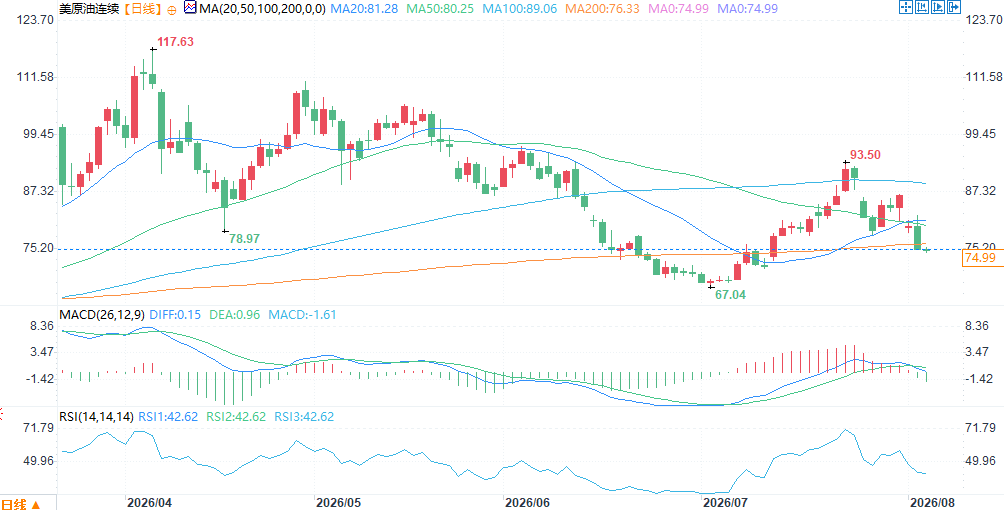 (US crude oil futures daily chart, source: FX678) At 8:08 AM Beijing time on August 5, US crude oil futures were trading at $75.07 per barrel.
The mediators released positive signals: negotiations have made progress.
The Qatari Emir's office said on Tuesday that Trump and the Qatari Emir spoke by phone that day to discuss efforts to narrow the differences between Washington and Tehran and increase the likelihood of a lasting solution. The office stated that the Qatari Emir emphasized the importance of dialogue and adherence to the memorandum of understanding reached between the US and Iran in mid-June—which stipulated an immediate cessation of military operations. Qatari Foreign Ministry spokesman Ansari further stated that diplomatic contacts have entered a "very advanced stage," with mediators including Qatar, Pakistan, and Oman closely coordinating to push for negotiations between Washington and Tehran and the exchange of draft proposals. A senior Pakistani security official also stated, "Our only goal at present is to get both sides to at least agree to begin dialogue." The US side was more optimistic. Secretary of State Rubio told reporters, "These negotiations have made progress, but nothing has been finalized. We hope to reach an agreement soon." Treasury Secretary Bessant said that an agreement with Iran on reopening the Strait of Hormuz could be reached on Tuesday or Wednesday.Iran denies direct negotiations with the US, but says talks with Oman are "positive."
However, Iran's stance differs from that of the United States. Iranian Foreign Ministry spokesman Baghae stated that Iran is not currently engaged in any negotiations with the United States. However, he confirmed that talks between Iran and Oman regarding passage through the Strait of Hormuz are "positive" and ongoing, focusing on establishing a safe shipping lane. Baghae stated that the route being discussed aims to ensure the sovereign rights and national security of both Iran and Oman. This statement implies that Iran does not deny contact with Oman regarding the management of the Strait, but firmly denies direct dialogue with the United States. Trump's previous claim that "negotiations are underway" has once again been publicly refuted by Iran.Shipping risks remain: ships attacked again
Despite increasingly positive diplomatic signals, actual security for passage through the Strait of Hormuz has not improved. The UK's Office for Maritime Trade Operations (UKMTO) reported that a cargo ship was hit by an unidentified projectile near the Strait of Hormuz off the coast of Oman; the crew abandoned ship, and one sailor is missing. Furthermore, the Indian Minister of Shipping stated that an Indian vessel sank after being hit by a projectile in waters near Yemen, but all 14 people on board were rescued. A senior Iranian source stated that Tehran is seeking full control over vessels entering the strait, while also monitoring the movements of vessels leaving, and possessing the capability to intervene if necessary. This statement suggests that even with progress in diplomatic negotiations, Iran's intention to maintain actual control over the strait has not diminished.Institutional Views
The head of business development at brokerage firm XS pointed out that the prospect of resolving the conflict through diplomatic means has helped to offset some of the geopolitical risk premium in oil prices following the resumption of US bombing of Iran last month. The firm stated, "If substantial progress is made in US-Iran negotiations, the market is likely to continue pricing in the possibility of supply disruptions at a lower level." Goldman Sachs expects Brent crude prices to remain within their current wide trading range until a new US-Iran agreement is confirmed or attacks and targets significantly escalate.The U.S. missile stockpile raises questions about its ability to sustain combat operations.
Meanwhile, questions have been raised about the sustainability of U.S. military operations. According to three sources familiar with the data, the U.S. military has depleted most of its high-precision, long-range missile stockpile during the war, primarily the Army Tactical Missile System (ATACMS) and Precision Strike Missiles (PrSM). Two of the sources stated that the U.S. has used "almost everything" of these two types of weapons. This background may explain why Washington is more inclined towards a diplomatic solution—its ability to sustain military strikes has been substantially constrained.Summarize
Signals of progress in US-Iran negotiations between Qatari and US officials sent oil prices plunging more than 5% to a three-week low on Tuesday. However, Iran denied direct talks with the US, only confirming "positive" talks with Oman on Strait of Hormuz management, and reports of further attacks on ships in the Strait of Hormuz added uncertainty to the prospects for a diplomatic solution. While the mediators expressed optimism, the core differences between the two sides have not yet been bridged. Goldman Sachs expects Brent crude prices to remain within their current wide trading range until an agreement is confirmed or the situation escalates significantly. Furthermore, the substantial depletion of the US high-precision missile stockpile may have already imposed a substantial constraint on Washington's military options, further increasing the urgency of a diplomatic solution. In the short term, oil prices will continue to oscillate between "diplomatic optimism" and "realistic risks." (US crude oil futures daily chart, source: FX678) At 8:08 AM Beijing time on August 5, US crude oil futures were trading at $75.07 per barrel.- Risk Warning and Disclaimer
- The market involves risk, and trading may not be suitable for all investors. This article is for reference only and does not constitute personal investment advice, nor does it take into account certain users’ specific investment objectives, financial situation, or other needs. Any investment decisions made based on this information are at your own risk.