New Zealand's employment data holds hidden clues; how will the New Zealand dollar perform against the US dollar in the future?
2026-08-05 12:14:52
New Zealand's unemployment rate climbed to a more than ten-year high in June, with a significant increase in slack in the labor market, mitigating the risk of inflation driven by sharp wage increases. However, the employment data showed significant internal divergence, with actual job growth being relatively rapid, and the rise in the unemployment rate stemming from a substantial increase in the labor force participation rate. Although the employment data was somewhat weak, it is unlikely to shake the central bank's short-term interest rate hike path, and the market is beginning to reassess the end of this tightening cycle. The influence of New Zealand's domestic interest rates on the New Zealand dollar has weakened, with global risk appetite becoming the core force driving the NZD/USD exchange rate, and the technical chart still maintaining a bullish pattern. Beneath this relatively weak unemployment rate data lies strong momentum for job growth. Employment increased by 0.5% quarter-on-quarter, far exceeding market forecasts of 0.2% and the Reserve Bank of New Zealand's 0.1%, with full-year employment growth reaching 1.2%. The unemployment rate rose instead of falling, primarily due to a significant increase in the labor force participation rate to 70.7%. A large influx of people into the labor market resulted in more job seekers than the economy could absorb, directly pushing up the unemployment and underemployment rates. Wages also showed no signs of overheating. Private sector labor costs rose by 2.0% year-on-year, slightly exceeding the central bank's expectations, but still far from the wage surge needed to drive inflation, further reducing the likelihood of a wage-inflation spiral.
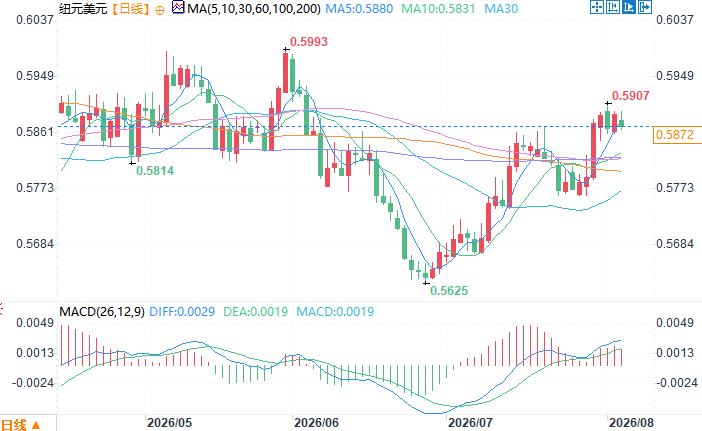 NZD/USD daily chart source: FX678. At 12:12 Beijing time on August 5th, the NZD/USD exchange rate was 0.5871/72.
Employment data shows a divergence in structure, with the space for idle labor continuing to expand.
New Zealand's unemployment rate rose to 5.6% in June, the highest level since the second quarter of 2015, exceeding market and Reserve Bank of New Zealand's expectations of 5.4%. The underutilization rate, representing the broad surplus of the labor force, rose to 13.8% from 12.9%. This indicator covers the unemployed, those seeking increased working hours, and those awaiting employment, providing a more comprehensive picture of the labor market's idle capacity. Beneath this relatively weak unemployment rate data lies strong momentum for job growth. Employment increased by 0.5% quarter-on-quarter, far exceeding market forecasts of 0.2% and the Reserve Bank of New Zealand's 0.1%, with full-year employment growth reaching 1.2%. The unemployment rate rose instead of falling, primarily due to a significant increase in the labor force participation rate to 70.7%. A large influx of people into the labor market resulted in more job seekers than the economy could absorb, directly pushing up the unemployment and underemployment rates. Wages also showed no signs of overheating. Private sector labor costs rose by 2.0% year-on-year, slightly exceeding the central bank's expectations, but still far from the wage surge needed to drive inflation, further reducing the likelihood of a wage-inflation spiral.The pace of short-term interest rate hikes is unlikely to change, and the market has lowered its expectations for the end of interest rate hikes.
The labor market is sending signals of easing, but this will not disrupt the Reserve Bank of New Zealand's short-term policy arrangements. The market still highly anticipates a 25 basis point rate hike at next month's policy meeting, continuing the tightening cycle that began in July. The Reserve Bank of New Zealand previously stated that inflation remains above target and economic activity is expected to recover, necessitating further monetary tightening to push inflation back to the 2% target level. Subsequent interest rate decisions will be based on a comprehensive assessment of economic data, corporate pricing behavior, and economic conditions. This employment data has led the market to reassess the required margin for interest rates above the neutral rate, which the Reserve Bank of New Zealand estimates to be around 3%. As a key indicator of interest rate expectations, the New Zealand two-year swap rate fell to 3.61% after the data release, reaching a low since mid-July. At the end of July, this indicator had surged to 3.78%, at which time the market was betting on a more aggressive rate hike path from the central bank. The two-year swap rate significantly impacts New Zealand fixed mortgage pricing and is a crucial channel for transmitting monetary policy to residents; the decline in the rate also signifies a significant cooling of market expectations for further tightening.Risk appetite drives exchange rates; the New Zealand dollar maintains a bullish technical tone.
For the New Zealand dollar against the US dollar, the influence of New Zealand interest rate expectations is weakening, and global market risk appetite is becoming the main driver of price movements. This explains why the New Zealand dollar only saw a slight pullback after the release of negative employment data. From a technical perspective, this pullback has not disrupted the breakout above the 0.5860 resistance level from last week, which has now become a key short-term support level, with the exchange rate finding support at this level over the past two trading days. If it breaks down effectively, the 50-day and 100-day moving averages converging at 0.5825 will form the next important support zone. On the upside, the exchange rate is encountering resistance above 0.5900, with 0.5900 and 0.5920 forming upward resistance. Once it holds above 0.5920, the exchange rate is expected to challenge the double top of the year at 0.5992. Momentum indicators are generally biased towards buying on dips, with the RSI remaining above the 50 neutral line and the MACD maintaining a bullish trend. The upward trend that began in early July has not yet been broken . In summary , increased labor supply in New Zealand is easing wage inflation pressures, but the economy itself remains resilient. The probability of a short-term interest rate hike by the central bank remains high, although the market has begun to lower its expectations for the peak of interest rates. In addition to monitoring domestic policies, the New Zealand dollar will need to closely track changes in global risk appetite going forward. NZD/USD daily chart source: FX678. At 12:12 Beijing time on August 5th, the NZD/USD exchange rate was 0.5871/72.
- Risk Warning and Disclaimer
- The market involves risk, and trading may not be suitable for all investors. This article is for reference only and does not constitute personal investment advice, nor does it take into account certain users’ specific investment objectives, financial situation, or other needs. Any investment decisions made based on this information are at your own risk.