Silver rose about 5% intraday, with traders watching the 50-day moving average.
2026-08-05 20:30:56
On Wednesday (August 5th) in early US trading, silver prices rose by about 5% to around $62.48 per ounce, a rapid increase that defies easy categorization as buying on dips. Traders appear to be actively shorting, a situation we haven't seen in a long time. The decline in oil prices, influenced by the Iran nuclear deal negotiations, led to a drop in US Treasury yields, with the 10-year Treasury yield falling to around 4.60% after recently approaching 4.75%, and the dollar continuing to weaken due to last week's intervention in the yen. The simultaneous fading of these three negative factors propelled silver prices higher.  This is not due to industrial demand or supply shocks. The interest rate-driven trading strategy that had been suppressing silver prices for weeks has now reversed. With the shift in the macroeconomic situation, those who had previously shorted silver have had to exit the market, and the current trend seems to be short covering followed by new buying. The risk is that each wave of this rally depends on an agreement that Iran claims has not yet reached. If the Strait of Hormuz negotiations break down, oil prices will rise, inflationary rhetoric will resurface, and silver prices will fall. Oil prices have been a key inflation concern for Fed hawks. Rising energy prices reinforced expectations for September and pushed yields high, making it difficult for silver to maintain its upward momentum. However, the Strait of Hormuz negotiations led to a drop in oil prices, weakening some of the aforementioned arguments. The 10-year US Treasury yield fell from nearly 4.75% to 4.60%, which is not a small fluctuation for silver, which has traded against rising interest rates for three consecutive weeks. This shift opened the market door. But the market has not calmed down. It is still trading on expectations that reduced shipping disruptions may mean lower future inflationary pressures. This is enough to drive silver prices higher. However, if market expectations reverse, this alone will not be enough to sustain its gains. Iran has denied any direct dialogue with the US. The so-called "potential agreement" is not a signed agreement, and any comments from Tehran could trigger sharp fluctuations in oil prices. Silver prices will not welcome such a reversal. The dollar's long-term stocks are still falling . The dollar was sought after and had huge open interest ahead of last week's Fed meeting. The Fed's stance of keeping interest rates unchanged was not dovish, but it was more moderate than the market expected. Subsequent yen intervention forced dollar longs to unwind, and the dollar index fell to a six-week low near 99.85. Silver was simultaneously affected by declining yields and a weaker dollar. This is why its movement was stronger than a typical one-day rebound. If this week's data is positive, the unwinding trend will continue. The probability of a September rate hike has fallen from around 67% to about 59%. The Fed remains a risk. Kansas City Fed President Jeff Schmid reiterated on Tuesday that monetary policy tightening is needed to bring inflation back to target levels. However, silver doesn't currently need the Fed to turn dovish. It simply needs the tightening momentum to continue to weaken, which is exactly what's happening now. Technical Analysis
 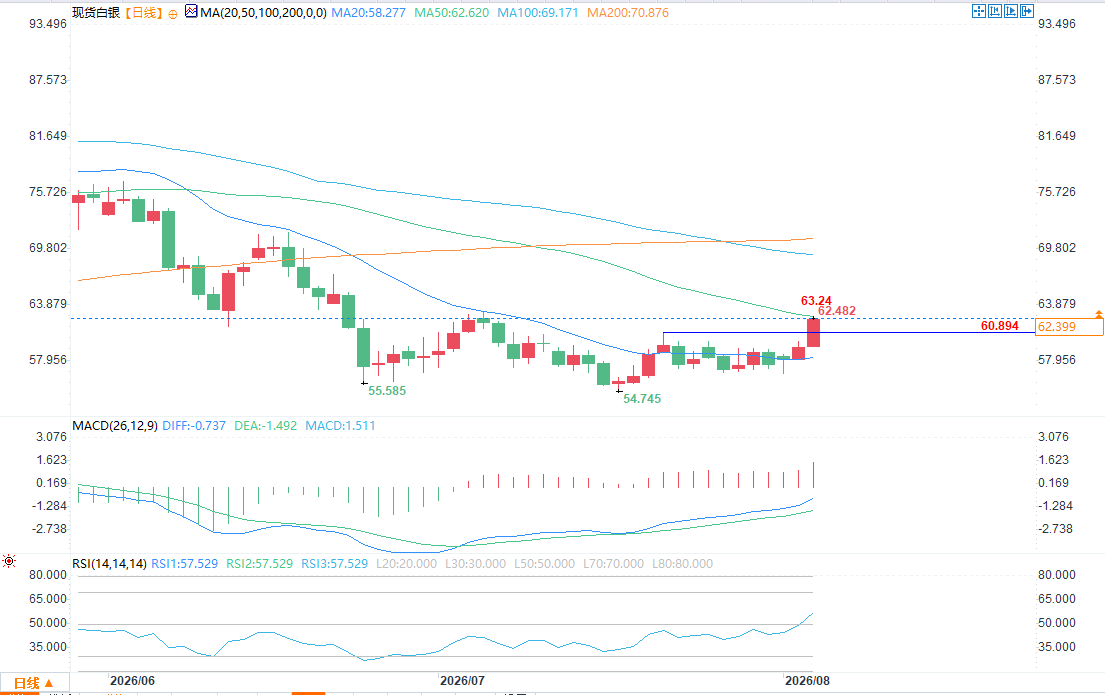 (Spot silver daily chart source: FX678) After breaking through $60.94, silver prices ended the previous downward trend and turned the main trend upward. This move puts silver prices poised to challenge the 50-day moving average at $62.62. The 50-day moving average is a potential resistance level; a break above this level could trigger a faster price increase. Continued breakouts above the 50-day moving average would indicate strengthening buying power. This could prompt prices to test the next peak, targeting $63.28. After breaking this peak, the 200-day moving average ($70.876) will become the focus. On the downside, a sustained break below the important 50% retracement level of $60.835 would signal a return of selling pressure. If this generates sufficient downward momentum, a short-term pullback to $58.00 is expected. Risk Warning Silver needs oil prices to remain low, yields to remain stable, and the US dollar to remain under pressure to rise. These three factors largely aligned this week, leading to a rapid rise in silver prices. A reversal in any one of them would put the rally to the test. Friday's jobs report will either continue this trend or end it. Weak jobs data, particularly slowing wage growth, will push the dollar lower, providing room for buyers to push it towards the 50-day moving average. Strong jobs data, especially a robust employment situation, will provide Schmidt and other hawks with what they need, and the interest rate trade will resume. The technicals have turned bullish, but buyers are chasing easing macroeconomic conditions rather than structural changes. As long as economic data remains positive, they can maintain upward momentum. Once the data falters, sellers will find a clear entry point.
This is not due to industrial demand or supply shocks. The interest rate-driven trading strategy that had been suppressing silver prices for weeks has now reversed. With the shift in the macroeconomic situation, those who had previously shorted silver have had to exit the market, and the current trend seems to be short covering followed by new buying. The risk is that each wave of this rally depends on an agreement that Iran claims has not yet reached. If the Strait of Hormuz negotiations break down, oil prices will rise, inflationary rhetoric will resurface, and silver prices will fall. Oil prices have been a key inflation concern for Fed hawks. Rising energy prices reinforced expectations for September and pushed yields high, making it difficult for silver to maintain its upward momentum. However, the Strait of Hormuz negotiations led to a drop in oil prices, weakening some of the aforementioned arguments. The 10-year US Treasury yield fell from nearly 4.75% to 4.60%, which is not a small fluctuation for silver, which has traded against rising interest rates for three consecutive weeks. This shift opened the market door. But the market has not calmed down. It is still trading on expectations that reduced shipping disruptions may mean lower future inflationary pressures. This is enough to drive silver prices higher. However, if market expectations reverse, this alone will not be enough to sustain its gains. Iran has denied any direct dialogue with the US. The so-called "potential agreement" is not a signed agreement, and any comments from Tehran could trigger sharp fluctuations in oil prices. Silver prices will not welcome such a reversal. The dollar's long-term stocks are still falling . The dollar was sought after and had huge open interest ahead of last week's Fed meeting. The Fed's stance of keeping interest rates unchanged was not dovish, but it was more moderate than the market expected. Subsequent yen intervention forced dollar longs to unwind, and the dollar index fell to a six-week low near 99.85. Silver was simultaneously affected by declining yields and a weaker dollar. This is why its movement was stronger than a typical one-day rebound. If this week's data is positive, the unwinding trend will continue. The probability of a September rate hike has fallen from around 67% to about 59%. The Fed remains a risk. Kansas City Fed President Jeff Schmid reiterated on Tuesday that monetary policy tightening is needed to bring inflation back to target levels. However, silver doesn't currently need the Fed to turn dovish. It simply needs the tightening momentum to continue to weaken, which is exactly what's happening now. Technical Analysis (Spot silver daily chart source: FX678) After breaking through $60.94, silver prices ended the previous downward trend and turned the main trend upward. This move puts silver prices poised to challenge the 50-day moving average at $62.62. The 50-day moving average is a potential resistance level; a break above this level could trigger a faster price increase. Continued breakouts above the 50-day moving average would indicate strengthening buying power. This could prompt prices to test the next peak, targeting $63.28. After breaking this peak, the 200-day moving average ($70.876) will become the focus. On the downside, a sustained break below the important 50% retracement level of $60.835 would signal a return of selling pressure. If this generates sufficient downward momentum, a short-term pullback to $58.00 is expected. Risk Warning Silver needs oil prices to remain low, yields to remain stable, and the US dollar to remain under pressure to rise. These three factors largely aligned this week, leading to a rapid rise in silver prices. A reversal in any one of them would put the rally to the test. Friday's jobs report will either continue this trend or end it. Weak jobs data, particularly slowing wage growth, will push the dollar lower, providing room for buyers to push it towards the 50-day moving average. Strong jobs data, especially a robust employment situation, will provide Schmidt and other hawks with what they need, and the interest rate trade will resume. The technicals have turned bullish, but buyers are chasing easing macroeconomic conditions rather than structural changes. As long as economic data remains positive, they can maintain upward momentum. Once the data falters, sellers will find a clear entry point.
- Risk Warning and Disclaimer
- The market involves risk, and trading may not be suitable for all investors. This article is for reference only and does not constitute personal investment advice, nor does it take into account certain users’ specific investment objectives, financial situation, or other needs. Any investment decisions made based on this information are at your own risk.