Iran and Oman are close to finalizing an agreement on a new shipping route in the Strait of Hormuz, sending gold prices to a seven-week high.
2026-08-06 09:58:52
The Strait of Hormuz, a vital passage for approximately 30% of the world's seaborne oil, has become a core geopolitical focal point in the escalating US-Iran conflict due to the dispute over its passage rights. Iran and Oman have recently engaged in intensive negotiations, attempting to establish a new passage arrangement to replace the model of the past 60 years. However, the US's hardline stance on control and fees presents significant obstacles to any agreement. Meanwhile, Iran has issued clear warnings to Gulf states through high-level diplomatic channels, designating key energy infrastructure as potential targets for retaliation. Whether the strait can be reopened depends on the final balance of power among various interests. Overall, market optimism regarding the imminent reopening of the Strait of Hormuz has further eased inflation concerns, lowered expectations of a Fed rate hike, and put pressure on the dollar and US Treasury yields, providing upward momentum for gold prices. Spot gold surged over 4% on Wednesday, recording its largest single-day gain since February. On Thursday (August 6th) in early Asian trading, spot gold continued its upward trend, rising as much as 1.3% by 09:45, reaching a high of $4302.45 per ounce, a new high since June 18th. 
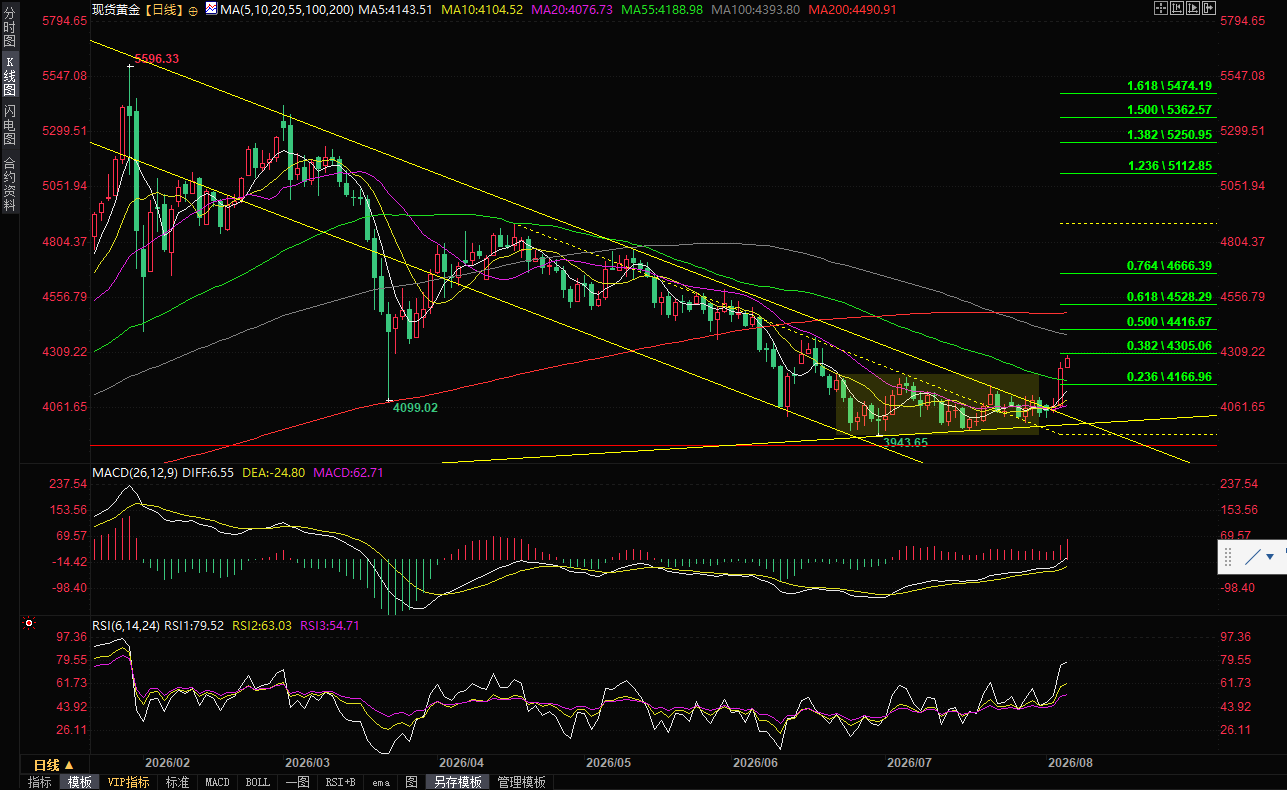 (Spot gold daily chart, source: FX678)
I. Agreement Framework Emerges: Iran's Demand for Control Nears Realization
Diplomatic negotiations over passage rights in the Strait of Hormuz are accelerating. Iranian Foreign Ministry spokesman Esmail Bagae confirmed on August 5 that Iran and Oman have reached an agreement on the geographical coordinates of the proposed route through the Strait of Hormuz, and their joint statement has entered the final review stage. Iranian Deputy Foreign Minister Kazem Gharibabadi stated on the same day that the agreement between Iran and Oman on commercial vessels' passage through the Strait of Hormuz is nearing finalization. According to the consensus reached by both sides, a completely new passage model will be established for the Strait of Hormuz, different from the past 60 years. The southern route through Omani territorial waters and the northern route within Iranian territorial waters will both be closed. The newly established route requires commercial vessels to pass through Iranian territorial waters for part of their journey into and out of the Strait. However, Gharibabadi emphasized that the new route is also temporary and is expected to be usable for two to four months. Two regional officials and a senior Iranian source revealed that the agreement will grant Tehran control over vessels passing through the Strait of Hormuz into the Gulf—one of the largest concessions made to Iran to date. The US news website Axios, citing sources, reported that the interim agreement under discussion sets out a 60-day temporary arrangement to be jointly implemented by Oman and Iran, with the possibility of further extension. Notably, Iran has made it clear that an agreement with Oman alone cannot fully guarantee safe passage through the Strait of Hormuz. Bagae warned that the security of the Strait remains closely linked to the ongoing US blockade and other "aggressive and threatening" actions against Iran. An Iranian Foreign Ministry spokesperson previously emphasized that even if Iran and Oman reach an agreement, the Strait of Hormuz will remain closed if the US does not lift its blockade of Iranian ports and resume compliance with the 14-point memorandum of understanding previously reached between Iran and the US.II. The Toll Dispute: 5%-7% vs 3% vs Zero Toll
As the route arrangements gradually become clearer, the issue of passage fees has become the focus of the bargaining among the parties. According to reports, a senior Iranian official revealed that Iran is seeking to charge ships using the Strait of Hormuz a fee equivalent to 5% to 7% of the cargo value. Oman is discussing a lower rate of about 3%, while Washington insists that no fees should be charged. Analysts point out that nominally setting the fee as "voluntary payment" might help break the deadlock, but under the threat of a possible Iranian attack, most shipping companies may still have to choose to pay in order to ensure safe passage. The US position on this is clear. US President Trump stated clearly at the White House on August 3 that the US will not allow Iran to charge ships passing through the Strait of Hormuz, "If there's going to be a charge, it will be us." A US official familiar with the negotiations also stated that any "temporary" route established through the Strait of Hormuz does not require Iranian approval and will not be charged; the US still hopes to restore the status quo where "neither party controls the route or passage capacity." The controversy surrounding the specific definition of control is also prominent. A regional source said that details still need to be finalized regarding the definition of "control." Gulf negotiators insisted that regional states oversee ship inspections, and that any payments must be voluntary. The aforementioned senior Iranian source stated that the current agreement text envisions Iran controlling ships entering the Gulf via the straits, with one of the main points of contention being the extent of Iranian power over ships traveling in the opposite direction.III. Iran issues stern warning: Energy infrastructure becomes a bargaining chip.
As diplomatic negotiations progress, Iran has issued clear warnings to regional countries through multiple channels. Media reports on August 5, citing five sources, stated that Iran has warned Gulf states that if the United States attacks Iranian territory again, Iran will strike key energy infrastructure throughout the Gulf region, as well as other targets. The sources indicated that this warning was conveyed to Gulf states through intensive high-level diplomatic contacts following US President Trump's July 28 threat to attack Iranian energy networks and infrastructure. Iranian Foreign Minister Abbas Araqchi relayed the warning in communications with officials from Saudi Arabia, Turkey, Qatar, and the Pakistani Army Chief of Staff, while urging US regional allies to lobby President Trump to return to diplomatic negotiations. A Gulf region source stated, "Iran has issued a clear warning: if the United States targets Iranian infrastructure, Iran will retaliate by striking energy facilities and other regional targets in the Gulf region." This warning comes against the backdrop of the US Central Command's continued naval blockade of Iran on August 5. By that day, the US military had forced 48 ships to divert, disabled 2 ships, and boarded 2 ships for inspection in the Strait of Hormuz. Meanwhile, on August 5, the Houthi rebels in Yemen announced a maritime blockade of Saudi ports and ships, and launched missiles at a Saudi oil tanker near the Red Sea port city of Yanbu, as well as another Saudi oil tanker in the Gulf of Aden. This situation further exacerbated shipping risks in the Red Sea, compounding the existing tensions in the Strait of Hormuz.IV. US Position and Negotiation Prospects: A Mix of Optimism and Caution
US President Trump expressed optimism about the prospects of the negotiations. On August 4, in an interview with Fox News, Trump stated that the Strait of Hormuz would be opened "soon," otherwise Iran would suffer a "fierce attack." He claimed that negotiations had lasted "all day" and that "the consultations are progressing very well." However, regional sources and Iranian officials questioned Trump's claims. One Iranian source stated, "The devil is in the details. A single tweet from Trump could shatter the entire agreement." Iranian Deputy Foreign Minister Gharibabadi denied that Iran and the US were negotiating, but stated that Iran had received a message from the US indicating its readiness to resume fulfilling commitments under the previously signed memorandum of understanding. Gharibabadi further stated that Iran had received a message from the US stating that the US was "fully prepared to fulfill" the commitments under the memorandum of understanding reached in mid-June—which stipulated an immediate cessation of military operations. However, he emphasized that this was one of the necessary conditions for reopening the Strait of Hormuz, but not sufficient on its own. Strategically, any arrangement granting Iran control over shipping in the Strait of Hormuz would represent a significant strategic advantage for Tehran. An Associated Press analysis points out that any agreement formally establishing Iranian control of the Strait of Hormuz would mark a major strategic victory for Tehran. The United States has repeatedly stated that it will never accept Iranian control of this vital global energy transport route. International crude oil prices have fallen sharply in recent trading days, hitting a three-week low, due to Trump's decision to cancel a new round of attacks on Iran citing the possibility of ending the conflict through negotiations. On Wednesday, prices fluctuated at low levels. However, given the significant differences among the parties on core issues such as the definition of control, toll rates, and the lifting of the US blockade, the Strait of Hormuz's potential reopening in the short term remains highly uncertain.Editor's Summary
Negotiations on passage rights in the Strait of Hormuz have entered a crucial stage. Iran and Oman have reached a consensus on the geographical coordinates of the shipping lanes, and their joint statement has entered final review, indicating that technical obstacles are being gradually cleared. However, the differences in passage fee rates—a significant gap between Iran's demand for 5%-7%, Oman's proposed 3%, and the US's insistence on zero fees—and the fundamental dispute over the definition of "control" remain the biggest obstacles to the agreement's implementation. Iran is building multi-layered leverage by warning that energy facilities in the Persian Gulf countries could be targeted for retaliation, and the Houthi rebels are simultaneously escalating their blockade of the Red Sea. The Trump administration faces domestic pressure from the midterm elections and public demand to end the war, but the US has very limited room for compromise on the fundamental issue of Iranian control of the Strait. In the coming weeks, the bargaining among various parties regarding passage fee arrangements, the definition of control, and the conditions for lifting the US blockade will determine the ultimate fate of this most important global energy transport route. As the situation in the Middle East shows signs of easing, market expectations for a Fed rate hike in September have fallen from 67% two days ago to 55%. Spot gold surged, briefly touching the $4,300 mark and hitting a seven-week high, initially breaking out of the more than one-and-a-half-month-long consolidation range (3,950-4,200) since June 24. If it can hold above $4,200, gold prices are expected to initiate a medium-term uptrend. However, Federal Reserve Governor Cook stated that she is open to raising short-term interest rates to address inflation. Investors still need to closely monitor changes in the Fed's rate hike expectations. On the data front, the ADP report showed that private sector job growth in the US slowed to 44,000 jobs in July, lower than the revised 95,000 in June. The market is awaiting Friday's non-farm payroll report for further assessment of policy direction. Today's trading session will also see the release of initial jobless claims for the week ending August 1 and the Challenger job cuts for July, which investors should pay close attention to. (Spot gold daily chart, source: FX678)Frequently Asked Questions
Q: If the agreement between Iran and Oman is reached, how will the actual control of the Strait of Hormuz change? A: According to the currently disclosed framework of the agreement, Iran will gain control over ships passing through the Strait of Hormuz into the Persian Gulf. The existing northern route (controlled by Iran) and southern route (controlled by Oman) will both be closed, and the new route will require merchant ships to pass through Iranian territorial waters for most of their journey through the strait. This means that Iran will change from a "coastal state" to a "controller of the waterway," gaining actual management rights over passing ships. However, this arrangement is temporary and is expected to be valid for only 2 to 4 months. Q: What is the concept behind Iran's planned 5% to 7% passage fee? How much impact will it have on global shipping costs? A: The 5% to 7% refers to a percentage of the value of the cargo carried by the ship. The Strait of Hormuz is a vital passageway for global oil, natural gas, and fertilizer transportation, with a huge daily throughput. For example, a supertanker carrying $100 million worth of crude oil would have to pay $5 million in passage fees at a 5% rate. This fee will significantly increase global energy transportation costs and ultimately be passed on to end-consumer prices. Oman's proposed 3% rate is about half of what Iran is demanding, while the US insists on zero charges. Q: Why does the US so strongly oppose Iran charging and controlling the Strait of Hormuz? A: The Strait of Hormuz is the only route for about 30% of the world's seaborne oil and is considered the "world's oil valve." The US has long maintained that the strait, as international waters, should maintain free passage, and neither party should control the waterway or charge fees. The Trump administration believes that allowing Iran to charge and control the strait would set a dangerous precedent, not only giving Tehran enormous geopolitical leverage but also potentially being followed by other coastal states. Furthermore, since the outbreak of war between the US and Iran on February 28, 2026, the US has consistently used the blockade of Iranian ports as a key means of exerting pressure; any arrangement granting Iran control of the strait would weaken this strategic tool. Q: Does the agreement between Iran and Oman mean that the Strait of Hormuz will soon reopen? A: Not necessarily. Iran has clearly stated that the agreement between Iran and Oman alone is insufficient to ensure safe navigation through the strait. An Iranian Foreign Ministry spokesperson emphasized that the reopening of the Strait of Hormuz depends on two preconditions: the US lifting its blockade of Iranian ports and the US resuming its commitments under the previously reached 14-point memorandum of understanding. In other words, Iran considers the Iran-Afghanistan agreement a necessary condition, but not a sufficient one. The US Central Command stated on August 5th that it would continue its maritime blockade of Iran, meaning that even if the Iran-Afghanistan agreement is signed, the possibility of a full reopening of the Strait in the short term remains limited. Q: What does this agreement mean for the global energy market and regional geopolitical landscape? A: From an energy market perspective, the continued closure of the Strait of Hormuz has severely impacted global oil supplies. Any reopening arrangement would alleviate supply concerns, explaining the sharp drop in international oil prices after Trump signaled a willingness to negotiate. From a geopolitical perspective, if the agreement ultimately grants Iran control of the Strait, it will mark a significant shift in the regional power structure towards Tehran since the five months of the US-Iran war. This would be one of the biggest concessions the US has made to Iran, potentially reshaping the entire Gulf region's security architecture. However, Iran's warning that energy facilities in the Persian Gulf countries could be targets of retaliation indicates that even with diplomatic channels open, the shadow of military conflict has not dissipated. Q: Analysis of the Impact of the Strait of Hormuz Standoff on Gold Prices. On August 5th, spot gold surged 4.16% to $4246.79 per ounce, a near two-month high, continuing its upward trend on Thursday, briefly touching the $4300 mark. The traditional transmission path of "Strait blockade → soaring oil prices → rising inflation → interest rate hike expectations → stronger dollar" has consistently suppressed gold prices; now, with signs of easing tensions, falling oil prices, and a weakening dollar, the logic has reversed, pushing up gold prices. However, with the details of the agreement still undecided, the passage fee dispute unresolved, and Iran warning that it would target energy facilities if the US attacks again, the sustainability of the short-term rise in gold prices remains uncertain. As of 09:55 Beijing time, spot gold is currently trading at $4288.85 per ounce.- Risk Warning and Disclaimer
- The market involves risk, and trading may not be suitable for all investors. This article is for reference only and does not constitute personal investment advice, nor does it take into account certain users’ specific investment objectives, financial situation, or other needs. Any investment decisions made based on this information are at your own risk.