Iran's "toll-charging dream" and Trump's "opening order" leave crude oil bulls and bears awaiting the final verdict.
2026-08-06 15:12:52
Brent crude oil futures traded in a narrow range at low levels during the Asian session on Thursday (August 6), currently hovering around $79.50 per barrel. Oil prices found some support at current levels, with the gap between market optimism regarding the reopening of the Strait of Hormuz and actual progress, coupled with the continued divergence between the positions of Iran and the United States, causing oil prices to fluctuate between "diplomatic optimism" and "realistic obstacles." 
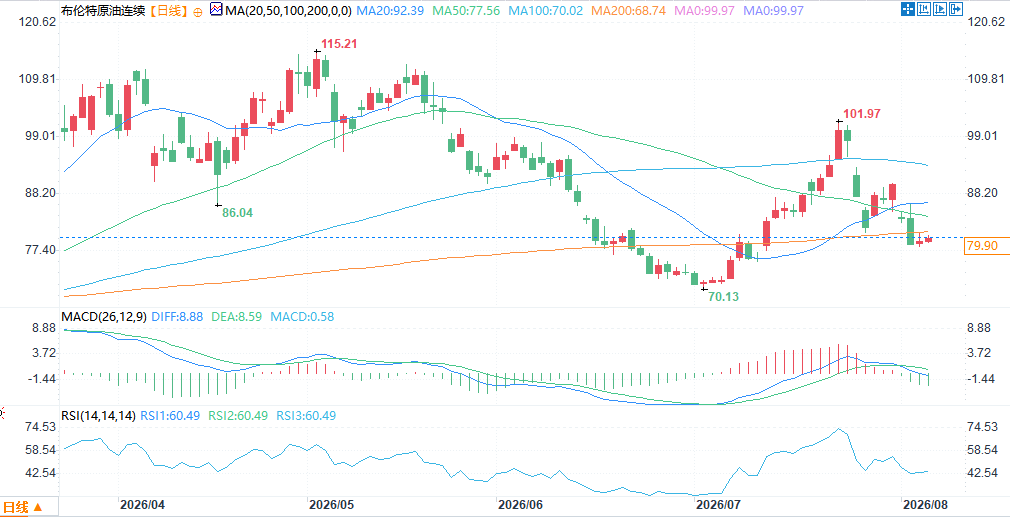 (Brent crude oil futures daily chart, source: FX678) At 15:07 Beijing time on August 6, Brent crude oil futures were trading at $79.54 per barrel.
Expectations for the reopening of Hormuz are rising.
Oil prices found some respite after the earlier sell-off, but downward pressure has not completely dissipated. Market expectations of an imminent reopening of the Strait of Hormuz continue to weigh on prices. However, a contrast between Iranian Foreign Ministry spokesman Bagaei's statement that Iran and Oman are close to finalizing a navigation management framework and Trump's optimistic pronouncements of an "immediate, full, and complete reopening" has caused oil prices to fluctuate between "diplomatic optimism" and "realistic obstacles." According to senior Gulf officials, there is a 50% chance of an agreement being reached before Friday, and this uncertainty itself is providing some support for oil prices. The bulls and bears are currently at a balance around $74, awaiting the finalization or failure of an agreement.Agreement Framework and Disagreements: Iran Seeks Fee Mechanism, US Opposes
Iran is reportedly pushing for a joint toll collection mechanism in the Strait of Hormuz. Financial markets will be closely watching the reactions of leaders of relevant countries—especially those that have consistently supported freedom of navigation in the strait. The United States has repeatedly condemned Iran's attempts to gain recognition of its jurisdiction in the vicinity of the strait. If the agreement ultimately grants Iran control or the right to collect tolls on passing vessels, it would mean that Iran has gained partial jurisdiction over the world's most important energy transport route without direct military conflict. This would be a significant strategic achievement for Iran in this conflict and a major concession by the United States on this issue. However, the US has repeatedly stated that it will not accept Iranian control of the waterway, and there is a clear tension between Trump's latest statement and the previous positions of officials.The market awaits global response and details of the agreement.
The market is currently closely watching stakeholders' reactions to a potential Hormuz agreement. Any formal announcement could influence the short-term direction of oil prices. If the agreement is widely accepted, oil prices may face further downward pressure; if relevant countries raise objections or conditions, it could provide short-term support. Furthermore, the specific details of the agreement—including the pricing mechanism, the division of control, and the implementation timeline—will be key factors in market pricing.Institutional Views
In its latest report, Goldman Sachs stated that Brent crude oil is expected to fluctuate around $80 per barrel until a clear nuclear agreement is reached between the US and Iran or the conflict escalates significantly. Goldman Sachs estimates the fair value of spot crude at approximately $80, meaning the market is only pricing in a modest risk premium. Global visible inventories have been declining at a rate of 6.3 million barrels per day over the past two weeks, with Gulf exports recovering to only 36% of pre-war levels. Goldman Sachs stated that if severe disruptions continue in the Strait of Hormuz, prices could rise sharply; however, if supply normalizes rapidly, there are downside risks. Bank of America projects Brent's average price to be around $77.50 in 2026, falling to around $65 in 2027. Bank of America believes that the Middle East supply disruptions will gradually dissipate, and the pre-war surplus situation will re-emerge, thus exerting sustained downward pressure on prices. As Gulf production recovers and global inventories accumulate, the oil market will shift from a tight balance to a significant surplus.Summarize
Market expectations for the imminent reopening of the Strait of Hormuz continue to rise. Iran and Oman are close to finalizing a navigation management framework, with Iran pushing for a joint toll mechanism, but the US has repeatedly and explicitly opposed Iranian control of the waterway. Senior Gulf officials stated there is a 50% chance of an agreement by Friday, creating tension between Trump's optimistic statements and the officials' previous stance. The market is closely watching the Middle East situation, and any related announcements could influence the short-term direction of oil prices. If the agreement is widely accepted, oil prices may seek further downward support; if resistance or constraints are encountered, it could provide short-term upward momentum. Against the backdrop of fluctuating geopolitical signals, the high volatility of oil prices is expected to continue, and the actual content of the Hormuz agreement and global reactions will be key variables determining the next direction of oil prices. (Brent crude oil futures daily chart, source: FX678) At 15:07 Beijing time on August 6, Brent crude oil futures were trading at $79.54 per barrel.
- Risk Warning and Disclaimer
- The market involves risk, and trading may not be suitable for all investors. This article is for reference only and does not constitute personal investment advice, nor does it take into account certain users’ specific investment objectives, financial situation, or other needs. Any investment decisions made based on this information are at your own risk.