Australian Dollar/US Dollar Trading Signal: Moderately Bullish, but a Reversal Cannot Be Ruled Out Before Non-Farm Payroll Data Release
2026-08-06 18:00:52
On Thursday (August 6), during the European session, the Australian dollar retreated slightly against the US dollar after rising to 0.7064 on Wednesday. It traded at 0.7039 during the session, showing a slight decline.  US Non-Farm Payrolls and RBA Decision The prospect of reopening the Strait of Hormuz has driven the Australian dollar significantly higher than the US dollar. This week, ongoing negotiations between Iran and Oman have fueled market expectations for the resumption of navigation through the Strait, leading to a decline in international oil prices. The next few days will be a crucial window for this currency pair. Later today, the US will release its latest initial and continuing jobless claims. Economists expect initial jobless claims to rise to 203,000 last week, compared to 197,000 the previous week. The Challenger Institute for the Workforce will also release data on US corporate layoffs last month. The upcoming non-farm payrolls report (NFP) this Friday will be the next major catalyst driving the currency pair's movement. Economists expect the US to add 80,000 jobs in July, compared to 57,000 the previous month. However, historical experience shows that actual non-farm payroll data often falls short of market expectations. Data released on Wednesday showed that the US private sector added only 44,000 jobs in July, far below analysts' expectations. Meanwhile, the Australian dollar's performance will also be influenced by the Reserve Bank of Australia's (RBA) interest rate decision next week. Market economists are divided: some believe the Reserve Bank of Australia (RBA) will raise interest rates to 4.60%, marking the fourth consecutive month of rate hikes. Other analysts predict the RBA will maintain current rates but retain policy space for further rate increases later this year. Core inflation and short-term inflation expectations both declined in the second quarter, and labor market conditions have eased. The drop in oil prices in June partially explains the rebound in consumer confidence, while household spending also increased, particularly on air travel and entertainment. In July, the services PMI rose to its highest level in six months, driven by increased new orders and a return of product price inflation to April/May levels. Standard Chartered analysts noted that Governor Block's recent remarks indicated an unfavorable start to the economy due to excessive demand and a positive output gap, necessitating caution. It should be noted that economic growth appears to be slowing: unemployment rose in June, and labor market conditions deteriorated. However, a stable number of job vacancies and strong employment growth still suggest some tightness in the labor market. Short-term inflation expectations fell below pre-war levels in July, but this figure may still be too high for the Reserve Bank of Australia. (Technical Analysis )
 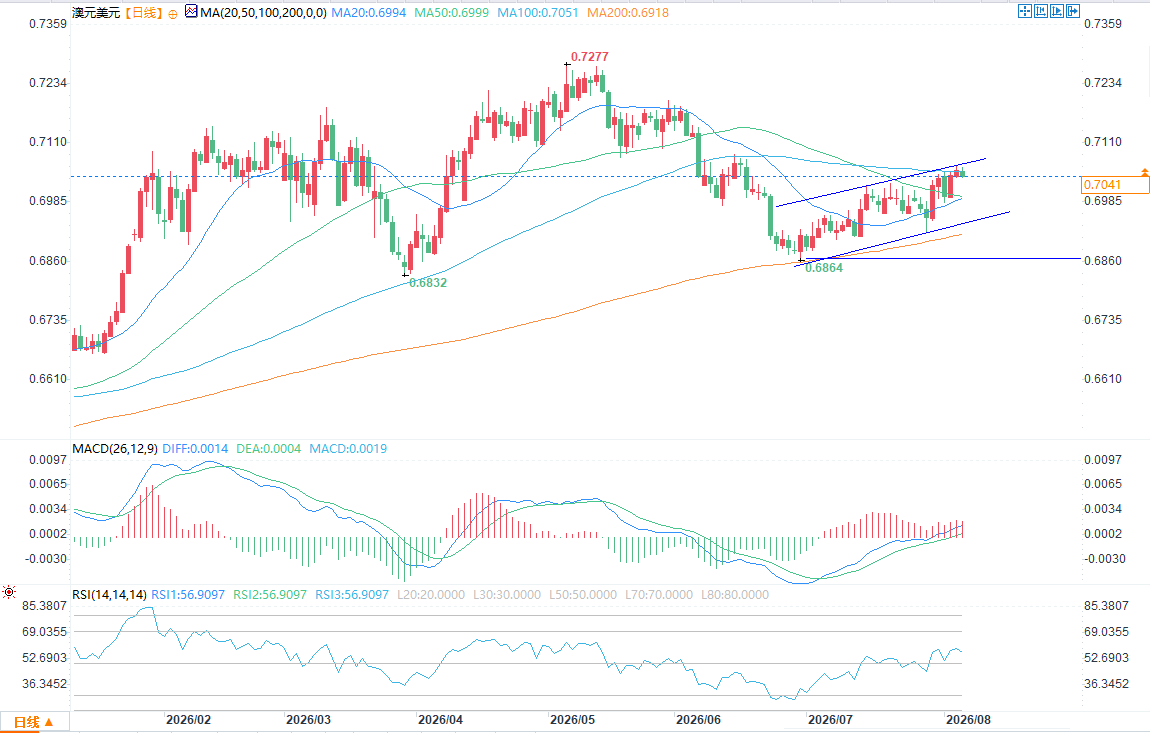 (AUD/USD Daily Chart Source: EasyForex) The daily chart shows that the Australian dollar has been rising strongly against the US dollar in recent weeks, reaching 0.7064, its highest level since June 17. The pair has now risen above the 50-day moving average and is testing the 100-day moving average at 0.7051. The pair is retesting the upper edge of the ascending channel, which is a bearish flag pattern formed over the past few months. The Relative Strength Index (RSI) has risen above 50, the key level for bulls and bears. Therefore, the pair is likely to continue its slight upward movement until it enters overbought territory; subsequently, a pullback is possible, possibly before or after the Reserve Bank of Australia's (RBA) policy decision next week. Bullish Strategy Enter a long position in AUD/USD, with a take-profit target of 0.7150 and a stop-loss at 0.6923. Trading duration: 1-2 trading days. Bearish Strategy Enter a short position in AUD/USD, with a take-profit target of 0.6923 and a stop-loss at 0.7150.
US Non-Farm Payrolls and RBA Decision The prospect of reopening the Strait of Hormuz has driven the Australian dollar significantly higher than the US dollar. This week, ongoing negotiations between Iran and Oman have fueled market expectations for the resumption of navigation through the Strait, leading to a decline in international oil prices. The next few days will be a crucial window for this currency pair. Later today, the US will release its latest initial and continuing jobless claims. Economists expect initial jobless claims to rise to 203,000 last week, compared to 197,000 the previous week. The Challenger Institute for the Workforce will also release data on US corporate layoffs last month. The upcoming non-farm payrolls report (NFP) this Friday will be the next major catalyst driving the currency pair's movement. Economists expect the US to add 80,000 jobs in July, compared to 57,000 the previous month. However, historical experience shows that actual non-farm payroll data often falls short of market expectations. Data released on Wednesday showed that the US private sector added only 44,000 jobs in July, far below analysts' expectations. Meanwhile, the Australian dollar's performance will also be influenced by the Reserve Bank of Australia's (RBA) interest rate decision next week. Market economists are divided: some believe the Reserve Bank of Australia (RBA) will raise interest rates to 4.60%, marking the fourth consecutive month of rate hikes. Other analysts predict the RBA will maintain current rates but retain policy space for further rate increases later this year. Core inflation and short-term inflation expectations both declined in the second quarter, and labor market conditions have eased. The drop in oil prices in June partially explains the rebound in consumer confidence, while household spending also increased, particularly on air travel and entertainment. In July, the services PMI rose to its highest level in six months, driven by increased new orders and a return of product price inflation to April/May levels. Standard Chartered analysts noted that Governor Block's recent remarks indicated an unfavorable start to the economy due to excessive demand and a positive output gap, necessitating caution. It should be noted that economic growth appears to be slowing: unemployment rose in June, and labor market conditions deteriorated. However, a stable number of job vacancies and strong employment growth still suggest some tightness in the labor market. Short-term inflation expectations fell below pre-war levels in July, but this figure may still be too high for the Reserve Bank of Australia. (Technical Analysis ) (AUD/USD Daily Chart Source: EasyForex) The daily chart shows that the Australian dollar has been rising strongly against the US dollar in recent weeks, reaching 0.7064, its highest level since June 17. The pair has now risen above the 50-day moving average and is testing the 100-day moving average at 0.7051. The pair is retesting the upper edge of the ascending channel, which is a bearish flag pattern formed over the past few months. The Relative Strength Index (RSI) has risen above 50, the key level for bulls and bears. Therefore, the pair is likely to continue its slight upward movement until it enters overbought territory; subsequently, a pullback is possible, possibly before or after the Reserve Bank of Australia's (RBA) policy decision next week. Bullish Strategy Enter a long position in AUD/USD, with a take-profit target of 0.7150 and a stop-loss at 0.6923. Trading duration: 1-2 trading days. Bearish Strategy Enter a short position in AUD/USD, with a take-profit target of 0.6923 and a stop-loss at 0.7150.
- Risk Warning and Disclaimer
- The market involves risk, and trading may not be suitable for all investors. This article is for reference only and does not constitute personal investment advice, nor does it take into account certain users’ specific investment objectives, financial situation, or other needs. Any investment decisions made based on this information are at your own risk.