Middle East supply supports tight US oil product balance, oil price fundamentals in a tug-of-war
2026-08-06 18:20:52
On Thursday (August 6), during the European and American trading sessions, international oil prices continued to fluctuate at recent lows, with WTI crude oil currently trading at $75.17. When prices rise, focus on the trend; when prices fall, focus on the fundamentals. The overall fundamentals of crude oil are as follows: The ongoing geopolitical tensions in the Middle East continue to disrupt the global energy supply chain. Shipping risks in the Strait of Hormuz are high, and regional shipping is hampered. However, the UAE, through its diversified transportation strategy, has defied the trend and stabilized its crude oil exports, providing a crucial supply buffer for the global oil market. Coupled with record-high US diesel exports and continuously declining domestic inventories, the new supply and demand dynamics are reshaping the logic of global oil product trading, becoming the core driver of recent oil price fluctuations and structural market trends. 
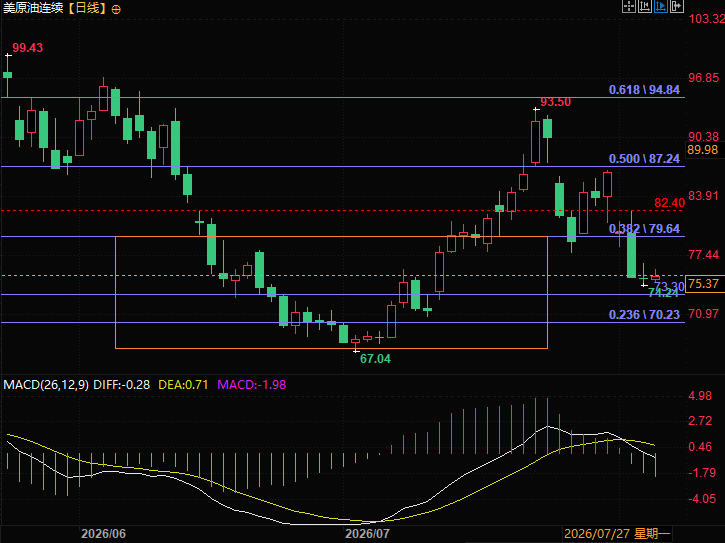 (WTI crude oil futures daily chart, source: EasyForex) At 18:14 Beijing time, WTI crude oil futures were trading at $75.61.
Middle East supply resilience is evident: UAE bucks the trend and supports global crude oil supply.
The ongoing US-Iran standoff has kept the risk of attacks on ships in the Strait of Hormuz high, restricting seaborne exports for most Middle Eastern oil-producing countries. Against this backdrop, the UAE has become a core pillar of resilience in the regional supply chain, leading all global oil-producing economies in crude oil exports over the past two months. This has effectively offset pessimistic market expectations of energy supply shortages, providing a valuable buffer for the global energy market, which is mired in a structural crisis. To mitigate geopolitical risks in the Strait, Abu Dhabi National Oil Company (ADNOC) has adopted a special export strategy, extensively using "black ship" operations (ships operating under the guise of automated identification systems) to conduct cross-border transportation. Because such covert operations are difficult to fully track in maritime databases, the industry generally believes that the actual scale of UAE crude oil exports is significantly higher than publicly available monitoring data. According to anonymous traders, since June, ADNOC has completed seven large-scale crude oil tenders, selling over 130 million barrels of crude oil. This volume is roughly equivalent to the monthly total demand of Japan, Asia's third-largest crude oil consumer, demonstrating a significant support for supply. Thanks to its flexible transportation strategy, the UAE became the only oil-producing country in the Middle East to restore its seaborne crude oil exports to pre-war levels in June and July, with its exports mainly flowing to core Asian refineries in China and Japan. Its core transportation plan includes multiple alternative channels, including high-risk shuttle shipping, transshipment via the Gulf of Oman, and utilizing its nationwide pipeline network to bypass the Strait of Hormuz, minimizing the risk of disruptions caused by geopolitical conflicts. In contrast, while neighboring oil-producing countries like Iraq and Kuwait have sporadic transshipment operations, their volume is limited and insufficient to effectively supplement supply. Thanks to the UAE's strong support, the global crude oil supply shortage has eased, effectively suppressing the momentum for a sharp rise in oil prices. At the same time, the UAE's energy exports have diversified, with liquefied natural gas (LNG) exports also remaining smooth, continuously supplying a stable source of energy to the global market. Leveraging its dominant market position, the UAE has continued to increase its influence in crude oil pricing. Last month, during the decline in international oil prices, Abu Dhabi National Oil Company directly demanded that its counterparties offering low prices raise their bids, thus solidifying the regional crude oil pricing benchmark. However, it has not yet pushed forward the implementation of its Murban crude oil futures benchmark contract.Regional landscape uncertainties: Uncertainty surrounding air routes increases UAE's export dependence
It is worth noting that the regional supply pattern remains uncertain. The ongoing protracted negotiations between the US and Iran, coupled with the lack of a navigation agreement in the Strait of Hormuz, mean that even if a temporary navigation agreement is reached, the current special transshipment model will continue. Meanwhile, Saudi Arabia's traditional alternative export routes remain under pressure. Its pipeline export route, relying on the Red Sea port of Yanbu, has recently been frequently harassed by Houthi rebels, significantly reducing the stability of the route. This may force global refineries to further increase their reliance on UAE crude oil, continuously reshaping the Middle East's crude oil export landscape.US diesel exports surge to record high, depleting domestic reserves.
Besides the supply-side changes in the Middle East, US oil export data has once again surprised the market, becoming a significant variable in global energy supply and demand. Driven by the global oil shortage triggered by the Middle East energy crisis, US diesel exports hit a record high last week, averaging over 1.8 million barrels per day, breaking the previous record set this spring. From a supply and demand perspective, the US diesel market is now in a tight balance of "high exports, low production, and low inventory." Data from the US Energy Information Administration shows that while US diesel exports have surged, domestic diesel production and inventory have declined simultaneously. Current diesel inventory is 12% lower than the five-year average, placing it in a historically low range. Bloomberg data further adds that this export boom is not a short-term impulse; US diesel exports had been consistently maintained at a high level of 1.5 million barrels per day for the previous five weeks, with continuous massive exports consuming domestic inventory. Current US diesel inventory has fallen to its lowest level since 1996. The primary destination for US diesel exports is the European market. Europe is continuously impacted by energy transition policies, leading to a sustained contraction in domestic refining capacity. Coupled with slower-than-expected progress in electrification of transportation across the region, the regional fuel supply-demand gap continues to widen, making it highly reliant on US diesel imports to fill the gap. Continued exports have depleted US domestic oil reserves, and with the approaching winter heating season in the Northern Hemisphere, market supply and demand risks are accumulating further. Diesel is a core feedstock for heating oil, and increased global heating demand in winter means that the already tight diesel supply and demand situation will further tighten.Forecast of future risks: The maintenance season combined with a recovery in demand will continue to support oil prices through premium pricing.
More importantly, August to October is the traditional maintenance season for US refineries. The concentrated maintenance of refinery equipment will further suppress oil product output. Under the quadruple pressure of shrinking production, low inventories, rising demand, and high export growth, US diesel and related oil product prices are more likely to rise than fall. Although refineries are currently operating at overcapacity, which can temporarily postpone maintenance schedules, long-term maintenance demand cannot be avoided. The certainty of subsequent oil product supply contraction is strong, which will continue to support global oil product premiums and provide a bottom support for the overall crude oil market.Summary and Technical Analysis:
Overall, the current core logic of global crude oil trading exhibits a dual characteristic: In the short term, the UAE's counter-trend support for Middle Eastern supply alleviates market expectations of extreme shortages, suppressing significant upward potential in oil prices; in the medium to long term, unresolved geopolitical risks in the Middle East, historically low US oil product inventories coupled with supply contraction during the maintenance season, and a steady recovery in global demand, combined with these multiple factors, make it difficult to reverse the tight supply-demand balance in the global oil market. Oil prices are expected to maintain a generally volatile but upward trend, with structural upside risks continuing to accumulate. Technically, WTI oil prices have adjusted to near the 50% retracement level of the previous trading range, finding strong support. Furthermore, the recent lack of a significant rebound indicates insufficient buying power, suggesting potential for further lows. This also implies a significant clearing of speculative funds, meaning that subsequent major news events will amplify volatility due to a rapid increase in the number of participants. (WTI crude oil futures daily chart, source: EasyForex) At 18:14 Beijing time, WTI crude oil futures were trading at $75.61.
- Risk Warning and Disclaimer
- The market involves risk, and trading may not be suitable for all investors. This article is for reference only and does not constitute personal investment advice, nor does it take into account certain users’ specific investment objectives, financial situation, or other needs. Any investment decisions made based on this information are at your own risk.