Oil price rebound couldn't stop gold's strong performance; gold rose 6% in a single week, boosted by both geopolitical tensions and easing interest rates.
2026-08-07 16:34:56
On Friday (August 7th) during the Asian and European sessions, spot gold continued its high-level fluctuations, currently up 1.21% and trading around 4291. Recent positive news has been limited, and oil prices have also rebounded sharply, but this has not limited gold's upward momentum. US President Trump stated that he believes the war with Iran will "end soon," but the two sides have not agreed on any terms for negotiation, and only a few ships are still passing through the Strait of Hormuz. The market witnessed a brief agreement earlier this year, so confidence in a new agreement fully restoring normal shipping is weak. Under these circumstances, the strength of gold prices may be more attributable to bets on a weaker non-farm payrolls report tonight, bargain hunting after a sharp drop, and increased buying interest from the recent recovery in global market risk appetite. More than five months ago, Trump, in conjunction with Israel, launched military action against Iran, and the conflict continues to this day. The control and navigation of the Strait of Hormuz is the core contradiction in the US-Iran rivalry. This crucial waterway, carrying about 20% of global oil transportation, is not only a choke point in the global energy supply chain but also a focal point of the power struggle between the two sides. If Trump wants to reach a settlement agreement and resume regular cross-strait shipping, he must make compromises that go against his tough style, which means a very high political cost for him, given his binary approach to governance based on winning and losing. 
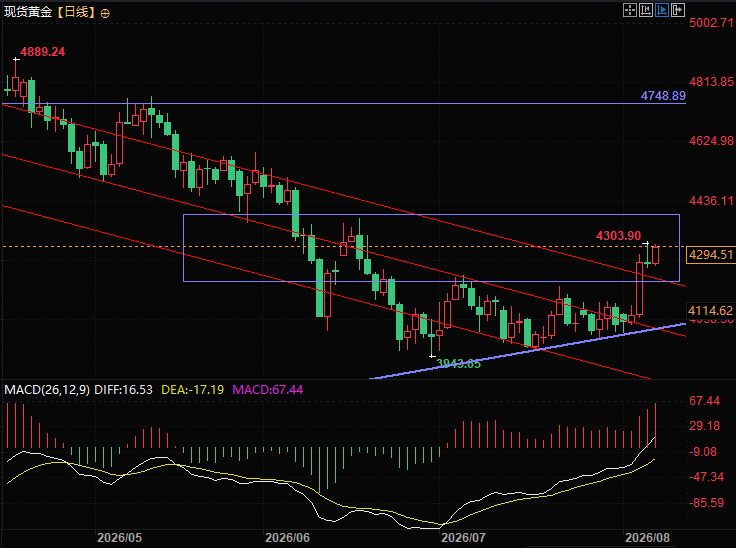 (Spot gold daily chart, source: EasyTrade) At 16:27 Beijing time, spot gold is currently trading at $4295 per ounce.
US-Iran negotiations stalled: core differences remain unresolved, Trump caught in a compromise dilemma.
Both the US and Iran have signaled that an agreement is nearing implementation, but fundamental differences remain regarding core demands, making it difficult to break the deadlock in negotiations. Iran insists on retaining partial control over the Strait of Hormuz, explicitly stating that the strait cannot be restored to its pre-war state of complete freedom of international navigation, and also demands passage fees. Conversely, the Trump administration has consistently and firmly rejected any proposals that could strengthen Iran's influence in the Persian Gulf waterways, resolutely resisting any passage fee clauses. The current proposed temporary navigation framework involves a differentiated passage model: ships enter the Persian Gulf via Iranian-controlled channels and exit via Oman-controlled channels, with the US explicitly stating that no passage fees or navigational obstacles will be imposed on the temporary channels. US officials revealed that diplomatic mediation is Trump's priority, and the US believes it holds all the initiative in the Iran game, but actual progress in negotiations remains fraught with obstacles.Cross-strait shipping remains sluggish, and shipping risks have not been completely eliminated.
Despite thousands of military strikes launched by the US against Iran, Iran retains its harassment capabilities, including drones, missiles, and mines, continuing to control the vital commercial shipping route through the Strait of Hormuz. This has resulted in persistently low traffic volume in the Strait of Hormuz, jeopardizing the stability of energy transport. Traffic data shows a fluctuating and sluggish trend: while the number of vessels passing through the strait had previously rebounded from 45 to 84 per week, it remains significantly lower than the pre-crisis weekly volume of over 700 vessels. This week, the market's continued focus on the progress of talks between Iran and Oman further suppressed traffic activity, with the number of vessels passing through the strait from Monday to Thursday dropping to 33, a sharp decline from 50 vessels in the same period last week. Specifically, only four vessels passed through the strait on Thursday, including the VLCC "Nisos Kia" carrying 2 million barrels of Iraqi Basra crude oil. The other three vessels were two liquefied petroleum gas carriers and one small bulk carrier, indicating a simple traffic structure and extremely low trading activity. Meanwhile, shipping risks have not been eliminated. In the past week, at least two ships in the strait were attacked and damaged, and many ships were attacked at close range or received warnings from the Iranian Revolutionary Guard. The strait, which the US claims is "barely open," has never been able to achieve safe and stable navigation.The pressure on the United States, both domestically and internationally, has laid the groundwork for a de-escalation of the situation.
The protracted war in Iraq has plunged the United States into a predicament of multiple internal and external pressures. Militarily, the US military is facing a significant supply shortage of advanced anti-missile interceptor munitions used to defend against Iranian attacks and protect its troops stationed abroad, leading to a continuous decline in its main weapons inventory. While Trump has publicly acknowledged that some ammunition reserves are "slightly strained," he has consistently refused to acknowledge the inventory crisis caused by the war, even threatening to hold those responsible for leaking weapons inventory data accountable. Currently, the US Department of Defense is actively lobbying Congress to secure billions of dollars in additional military spending to compensate for the losses incurred during the war. Domestically, anti-war sentiment continues to grow. A poll conducted by the Associated Press-NORC Center for Public Affairs Research in late July showed that approximately two-thirds of American adults believe the war in Iraq is not worthwhile, covering the vast majority of Democratic and independent voters, as well as 37% of Republican supporters. The ongoing war is driving up gasoline prices and dragging down the economy, and will also negatively impact the Republican Party's chances in the November midterm elections. Several former government officials analyze that the accumulating economic and political pressures may force Trump to make concessions on the Strait of Hormuz issue. The market also picked up on signs of easing tensions, with Trump publicly stating that he believed the US-Iran war would likely end soon, laying the foundation for de-escalating geopolitical tensions in the Middle East and a decline in risk sentiment.The easing of geopolitical tensions in the Middle East has spurred a strong rebound in gold prices.
The anticipated easing of tensions between the US and Iran has completely reversed the trading logic of the commodities and precious metals markets, becoming the core driving force behind the recent surge in gold prices. As tensions in the Middle East ease and global inflation expectations continue to decline, international crude oil is likely to close lower this week. Lower energy prices further weaken high inflationary pressures, and market pricing in the Federal Reserve's prolonged high interest rates continues to cool. As a non-interest-bearing inflation hedge, gold's price movement is highly correlated with interest rate expectations: a high-interest-rate environment significantly reduces the attractiveness of gold as an investment, while the current easing of inflation and high-interest-rate expectations has directly broken the previous consolidation pattern of gold prices. StoneX senior analyst Matt Simpson pointed out that thanks to the signs of easing geopolitical tensions in the Middle East, gold successfully broke out of its weeks-long sideways consolidation range above $4,000, initiating a trend-driven rally. This week, spot gold saw a cumulative increase of 6%, marking its best weekly performance since January, with prices breaking through $4,285 per ounce, a new seven-week high. Looking at the market outlook, the market is currently pricing in a 55% probability of a Fed rate hike on September 16th. The upcoming US July non-farm payroll data may cause short-term market noise, but it's unlikely to change the overall bullish trend for gold. OCBC analysts point out that short-term momentum has improved, but the upcoming employment data will be crucial in testing yields, the dollar's performance, and whether the gold price breakout can be sustained. Industry analysts emphasize that the $4,000 level has formed solid support, and bulls are waiting for a technical pullback to test the $4,600 target price. Meanwhile, Marex is also optimistic about gold's performance in August, believing that the price fluctuation range will widen further. Coupled with the continued easing of tensions in US-Iran negotiations and the reopening of the Taiwan Strait, this round of gold's rebound has ample momentum for continuation. Technically, spot gold has broken through the upper rail of the descending channel and the upper edge of the trading range, with the current measured increase around 4394. Support is at the lower edge of the trading range and around 4150. (Spot gold daily chart, source: EasyTrade) At 16:27 Beijing time, spot gold is currently trading at $4295 per ounce.
- Risk Warning and Disclaimer
- The market involves risk, and trading may not be suitable for all investors. This article is for reference only and does not constitute personal investment advice, nor does it take into account certain users’ specific investment objectives, financial situation, or other needs. Any investment decisions made based on this information are at your own risk.