After six consecutive weeks of gains, can the Australian dollar break through 0.7100 against the US dollar? Two major events this week will determine the outcome.
2026-08-10 08:52:53
The Australian dollar edged higher against the US dollar in early Asian trading on Monday (August 10), currently trading around 0.7065, extending its six-week winning streak. However, this rebound is about to face a major test from the Reserve Bank of Australia (RBA) and US inflation data. Since second-quarter inflation data came in below expectations, the market has largely ruled out the possibility of a near-term interest rate hike by the RBA, making the US dollar's performance and US economic data increasingly crucial to the Australian dollar's exchange rate. 
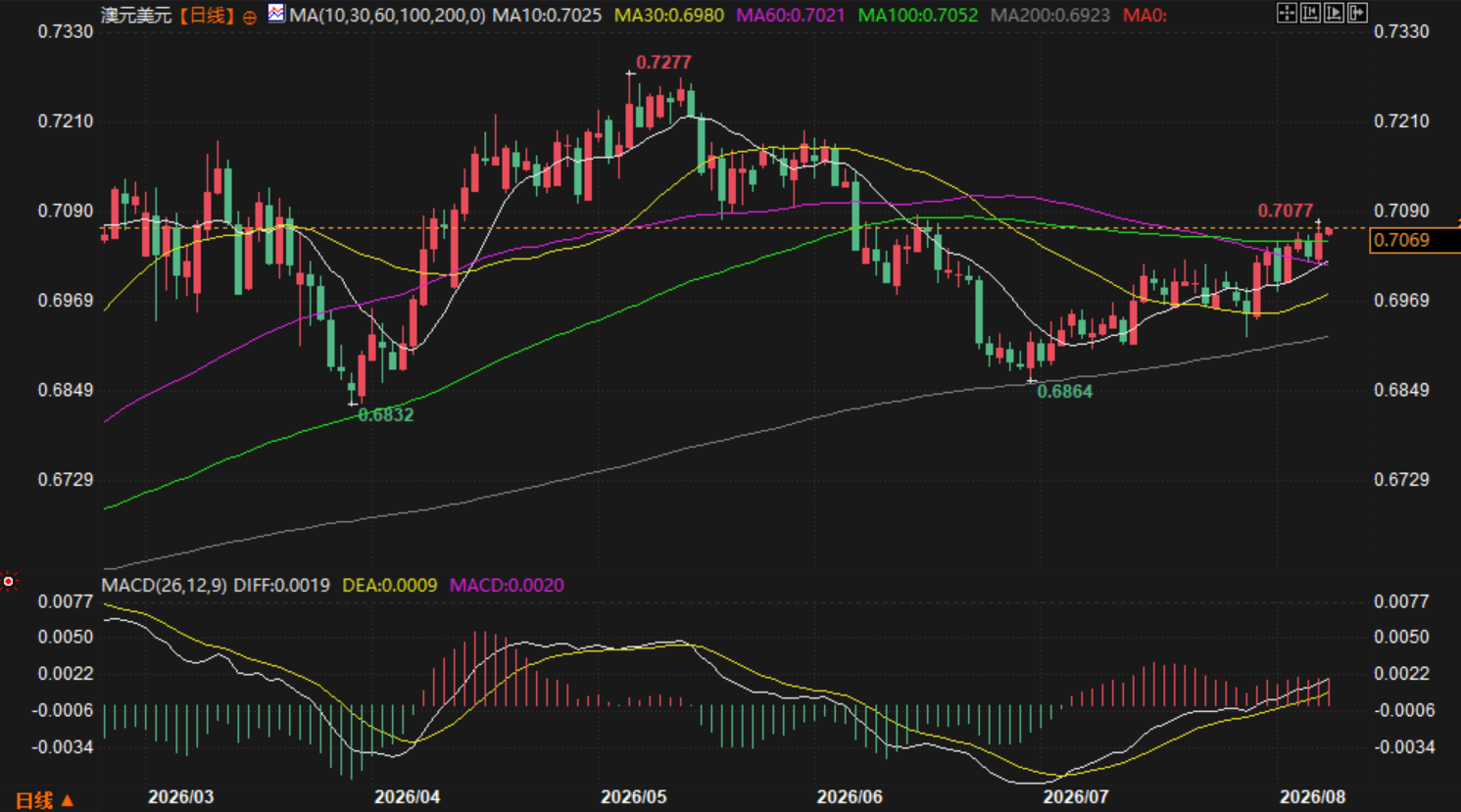 (Australian dollar against US dollar daily chart, source: EasyForex) At 8:50 AM Beijing time on August 10, the Australian dollar was trading at 0.7064/65 against the US dollar.
US job growth is slowing, and the labor market is showing signs of weakness.
The weak non-farm payrolls report released last Friday further dampened market expectations for a September rate hike by the Federal Reserve. Data showed that non-farm payrolls decreased by 23,000, the first negative growth in six months, far below the expected increase of 85,000. The June figure was revised down to 20,000 from the initial 57,000. Private sector employment increased by only 30,000, missing the expected 78,000, with the June figure revised down significantly from 48,000 to 33,000. The healthcare and social welfare sectors, which have contributed about 80% of total job growth over the past 18 months, added only 22,000, while the government sector lost 53,000 and retail trade declined by 19,400. Although the unemployment rate fell slightly to 4.1%, the market's focus was clearly on the lack of job growth. Federal funds rate futures indicate that the market currently expects a 57% probability of keeping rates unchanged in September, compared to a 54% probability of a 25 basis point rate hike before the non-farm payrolls data release. The probability of a rate hike in October is currently 47%. The US dollar index weakened across the board on Friday, performing the worst among major currencies, forming a bearish engulfing pattern on the daily chart and closing at its lowest level in nearly two months. Gold, on the other hand, surged, hitting a seven-week high and marking its best weekly performance in 28 weeks.Australian Economic Data and Events Outlook for This Week
Two weeks ago, the second-quarter CPI data came in below expectations, and the market had largely ruled out the possibility of a rate hike by the Reserve Bank of Australia (RBA) this week. However, the overnight index swap (OIS) curve still showed an 89% probability of a 25 basis point rate hike within the next year. Therefore, the RBA's tone will significantly influence this rate hike expectation, but the market generally believes that a rate hike in the near term is unlikely. Inflation remains above the RBA's comfort zone and above its target band, which should force the RBA to maintain a hawkish stance in tomorrow's decision. However, unless the Middle East peace process takes another turn leading to a surge in oil prices, the RBA's 4.35% cash rate may have already peaked. That said, the RBA is unlikely to deliberately suppress the Australian dollar with dovish rhetoric. Therefore, the direction of the Australian dollar's movement is more likely to be driven by a weaker US dollar than by rising expectations of a hawkish RBA stance. This means the Australian dollar is likely to experience a slow climb rather than a sharp surge.US inflation data may become a key indicator.
With the latest non-farm payroll data falling short of expectations, traders will be highly vigilant for any signs of weakness in upcoming US economic data. Core CPI is undoubtedly the most crucial factor, especially given that ISM services prices have retreated from their highs and crude oil prices are below their potential levels. Even a mildly weak inflation report could completely dispel market expectations of another Fed rate hike, pushing the dollar lower and boosting risk appetite, thereby driving the Australian dollar higher against the US dollar. Subsequently, market focus will shift to the Producer Price Index (PPI) and retail sales data, and any signs of weakness could further strengthen short positions in the US dollar. Therefore, this week's US inflation data may be key to determining the direction of the Australian dollar. An unexpected rise in CPI could disrupt market expectations and help the US dollar recover lost ground.Australian Dollar Performance: Uneven Gains, Limited Momentum
The Australian dollar has performed relatively strongly this month, but its movements have been uneven – potentially foreshadowing a divergent pattern in future performance. Cleaner, more explosive moves often occur during periods of heightened risk aversion, risk rallies, or increased divergence in central bank policies, conditions that are currently absent. Therefore, unless a new catalyst emerges, the Australian dollar's volatility is likely to be relatively limited. The best opportunity for a rebound in the Australian dollar against the US dollar may still lie in continued weaker-than-expected US data.Changes in positions: Long positions increased
Large speculators increased their net long positions in the Australian dollar by 66,000 contracts last week, the largest weekly increase in three months. Net short positions decreased slightly, indicating a slow shift in market dynamics behind the Australian dollar's rebound. Total open interest rose in tandem with prices, reflecting increasing overall demand for the Australian dollar from futures traders. Therefore, despite the Australian dollar's six-week winning streak against the US dollar, it still has room to rise further as long as the US dollar remains under pressure. While six consecutive weeks of gains are extreme, the magnitude of this rebound is not excessive. Given the strong negative correlation between the Australian dollar and the US dollar, the US dollar continues to dominate the direction.Summarize
In summary, the Australian dollar is at a critical juncture, where technical and fundamental factors converge. Six consecutive weeks of gains have provided strong short-term momentum for the Australian dollar, but whether it can break through further depends largely on two key variables this week: the Reserve Bank of Australia's (RBA) policy rhetoric and US inflation data. The RBA is likely to keep interest rates unchanged but maintain hawkish rhetoric, limiting its direct boost to the Australian dollar. The real directional guidance is more likely to come from the US CPI – if the data is weak, the US dollar will be under pressure, and the Australian dollar could challenge above 71 US cents; if the data is strong, the Australian dollar's rebound may come to a temporary halt. (Australian dollar against US dollar daily chart, source: EasyForex) At 8:50 AM Beijing time on August 10, the Australian dollar was trading at 0.7064/65 against the US dollar.
- Risk Warning and Disclaimer
- The market involves risk, and trading may not be suitable for all investors. This article is for reference only and does not constitute personal investment advice, nor does it take into account certain users’ specific investment objectives, financial situation, or other needs. Any investment decisions made based on this information are at your own risk.