Gold Trading Alert: Gold prices continue to rise, hitting an eight-week high. Amid inflation uncertainty and the Middle East turmoil, bulls are betting on the $4,500 level.
2026-08-11 07:02:54
Global gold markets rallied on Monday, with spot gold rising 1.3% to above $4,390 an ounce, briefly touching $4,395.11, a high since June 5. This surge surpassed the seven-week high of $4,371.63 reached after Friday's unexpectedly weak US non-farm payroll data, indicating a clear shift in market sentiment towards cautious optimism. A combination of bullish momentum and fear of missing out has driven continued capital inflows, while key US inflation data to be released this week and the latest geopolitical developments in the Middle East are becoming the core variables influencing the short-term direction of gold prices. On Tuesday (August 11) in early Asian trading, spot gold continued its upward trend, rising as much as 06:55 to $4,400.74 per ounce, again a high since June 5. 
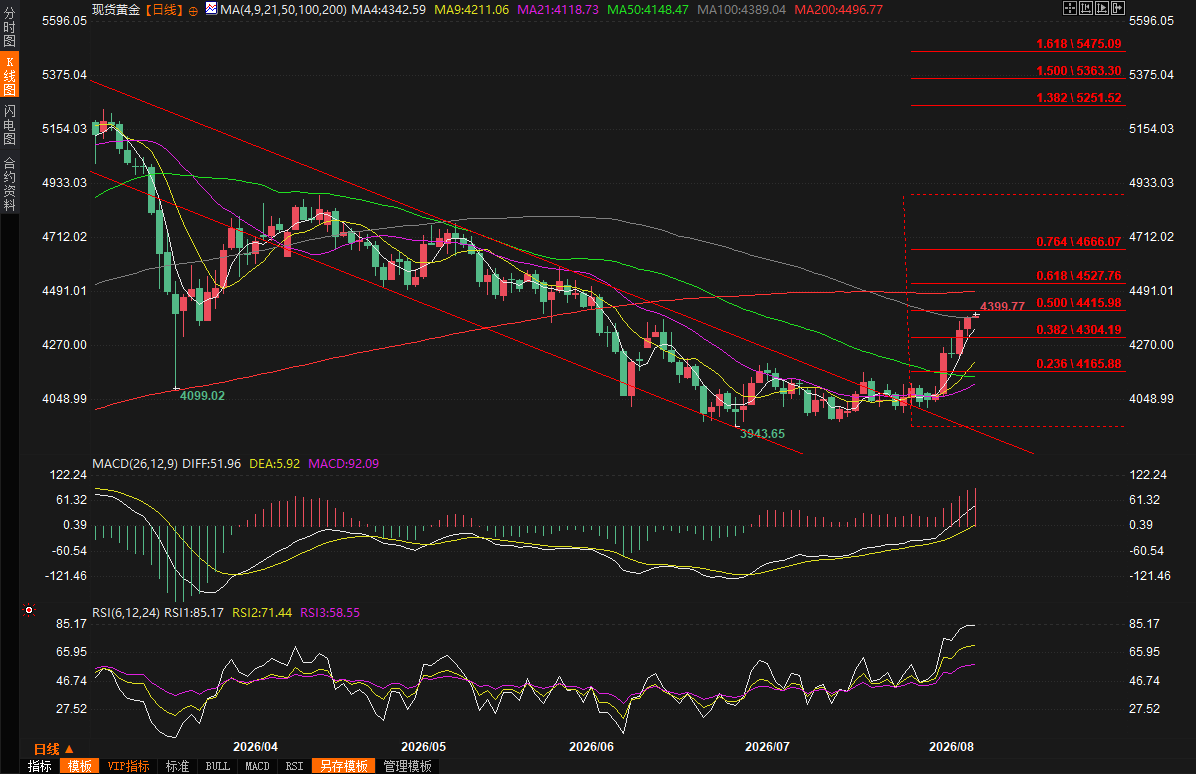 (Spot gold daily chart, source: EasyTrade) At 06:58 Beijing time, spot gold is currently trading at $4399.77 per ounce.
The People's Bank of China's continued buying spree, coupled with strong technical indicators, creates a synergy.
The current rise in gold prices is not an isolated event. Official data released last week showed that the People's Bank of China significantly increased its gold purchases in July, with the increase in gold in foreign exchange reserves reaching its highest level since October 2023. This action sends a clear signal: against the backdrop of escalating global uncertainty, the government is still actively allocating gold as a strategic reserve. Market strategists point out that the overall technical momentum for gold is quite strong. Traders are focused on the support provided by continued Chinese buying, while also worrying about missing the opportunity for gold prices to return to the $4,500 mark. This "cautious yet unwilling to miss out" mentality makes buying particularly resolute near key resistance levels. Data shows that global central banks' net gold purchases reached 289 tons in the second quarter of this year, a significant year-on-year increase of 62%, setting a new record for the same period. A survey by the World Gold Council shows that 45% of surveyed central banks plan to continue increasing their gold reserves in the next 12 months, and 89% of central banks expect global official gold reserves to rise further. Data updated by the People's Bank of China on August 7th shows that as of the end of July 2026, China's gold reserves reached 76.08 million ounces (approximately 2366.35 tons), an increase of 640,000 ounces from the end of June. This marks the 21st consecutive month of increases in gold reserves by the People's Bank of China, with the increase further expanding from 480,000 ounces in June. From a broader perspective, gold, as a traditional safe-haven and inflation-hedging asset, is gaining support under multiple factors. Weakening labor market data has eased market expectations for aggressive interest rate hikes by the Federal Reserve in the short term. The Chicago Mercantile Exchange's FedWatch tool shows that traders are pricing in a 50% probability of a rate hike in September, while the probability of a December rate hike remains as high as 81%. This shift in expectations provides a relatively favorable interest rate environment for gold. Once this week's inflation data further confirms that price pressures are under control, the upside potential for the dollar and real interest rates may be limited, indirectly benefiting gold.Inflation data serves as a short-term indicator, with the market closely monitoring CPI and PPI.
This week, market focus is heavily on the US July Consumer Price Index (CPI) and Producer Price Index (PPI). Investors widely expect these data to provide key clues for judging the Federal Reserve's subsequent policy path. Surveys show that the market expects the July CPI to rise 0.1% from a 0.4% decline in June, with the year-on-year increase expected to fall from 3.5% to 3.4%; core CPI is expected to rise 0.1% month-on-month and 2.5% year-on-year. Jason Williams, US interest rate strategist at Citigroup, noted that Citigroup economists expect this month's CPI report to be weak again. However, he also warned: "A strong consumer price index could quickly change the market narrative, and US Treasuries could face significant selling pressure." Tim Waterer, chief market analyst at KCM Trade, expects weak data to strengthen the case for maintaining interest rates, and gold prices will find support above $4,300 in the short term. If inflation data continues to weaken, the probability of a Fed rate hike in September will further decrease, and the dollar index and US Treasury yields are expected to continue to decline, opening up more upside potential for gold. Conversely, if inflation data is unexpectedly strong, expectations of interest rate hikes may resurface, potentially putting downward pressure on gold prices in the short term. Meanwhile, the correlation between the US dollar and the US Treasury market is also worth noting. On Monday, the US dollar index strengthened slightly, partly driven by rising oil prices, while US Treasury yields rebounded before the inflation data release. The yield curve is steepening, making short-term interest rates more sensitive to policy expectations. Analysts point out that the downside risks currently facing US Treasuries are asymmetrical—a strong inflation report could quickly alter the market narrative, triggering significant selling pressure. This environment is two-way for gold: fluctuations in interest rate expectations amplify gold price volatility, but safe-haven demand and official buying provide some buffer for prices.The standoff in the Strait of Hormuz has driven up oil prices, indirectly reinforcing the safe-haven appeal of gold.
What truly complicates market sentiment is the latest development in the Middle East. Negotiations between Iran and Oman to reopen the Strait of Hormuz and establish a new shipping lane are nearing a final agreement, but Tehran has made it clear that reopening this strategic waterway is tied to conditions such as US compensation, lifting of sanctions, and cessation of military threats. US President Trump, for the first time, has made reciprocal demands, insisting that Iran pay compensation for those killed and injured in the conflict and those killed in protests, extending this to broader regional responsibility. These reciprocal demands have dramatically dimmed the prospect of a substantial agreement in the short term. This stalemate has directly pushed up oil prices. Brent crude and US crude futures both recorded gains of over 6% on Monday, marking their largest single-day increases in recent times, partially erasing earlier losses due to expectations of the strait's reopening. The Strait of Hormuz carries approximately one-fifth of the world's oil and liquefied natural gas transport; a prolonged blockade or high-risk passage would inevitably drive up energy costs and global inflationary pressures. The continued high oil prices, in turn, will reinforce market concerns about sticky inflation, thus indirectly supporting gold's role as an inflation hedge. Meanwhile, geopolitical uncertainty itself can also stimulate safe-haven flows into gold. Houthi attacks on Saudi oil refineries, the drop in US strategic petroleum reserves to a 40-year low, and supply disruptions in the Black Sea region are all exacerbating tensions in the energy market, further amplifying gold's appeal as a "hedge against uncertainty." However, investors also need to be mindful of the impact of soaring oil prices on expectations of a Federal Reserve rate hike. If market expectations for a Fed rate hike rise significantly again, it could put downward pressure on gold prices once more.Gold Outlook Amidst Mixed Signals: Short-Term Fluctuations, but Upside Potential Remains in the Medium Term
In summary, the People's Bank of China's continued buying, strong technical momentum, and market expectations of a shift in Federal Reserve policy have provided a solid foundation for the bulls, helping gold prices rise to a two-month high. However, uncertainty surrounding this week's inflation data and the ongoing Middle East negotiations could trigger short-term volatility. The sharp rebound in oil prices has already reminded the market that geopolitical risks are far from over, and if inflation data is unexpectedly strong, the repricing of interest rate expectations could put downward pressure on gold prices. From a longer-term perspective, gold's strategic value has not been weakened by short-term fluctuations. Against the backdrop of high global debt, frequent geopolitical conflicts, and the diversification of reserves by major central banks, demand for allocation at the official and institutional levels continues to accumulate. The $4,500 mark is not an unattainable target, but the path to achieving it is likely to be accompanied by setbacks and fluctuations. Investors need to closely monitor this week's CPI and PPI data, as well as any substantial progress in the Strait of Hormuz negotiations. The resonance of data and events will determine whether gold prices break through previous highs and continue to rise, or enter a consolidation phase at the current level. (Spot gold daily chart, source: EasyTrade) At 06:58 Beijing time, spot gold is currently trading at $4399.77 per ounce.
- Risk Warning and Disclaimer
- The market involves risk, and trading may not be suitable for all investors. This article is for reference only and does not constitute personal investment advice, nor does it take into account certain users’ specific investment objectives, financial situation, or other needs. Any investment decisions made based on this information are at your own risk.