Rising oil prices supported the Canadian dollar, causing the USD/CAD pair to fall to a two-month low.
2026-08-11 14:12:54
The USD/CAD pair continued its recent consolidation in Asian trading on Tuesday, hovering near the mid-range of 1.3900, close to the two-month low reached last week. With intertwined market fundamentals, investors are hesitant to establish large directional positions, awaiting new macroeconomic signals.  The Canadian dollar has recently shown relative strength, primarily driven by rising oil prices and improved Canadian employment data. As a commodity currency, the Canadian dollar is typically heavily influenced by the energy market. When oil prices rise, improved expectations for Canadian export revenue often enhance the Canadian dollar's attractiveness. The rebound in oil prices and improved Canadian economic data have been key factors supporting the Canadian dollar and pushing USD/CAD to remain low . The recent oil market has been driven by supply risks, with increased uncertainty in key shipping routes leading to renewed market concerns about energy supply disruptions. Simultaneously, this uncertainty has reduced market expectations for a rapid recovery in energy transportation. Restrictions on major shipping routes have perpetuated the global oil supply risk premium, keeping oil prices at higher levels. This factor supports the Canadian dollar through commodity price channels. In Canada, recent employment data has been relatively positive, boosting market confidence in the resilience of the Canadian economy. Improved employment has reduced pressure on the Bank of Canada to shift towards easing in the short term, also providing some support for the Canadian dollar. However, the US dollar has not completely lost its advantage. As rising energy prices have reignited inflation concerns, the market is reassessing the Federal Reserve's future policy path. If continued oil price increases lead to a rebound in inflationary pressures, the Federal Reserve may need to maintain a more cautious policy stance. The market is still betting on further interest rate hikes by the Federal Reserve this year, supporting high US Treasury yields and helping the dollar maintain its previous rebound. Fed policy expectations and energy price changes are the main factors driving the price action between the US dollar and the Canadian dollar . Investors are currently focusing on the upcoming US Consumer Price Index (CPI) and Producer Price Index (PPI). These two data points will influence market expectations of US inflation trends and further alter the dollar's trajectory. If US inflation continues to decline, the market may lower the probability of future Fed rate hikes, potentially putting pressure on the dollar and pushing USD/CAD lower. Conversely, if energy prices drive inflation data higher than expected, the market may re-emphasize tightening expectations, providing support for the dollar. From an overall market perspective, USD/CAD is currently in a state of equilibrium. On one hand, rising oil prices and improved Canadian economic data support the Canadian dollar; on the other hand, safe-haven demand for the dollar and Fed policy expectations limit the downside potential. Therefore, the market is more likely to maintain range-bound trading in the short term. Looking at the daily chart, USD/CAD is currently trading near the 100-day simple moving average of 1.3918, approaching a key technical area. A break below the 1.3918 support level could lead to a further test of the recent lows near 1.3900, opening up potential for a correction towards the 1.3850 area. The first resistance level to watch is the recent rebound high; a break above this level could lead to a retest of the 1.4000 psychological level. The current price is near the 100-day moving average, indicating a consolidation phase rather than a clear trend. On the 4-hour chart, USD/CAD maintains a weak, range-bound structure, consolidating at lower levels and awaiting a directional move. A break below 1.3900 could extend the downtrend, targeting around 1.3850; a rebound above 1.3950-1.3980 could trigger a technical rebound, potentially challenging the 1.4000 level. Short-term price action will be influenced by oil prices, the US dollar index, and US inflation data.
 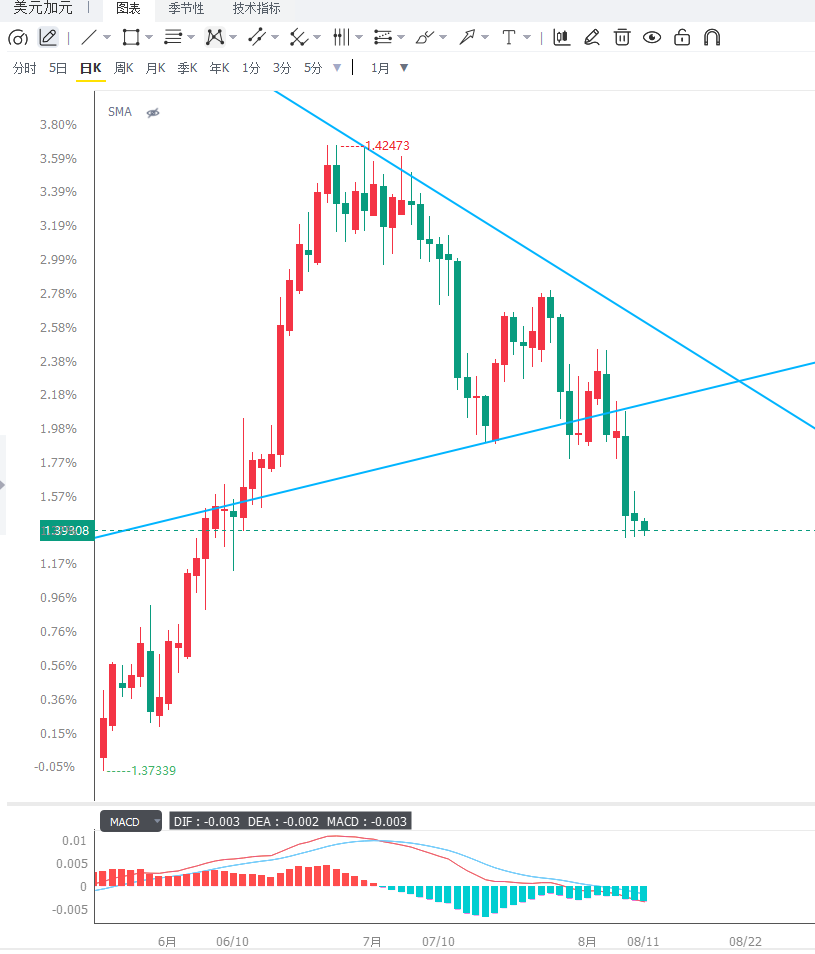 The USD/CAD pair is currently influenced by both the energy market and monetary policy expectations. Rising oil prices and improved Canadian employment are supporting the Canadian dollar, keeping the exchange rate near two-month lows; however, safe-haven demand for the US dollar and expectations of a potential Fed rate hike are limiting further downside for USD/CAD. Going forward, market focus will be on US inflation data and changes in energy supply risks. If US inflation continues to cool, the US dollar may weaken further, and USD/CAD is likely to continue its correction; however, if rising oil prices reignite inflationary pressures, expectations of Fed policy changes could support a dollar rebound. In the short term, the area around 1.3900 will be a crucial technical zone for determining the next direction.
The Canadian dollar has recently shown relative strength, primarily driven by rising oil prices and improved Canadian employment data. As a commodity currency, the Canadian dollar is typically heavily influenced by the energy market. When oil prices rise, improved expectations for Canadian export revenue often enhance the Canadian dollar's attractiveness. The rebound in oil prices and improved Canadian economic data have been key factors supporting the Canadian dollar and pushing USD/CAD to remain low . The recent oil market has been driven by supply risks, with increased uncertainty in key shipping routes leading to renewed market concerns about energy supply disruptions. Simultaneously, this uncertainty has reduced market expectations for a rapid recovery in energy transportation. Restrictions on major shipping routes have perpetuated the global oil supply risk premium, keeping oil prices at higher levels. This factor supports the Canadian dollar through commodity price channels. In Canada, recent employment data has been relatively positive, boosting market confidence in the resilience of the Canadian economy. Improved employment has reduced pressure on the Bank of Canada to shift towards easing in the short term, also providing some support for the Canadian dollar. However, the US dollar has not completely lost its advantage. As rising energy prices have reignited inflation concerns, the market is reassessing the Federal Reserve's future policy path. If continued oil price increases lead to a rebound in inflationary pressures, the Federal Reserve may need to maintain a more cautious policy stance. The market is still betting on further interest rate hikes by the Federal Reserve this year, supporting high US Treasury yields and helping the dollar maintain its previous rebound. Fed policy expectations and energy price changes are the main factors driving the price action between the US dollar and the Canadian dollar . Investors are currently focusing on the upcoming US Consumer Price Index (CPI) and Producer Price Index (PPI). These two data points will influence market expectations of US inflation trends and further alter the dollar's trajectory. If US inflation continues to decline, the market may lower the probability of future Fed rate hikes, potentially putting pressure on the dollar and pushing USD/CAD lower. Conversely, if energy prices drive inflation data higher than expected, the market may re-emphasize tightening expectations, providing support for the dollar. From an overall market perspective, USD/CAD is currently in a state of equilibrium. On one hand, rising oil prices and improved Canadian economic data support the Canadian dollar; on the other hand, safe-haven demand for the dollar and Fed policy expectations limit the downside potential. Therefore, the market is more likely to maintain range-bound trading in the short term. Looking at the daily chart, USD/CAD is currently trading near the 100-day simple moving average of 1.3918, approaching a key technical area. A break below the 1.3918 support level could lead to a further test of the recent lows near 1.3900, opening up potential for a correction towards the 1.3850 area. The first resistance level to watch is the recent rebound high; a break above this level could lead to a retest of the 1.4000 psychological level. The current price is near the 100-day moving average, indicating a consolidation phase rather than a clear trend. On the 4-hour chart, USD/CAD maintains a weak, range-bound structure, consolidating at lower levels and awaiting a directional move. A break below 1.3900 could extend the downtrend, targeting around 1.3850; a rebound above 1.3950-1.3980 could trigger a technical rebound, potentially challenging the 1.4000 level. Short-term price action will be influenced by oil prices, the US dollar index, and US inflation data. The USD/CAD pair is currently influenced by both the energy market and monetary policy expectations. Rising oil prices and improved Canadian employment are supporting the Canadian dollar, keeping the exchange rate near two-month lows; however, safe-haven demand for the US dollar and expectations of a potential Fed rate hike are limiting further downside for USD/CAD. Going forward, market focus will be on US inflation data and changes in energy supply risks. If US inflation continues to cool, the US dollar may weaken further, and USD/CAD is likely to continue its correction; however, if rising oil prices reignite inflationary pressures, expectations of Fed policy changes could support a dollar rebound. In the short term, the area around 1.3900 will be a crucial technical zone for determining the next direction.
- Risk Warning and Disclaimer
- The market involves risk, and trading may not be suitable for all investors. This article is for reference only and does not constitute personal investment advice, nor does it take into account certain users’ specific investment objectives, financial situation, or other needs. Any investment decisions made based on this information are at your own risk.