With Canada's employment booming and oil prices strengthening due to geopolitical factors, how far can the Canadian dollar go?
2026-08-11 15:46:07
On Tuesday (August 11) during the Asian session, the USD/CAD pair traded in a narrow range, currently hovering around 1.3930, near the two-month low reached last week. The Canadian dollar is supported by two factors: continued strength in oil prices due to geopolitical risks and strong Canadian employment data from last Friday. However, persistent market expectations of a Federal Reserve rate hike and geopolitical uncertainty are providing some support for the US dollar, limiting the downside potential of the USD/CAD pair. Traders remain cautious ahead of key US inflation data releases, unwilling to make large directional bets. 
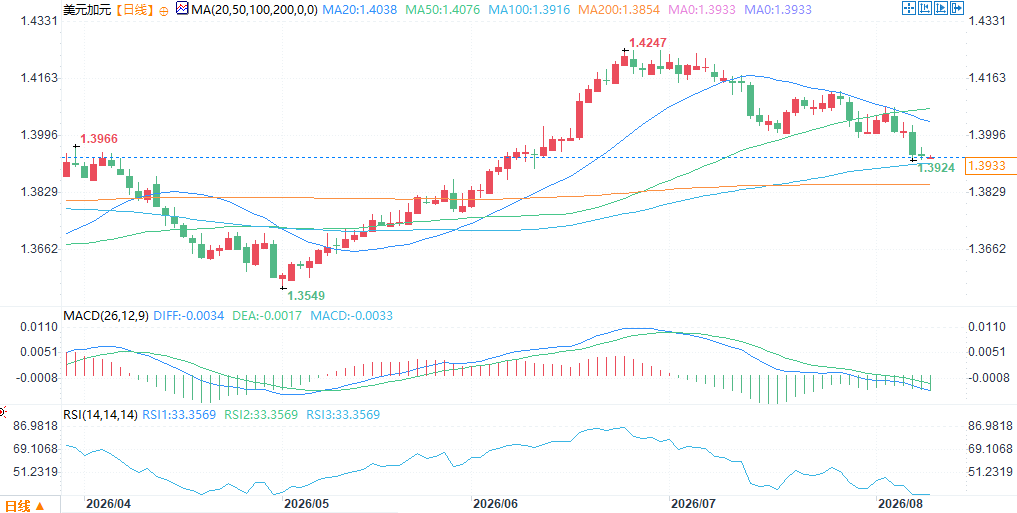 (USD/CAD daily chart, source: EasyForex) At 15:44 Beijing time on August 11, the USD/CAD exchange rate was 1.3938/37.
Strong oil prices provide support for the Canadian dollar.
The standoff between the US and Iran over the Strait of Hormuz continues to escalate, with Iran explicitly ruling out the possibility of resuming negotiations in the short term, further dashing hopes for a swift reopening of this crucial waterway. Meanwhile, the Houthi rebels, backed by Iran, have imposed a naval blockade on Saudi Arabia, leading to continued restrictions on shipping in the Bab el-Mandeb Strait and fueling concerns about global energy supplies. Driven by these geopolitical risks, crude oil prices have remained strong, rising to a near one-week high. As a major global oil exporter, Canada directly benefits from the inflow of US dollars due to rising oil prices. Increased energy export revenue has not only improved the current account position but also provided solid fundamental support for the Canadian dollar. Coupled with strong Canadian employment data released last Friday, showing job growth exceeding expectations, this further solidified market demand for the Canadian dollar. Driven by these multiple positive factors, the USD/CAD pair has remained under pressure near a two-month low, making the Canadian dollar one of the relatively strong major currencies recently.Expectations of a US interest rate hike limit the downside potential of the exchange rate.
Despite a strong fundamental outlook for the Canadian dollar, the downside for the US dollar is also significantly limited. Investors remain highly focused on the upside risk of inflation from oil price volatility, fearing that persistently high energy prices may force the Federal Reserve to adopt a more hawkish policy stance. The market is currently pricing in the possibility of at least one Fed rate hike before the end of the year, an expectation that provides a floor for the dollar. Furthermore, persistent geopolitical uncertainty in the Middle East further strengthens the demand for the dollar as a safe-haven asset. Against the backdrop of weak employment data and inflationary risks, the dollar has shown some resilience, helping it hold onto the modest gains of the previous trading day. It is this combined effect of rate hike expectations and safe-haven demand that effectively limits the downside for the USD/CAD pair, preventing a sharp, one-sided decline in the exchange rate.The market awaits guidance from US inflation data.
Ahead of key data releases, traders are generally adopting a wait-and-see approach, unwilling to make large bets on a clear direction for the USD/CAD pair. Market focus has shifted entirely to this week's upcoming US inflation data—Wednesday's Consumer Price Index (CPI) and Thursday's Producer Price Index (PPI). These two figures will be crucial in determining the Federal Reserve's subsequent policy path. If inflation data is moderate, market expectations for further Fed rate hikes may continue to cool, putting pressure on the dollar and opening up further downside potential for the USD/CAD pair. Conversely, if inflation rebounds more than expected, rate hike expectations will resurface, supporting the dollar and limiting the Canadian dollar's appreciation. Therefore, this week's inflation data will not only determine the short-term direction of the dollar but will also directly influence the volatility and direction of the USD/CAD pair.Summarize
The USD/CAD pair is currently trading around 1.3930, near the two-month low reached last week. The ongoing US-Iran standoff and shipping restrictions in the Bab el-Mandeb Strait continue to support oil prices, while strong Canadian employment data provides a double boost to the Canadian dollar. However, persistent market expectations of a Fed rate hike and geopolitical uncertainty are providing some support for the US dollar, limiting the downside for USD/CAD. Traders are cautious ahead of the release of US CPI and PPI data. Until the data and geopolitical news become clearer, USD/CAD is expected to remain in a low-level range-bound trading pattern. The market awaits US inflation data to provide clearer guidance for the next move. (USD/CAD daily chart, source: EasyForex) At 15:44 Beijing time on August 11, the USD/CAD exchange rate was 1.3938/37.
- Risk Warning and Disclaimer
- The market involves risk, and trading may not be suitable for all investors. This article is for reference only and does not constitute personal investment advice, nor does it take into account certain users’ specific investment objectives, financial situation, or other needs. Any investment decisions made based on this information are at your own risk.