The Reserve Bank of Australia's statement "no talk of interest rate cuts" has changed the pricing logic behind the Australian dollar.
2026-08-11 15:22:55
On Tuesday, August 11, the Reserve Bank of Australia (RBA) concluded its August policy meeting, maintaining the cash rate target at 4.35%. This outcome was largely in line with market expectations, but the policy communication was clearly more noteworthy than simply "holding rates steady." The RBA explicitly stated that inflation remains too high, and if upside risks materialize further, a further increase in the cash rate cannot be ruled out. More importantly, Governor Bullock confirmed that the meeting discussed "raising or maintaining interest rates," not lowering them. The Australian dollar remained above 0.70 against the US dollar before and after the policy announcement, and is currently trading around 0.7050. 
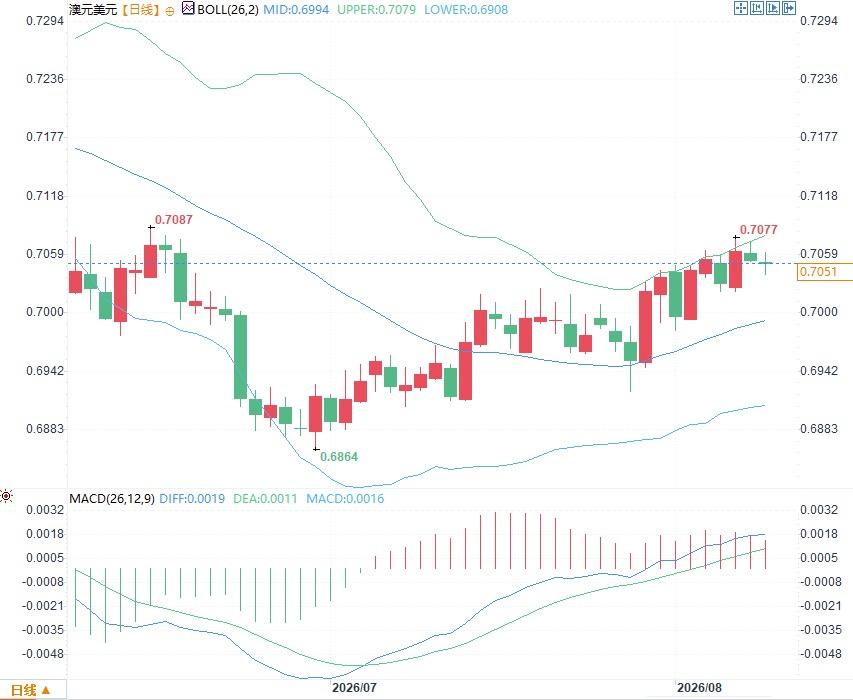 More notably, the recent price rebound has seen the trading range converging towards the upper boundary, while previous highs occurred around 0.7087 and more recently around 0.7077, indicating that the current technical structure has entered a previously densely traded area. There is a significant convergence between fundamental and technical factors: the market has fully recognized that the Reserve Bank of Australia (RBA) has not entered into discussions about interest rate cuts. Therefore, the core of the next phase of exchange rate repricing will largely depend on whether actual data supports its tighter policy stance. The July Consumer Price Index (CPI) will be released on August 26th, providing new insights into whether core inflation will remain sticky.
Pausing interest rate hikes does not equate to a policy shift; the real change lies in the decision function.
The most important information from this meeting was not the 4.35% interest rate level, but rather how the Reserve Bank of Australia (RBA) described its next policy choice. The official statement showed that the cash rate has been raised three times this year, financial conditions have tightened significantly, and money market rates, government bond yields, and exchange rates have all reacted to this tightening. At the same time, the growth rate of consumer spending has begun to slow gradually, new housing loans have declined significantly, and the tightness in the labor market has also eased. Therefore, the RBA chose to observe the lagged effects of previous tightening policies rather than mechanically continuing the pace of rate hikes. However, there is a fundamental difference between "waiting" and "shifting to easing." Block has repeatedly emphasized recently that inflation risks remain skewed to the upside, and this meeting even revisited raising the cash rate, whereas the June meeting did not discuss it to the same extent. This means that the policy response function is still centered on inflation constraints, and the current pause is mainly due to the fact that the tightening policy has entered a stage where the transmission effect needs to be observed, rather than because the price stability target has been achieved. From the perspective of interest rate market logic, this statement compresses the policy space for a short-term rate cut narrative. What the market needs to reassess is not what action will inevitably be taken at the next meeting, but rather that the RBA's tolerance for unexpected increases in inflation is declining. If cost pressures, wages, service prices, or energy prices intensify again, policy discussions could quickly return to further tightening.Behind the 3.8% inflation rate, core price pressures are the key variable.
The latest official data shows that Australia's Consumer Price Index (CPI) rose 3.8% year-on-year in June, down from 4.0% in May, with a monthly decline of 0.1%. On the surface, overall inflation has eased somewhat, but adjusted core inflation remained at 3.6% year-on-year, unchanged from May, indicating that underlying price pressures have not cooled significantly. Housing prices rose 6.8% year-on-year, food and non-alcoholic beverages rose 3.3%, and entertainment and cultural prices rose 3.3%, showing a clear structural characteristic in price pressures. This is why the Reserve Bank of Australia (RBA) has not significantly changed its policy language despite the decline in overall inflation. Energy price fluctuations can quickly alter the overall CPI, but the central bank is truly concerned about whether rising costs are spreading to the pricing of goods and services, and whether businesses are beginning to continuously pass on higher input costs to end consumers. The latest official statement has indicated that some businesses are raising prices for goods and services, while others are preparing to adjust prices. The RBA's August economic forecast further suggests that it will take a considerable amount of time for inflation to return to the midpoint of the 2% to 3% target range, and aggregate demand must maintain a low growth rate to alleviate capacity pressures. Official abbreviated forecasts indicate that inflation is not expected to return to the midpoint of the target range until around early 2028, while the unemployment rate is projected to gradually rise. In other words, the current policy framework is essentially accepting a period of low growth in exchange for inflation stabilizing again.The Australian dollar has entered a phase where policy and technical factors are jointly priced against the US dollar.
The Australian dollar's cumulative volatility against the US dollar has increased over the past month, so current market pricing cannot be simply attributed to the outcome of a single interest rate decision. It requires consideration of the Reserve Bank of Australia's policy expectations, global energy prices, expected US dollar interest rates, and volatility in risk assets. Looking at the daily chart, the Bollinger Bands' middle band is around 0.6994, the upper band is around 0.7079, and the lower band is around 0.6908. The price previously rebounded from a low of 0.6865 and is currently trading above the middle band and approaching the upper band. In the MACD indicator, the DIFF is around 0.0019, the DEA is around 0.0011, and the histogram is around 0.0016; both lines are above the zero line. More notably, the recent price rebound has seen the trading range converging towards the upper boundary, while previous highs occurred around 0.7087 and more recently around 0.7077, indicating that the current technical structure has entered a previously densely traded area. There is a significant convergence between fundamental and technical factors: the market has fully recognized that the Reserve Bank of Australia (RBA) has not entered into discussions about interest rate cuts. Therefore, the core of the next phase of exchange rate repricing will largely depend on whether actual data supports its tighter policy stance. The July Consumer Price Index (CPI) will be released on August 26th, providing new insights into whether core inflation will remain sticky.
- Risk Warning and Disclaimer
- The market involves risk, and trading may not be suitable for all investors. This article is for reference only and does not constitute personal investment advice, nor does it take into account certain users’ specific investment objectives, financial situation, or other needs. Any investment decisions made based on this information are at your own risk.