Why is Kevin Walsh so controversial?
2026-08-12 00:32:54
In my view, Kevin Warsh's entanglement in public controversy stems from two main reasons. First, while Warsh himself belongs to the core of the long-established financial establishment, President Trump, who nominated him as Federal Reserve Chairman, is an opponent of the establishment. The recent wave of pessimistic pronouncements about the Fed's credibility originates from this connection. Major financial commentators reject Warsh simply because he is seen as Trump's proxy. This has led to the current discussion surrounding the Fed becoming thoroughly politicized, with market pricing also influenced by political sentiment—the market is now generally betting on a Fed rate hike. As I have previously stated in my columns and live broadcasts, given the current fundamentals, the Fed has absolutely no reasonable basis for raising interest rates.  Second, I personally support reducing forward guidance, but the market is extremely resistant to this. For a long time, the market has been accustomed to the Fed providing detailed policy hints. The market needs to readjust to a model of trading independently, free from Fed guidance, and is currently resisting this shift. During this process, complaints about the continued collapse of the Fed's credibility will be incessant. My core view is that all current rhetoric targeting the Fed should be taken with a grain of salt and viewed with caution. Third, let's rewind to the same period last year. At that time, Chairman Powell delivered a keynote speech at the Jackson Hole Economic Symposium on August 22nd. This speech released an unexpectedly dovish signal: even if inflation remained above the policy target, the Fed would begin a rate-cutting cycle. Powell cited the continued weakening of the labor market as the reason, but the broader context of this policy shift was Trump's continued pressure and attacks on the Fed, even publicly criticizing it days before the speech. At that time, the market saw a surge in "currency devaluation trading," with gold and other precious metal prices skyrocketing, and the US Treasury yield curve steepening in a bear market – a trend highly similar to the current situation. However, at the time, the mainstream establishment commentary circle did not question the credibility of the Federal Reserve at all. This is the core reason why I believe that the current criticism of Warsh is full of political bias.
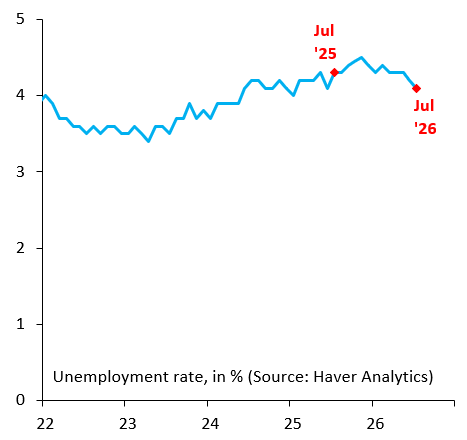
 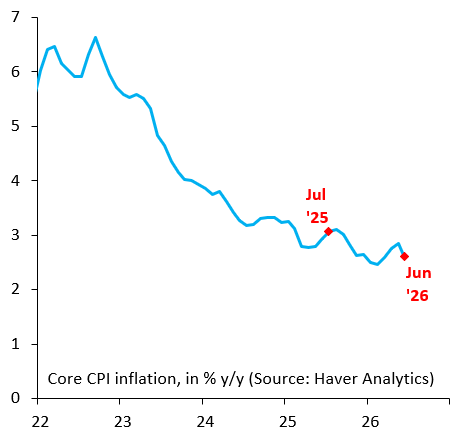 The chart above shows the year-on-year growth rate of the core Consumer Price Index (core CPI), and the chart below shows the US unemployment rate. In both charts, I've marked the latest available data before Powell's speech—July 2025: core inflation was 3.1% then, and is currently only 2.6%; the unemployment rate was 4.3% then, and has now fallen to 4.1%. Comparing these two sets of data completely fails to explain why market sentiment was collectively silent about Powell's policy shift last year, but is now collectively and aggressively undermining the Fed's credibility. Crucially, Powell's speech back then directly signaled a 75-basis-point rate cut cycle, while now the market is collectively dissatisfied because Warsh refused to raise rates. In conclusion, the current deluge of Fed-related rhetoric can be largely ignored.
  Secondly, there's the issue of reforming forward guidance. I believe reducing forward guidance is a correct and highly forward-looking move, but the market, already reliant on Fed policy subsidies, is strongly resisting it. The chart below shows the daily volatility of the 10-year Treasury yield and its sensitivity to deviations from Bloomberg consensus economic data. Compared to when I released this chart ten days ago, the volatility of the 10-year Treasury yield to unexpected economic data has decreased, and the trend is completely inconsistent with the adjustments the market should be making. The market is resisting the Fed's reform to weaken forward guidance, and under this resistance, accusations of "loss of Fed credibility" will continue to proliferate.
 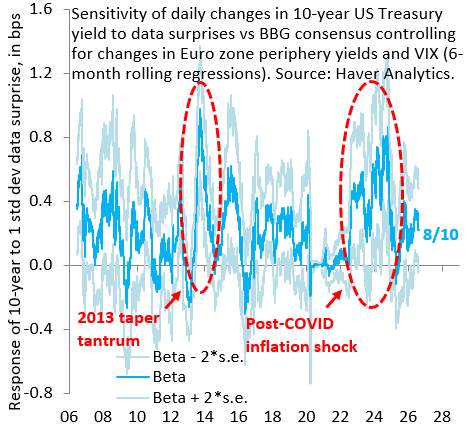 Finally, I'd like to offer two points for conclusion. First, while Warsh's performance at the first two Federal Open Market Committee (FOMC) press conferences wasn't exactly outstanding, it's a common trait for newly appointed Fed chairs to struggle with press conferences, so this shortcoming is insignificant. Second, there are hidden trading opportunities in the current market. The market's current bets on interest rate hikes seem more like an emotional outburst against Trump. Investors should detach themselves from political factors and focus on macroeconomic fundamentals, which currently do not support a rate hike.
Second, I personally support reducing forward guidance, but the market is extremely resistant to this. For a long time, the market has been accustomed to the Fed providing detailed policy hints. The market needs to readjust to a model of trading independently, free from Fed guidance, and is currently resisting this shift. During this process, complaints about the continued collapse of the Fed's credibility will be incessant. My core view is that all current rhetoric targeting the Fed should be taken with a grain of salt and viewed with caution. Third, let's rewind to the same period last year. At that time, Chairman Powell delivered a keynote speech at the Jackson Hole Economic Symposium on August 22nd. This speech released an unexpectedly dovish signal: even if inflation remained above the policy target, the Fed would begin a rate-cutting cycle. Powell cited the continued weakening of the labor market as the reason, but the broader context of this policy shift was Trump's continued pressure and attacks on the Fed, even publicly criticizing it days before the speech. At that time, the market saw a surge in "currency devaluation trading," with gold and other precious metal prices skyrocketing, and the US Treasury yield curve steepening in a bear market – a trend highly similar to the current situation. However, at the time, the mainstream establishment commentary circle did not question the credibility of the Federal Reserve at all. This is the core reason why I believe that the current criticism of Warsh is full of political bias. The chart above shows the year-on-year growth rate of the core Consumer Price Index (core CPI), and the chart below shows the US unemployment rate. In both charts, I've marked the latest available data before Powell's speech—July 2025: core inflation was 3.1% then, and is currently only 2.6%; the unemployment rate was 4.3% then, and has now fallen to 4.1%. Comparing these two sets of data completely fails to explain why market sentiment was collectively silent about Powell's policy shift last year, but is now collectively and aggressively undermining the Fed's credibility. Crucially, Powell's speech back then directly signaled a 75-basis-point rate cut cycle, while now the market is collectively dissatisfied because Warsh refused to raise rates. In conclusion, the current deluge of Fed-related rhetoric can be largely ignored. Secondly, there's the issue of reforming forward guidance. I believe reducing forward guidance is a correct and highly forward-looking move, but the market, already reliant on Fed policy subsidies, is strongly resisting it. The chart below shows the daily volatility of the 10-year Treasury yield and its sensitivity to deviations from Bloomberg consensus economic data. Compared to when I released this chart ten days ago, the volatility of the 10-year Treasury yield to unexpected economic data has decreased, and the trend is completely inconsistent with the adjustments the market should be making. The market is resisting the Fed's reform to weaken forward guidance, and under this resistance, accusations of "loss of Fed credibility" will continue to proliferate. Finally, I'd like to offer two points for conclusion. First, while Warsh's performance at the first two Federal Open Market Committee (FOMC) press conferences wasn't exactly outstanding, it's a common trait for newly appointed Fed chairs to struggle with press conferences, so this shortcoming is insignificant. Second, there are hidden trading opportunities in the current market. The market's current bets on interest rate hikes seem more like an emotional outburst against Trump. Investors should detach themselves from political factors and focus on macroeconomic fundamentals, which currently do not support a rate hike.
- Risk Warning and Disclaimer
- The market involves risk, and trading may not be suitable for all investors. This article is for reference only and does not constitute personal investment advice, nor does it take into account certain users’ specific investment objectives, financial situation, or other needs. Any investment decisions made based on this information are at your own risk.