Cooling US inflation has dampened expectations of interest rate hikes, and the USD/CAD pair remains range-bound at low levels.
2026-08-13 13:40:55
The USD/CAD pair remained largely stable during Thursday's Asian trading session, hovering around 1.3940, after a slight increase in the previous session. The current lack of clear direction is primarily due to the fact that the US dollar and the Canadian dollar are simultaneously influenced by conflicting fundamental factors: cooling US inflation is weakening the dollar, while declining international oil prices are weakening the Canadian dollar, which is highly correlated with energy prices. These two forces offset each other, keeping the USD/CAD pair within a relatively narrow range for the time being.  US July Consumer Price Index (CPI) data showed that the overall CPI rose 3.4% year-on-year, lower than June's 3.5%; the core CPI rose 2.5% year-on-year, lower than the previous value of 2.6%. Both figures were in line with market expectations. Monthly performance showed that the overall CPI rose approximately 0.1% month-on-month, and the core CPI rose approximately 0.2% month-on-month. There were no new signs of significant acceleration in overall inflation, and declining energy and food costs further helped control US consumer price pressures. The impact of this data on the US dollar is mainly reflected in monetary policy expectations. Previously, the market was concerned that US inflation was highly sticky, and the Federal Reserve might need to maintain a tight policy for a longer period. However, the July CPI data showed that price pressures are easing to some extent. Therefore, the market reduced its bets on further tightening of policy in September. Market surveys show that the interest rate market currently prices in a 40% probability of a Fed rate hike in September, and the probability of action in October has also decreased from approximately 75% to approximately 60%. The market is more inclined to price in the next rate hike as being postponed to December. Theoretically, the decline in the dollar's interest rate advantage should push USD/CAD lower, but this logic was offset by falling oil prices. The Canadian economy is highly dependent on energy exports, and crude oil prices typically influence the Canadian dollar through channels such as trade revenue, corporate profits, fiscal conditions, and capital flows. Therefore, when international oil prices experience significant adjustments, the Canadian dollar often faces additional pressure, thus limiting the downside potential of the USD/CAD exchange rate. Recently, the fundamental outlook for oil prices has deteriorated. The Organization of the Petroleum Exporting Countries (OPEC) lowered its 2026 global oil demand growth forecast to approximately 580,000 barrels per day in its latest monthly report. The International Energy Agency (IEA) further lowered its demand forecast, predicting that global oil consumption may decrease by approximately 1.6 million barrels per day this year, a significantly more pessimistic assessment than its previous estimate of a decrease of approximately 1 million barrels per day. This decline in demand expectations suggests that the global oil market may face more pronounced supply and demand pressures. This change is particularly noteworthy for the Canadian dollar, as falling oil prices not only affect Canada's energy export revenue but may also influence Canadian economic growth expectations through investment and capital flows. If international oil prices continue to decline, the Canadian dollar's commodity currency characteristics may once again become one of the main trading drivers in the market. However, current oil prices are not entirely determined by demand expectations. The shipping risks in the Strait of Hormuz continue to provide a risk premium for the crude oil market. US President Trump stated that the US has "complete control" over this vital waterway, but tensions between the US and Iran have not fundamentally eased, and related diplomatic negotiations have lacked significant progress. Market concerns exist that further escalation could lead to greater disruptions to crude oil shipments, thus limiting the downside for oil prices. Meanwhile, the US government is seeking to further increase economic pressure on Iran, including expanding sanctions and restricting Iranian crude oil exports. If these measures ultimately lead to a decrease in actual supply, crude oil prices may regain support, exerting downward pressure on USD/CAD through the Canadian dollar. Conversely, if supply disruptions do not escalate further, and global demand expectations continue to deteriorate, oil prices may remain weak, putting greater pressure on the Canadian dollar. Therefore, the current fundamentals of USD/CAD exhibit a clear "two-way hedging" characteristic. Cooling US inflation reduces expectations of a tighter Federal Reserve policy, theoretically unfavorable for the US dollar; while downward revisions to global crude oil demand forecasts and weaker oil prices weaken the Canadian dollar. The combined effect makes it difficult for the exchange rate to form a sustained trend in the short term. From a broader macroeconomic perspective, investors also need to pay attention to the differences in economic growth between the US and Canada. If the US economy remains resilient while the Canadian economy faces pressure from both falling energy prices and weak external demand, the USD/CAD interest rate differential may shift back towards the US dollar, pushing USD/CAD higher. Conversely, if US inflation continues to decline, economic activity gradually slows, and oil prices rise again due to supply risks, the Canadian dollar may receive double support, and USD/CAD may resume its downward trend. From a daily chart perspective, USD/CAD is currently fluctuating around 1.3940, indicating a short-term tug-of-war between bulls and bears. The previous rebound failed to create a significant breakout, and the area around 1.3900 currently forms a crucial short-term support zone, while the psychological resistance level of 1.4000 is the most immediate resistance. If the bulls can effectively break through 1.4000 and further stabilize above 1.4050, it would suggest an upward breakout from the previous consolidation, with further upside potential at 1.4100 and 1.4150. If the exchange rate fails to break through 1.4000 and falls back below 1.3900, the bullish momentum of the US dollar may weaken further, and the price is expected to fall back to around 1.3850 or even 1.3800. If international oil prices rise again, the Canadian dollar will receive support from commodity currencies, and this technical downward pressure may further intensify. Conversely, if oil prices continue to fall, and the US dollar regains safe-haven support, USD/CAD may retest above 1.4000. From a market momentum perspective, the daily chart structure does not currently show a very strong one-sided trend; the price is more of a range-bound movement. Therefore, it is more important to focus on the breakout of key ranges rather than chasing short-term fluctuations within the range. 1.3800-1.3900 can be considered the main support zone below, while 1.4000-1.4100 constitutes an important resistance zone above. On the 4-hour chart, USD/CAD has been in a narrow range recently, and short-term momentum has not yet formed a clear direction. If the price can break through the 1.3970-1.4000 area again, the bulls may regain the initiative in the short term and further test 1.4050; if the price falls below 1.3900, the short-term upward structure may be broken, and the probability of a further pullback to 1.3850 increases. Since the current exchange rate is simultaneously influenced by US interest rate expectations and international oil prices, technical breakouts are easily affected by macroeconomic data or sudden news in the energy market; therefore, it is crucial to observe the sustainability of any breakout.
 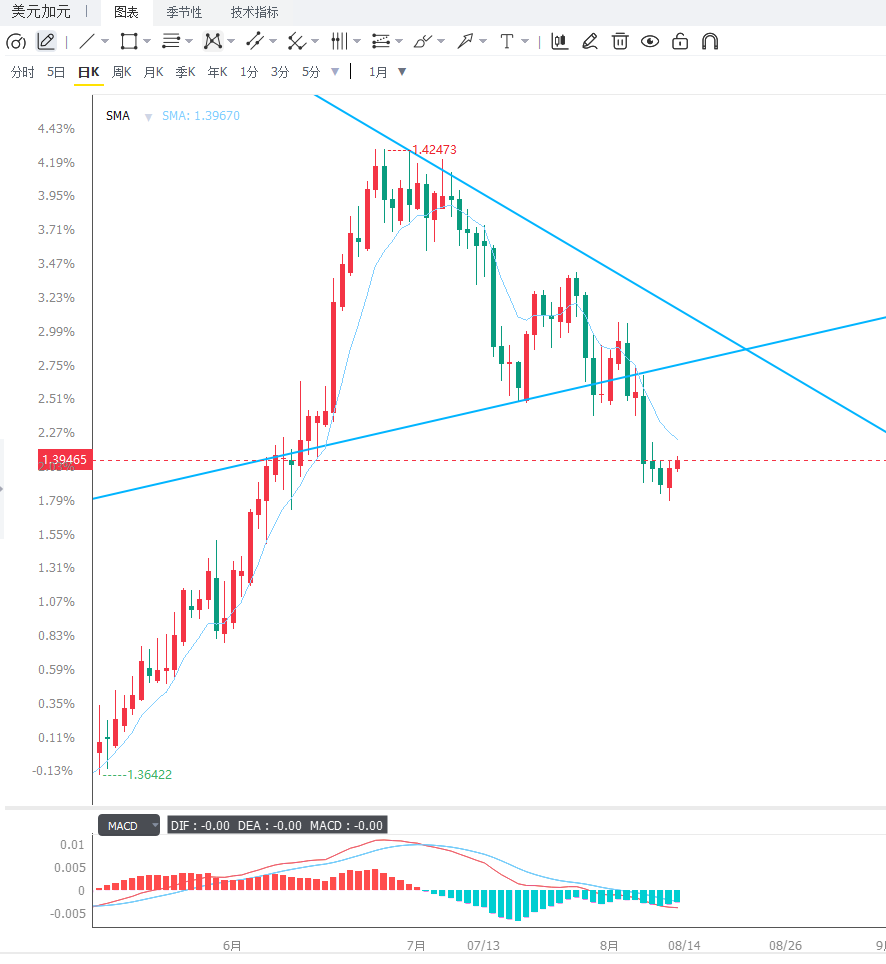 The most prominent feature of the USD/CAD pair at present is the simultaneous presence of negative factors for both the US dollar and the Canadian dollar. Cooling US inflation in July weakened expectations of further tightening by the Federal Reserve, putting pressure on the US dollar; however, falling international oil prices have diminished the Canadian dollar's energy export advantage, thus the exchange rate is temporarily fluctuating around 1.3940. In the short term, 1.4000 is a key level to determine whether the bulls can regain their advantage, while 1.3900 is an important support level. If oil prices continue to weaken while US economic data remains resilient, USD/CAD may extend towards 1.4000 or even 1.4100; if escalating risks in the Strait of Hormuz drive oil prices back up, while US inflation continues to cool, the Canadian dollar may find support, and the exchange rate could potentially fall towards the 1.3800 area. In the medium term, the true direction of USD/CAD depends on three variables: Federal Reserve interest rate expectations, international oil prices, and the economic growth difference between the US and Canada. The impact of oil prices on the Canadian dollar is particularly noteworthy. If global oil demand forecasts continue to decline, the Canadian dollar may face prolonged pressure; however, if geopolitical risks lead to a renewed tightening of supply, rising oil prices could quickly reverse this trend. Therefore, until key data and the energy market provide a clearer direction, the probability of USD/CAD maintaining its high-level fluctuations remains relatively high.
US July Consumer Price Index (CPI) data showed that the overall CPI rose 3.4% year-on-year, lower than June's 3.5%; the core CPI rose 2.5% year-on-year, lower than the previous value of 2.6%. Both figures were in line with market expectations. Monthly performance showed that the overall CPI rose approximately 0.1% month-on-month, and the core CPI rose approximately 0.2% month-on-month. There were no new signs of significant acceleration in overall inflation, and declining energy and food costs further helped control US consumer price pressures. The impact of this data on the US dollar is mainly reflected in monetary policy expectations. Previously, the market was concerned that US inflation was highly sticky, and the Federal Reserve might need to maintain a tight policy for a longer period. However, the July CPI data showed that price pressures are easing to some extent. Therefore, the market reduced its bets on further tightening of policy in September. Market surveys show that the interest rate market currently prices in a 40% probability of a Fed rate hike in September, and the probability of action in October has also decreased from approximately 75% to approximately 60%. The market is more inclined to price in the next rate hike as being postponed to December. Theoretically, the decline in the dollar's interest rate advantage should push USD/CAD lower, but this logic was offset by falling oil prices. The Canadian economy is highly dependent on energy exports, and crude oil prices typically influence the Canadian dollar through channels such as trade revenue, corporate profits, fiscal conditions, and capital flows. Therefore, when international oil prices experience significant adjustments, the Canadian dollar often faces additional pressure, thus limiting the downside potential of the USD/CAD exchange rate. Recently, the fundamental outlook for oil prices has deteriorated. The Organization of the Petroleum Exporting Countries (OPEC) lowered its 2026 global oil demand growth forecast to approximately 580,000 barrels per day in its latest monthly report. The International Energy Agency (IEA) further lowered its demand forecast, predicting that global oil consumption may decrease by approximately 1.6 million barrels per day this year, a significantly more pessimistic assessment than its previous estimate of a decrease of approximately 1 million barrels per day. This decline in demand expectations suggests that the global oil market may face more pronounced supply and demand pressures. This change is particularly noteworthy for the Canadian dollar, as falling oil prices not only affect Canada's energy export revenue but may also influence Canadian economic growth expectations through investment and capital flows. If international oil prices continue to decline, the Canadian dollar's commodity currency characteristics may once again become one of the main trading drivers in the market. However, current oil prices are not entirely determined by demand expectations. The shipping risks in the Strait of Hormuz continue to provide a risk premium for the crude oil market. US President Trump stated that the US has "complete control" over this vital waterway, but tensions between the US and Iran have not fundamentally eased, and related diplomatic negotiations have lacked significant progress. Market concerns exist that further escalation could lead to greater disruptions to crude oil shipments, thus limiting the downside for oil prices. Meanwhile, the US government is seeking to further increase economic pressure on Iran, including expanding sanctions and restricting Iranian crude oil exports. If these measures ultimately lead to a decrease in actual supply, crude oil prices may regain support, exerting downward pressure on USD/CAD through the Canadian dollar. Conversely, if supply disruptions do not escalate further, and global demand expectations continue to deteriorate, oil prices may remain weak, putting greater pressure on the Canadian dollar. Therefore, the current fundamentals of USD/CAD exhibit a clear "two-way hedging" characteristic. Cooling US inflation reduces expectations of a tighter Federal Reserve policy, theoretically unfavorable for the US dollar; while downward revisions to global crude oil demand forecasts and weaker oil prices weaken the Canadian dollar. The combined effect makes it difficult for the exchange rate to form a sustained trend in the short term. From a broader macroeconomic perspective, investors also need to pay attention to the differences in economic growth between the US and Canada. If the US economy remains resilient while the Canadian economy faces pressure from both falling energy prices and weak external demand, the USD/CAD interest rate differential may shift back towards the US dollar, pushing USD/CAD higher. Conversely, if US inflation continues to decline, economic activity gradually slows, and oil prices rise again due to supply risks, the Canadian dollar may receive double support, and USD/CAD may resume its downward trend. From a daily chart perspective, USD/CAD is currently fluctuating around 1.3940, indicating a short-term tug-of-war between bulls and bears. The previous rebound failed to create a significant breakout, and the area around 1.3900 currently forms a crucial short-term support zone, while the psychological resistance level of 1.4000 is the most immediate resistance. If the bulls can effectively break through 1.4000 and further stabilize above 1.4050, it would suggest an upward breakout from the previous consolidation, with further upside potential at 1.4100 and 1.4150. If the exchange rate fails to break through 1.4000 and falls back below 1.3900, the bullish momentum of the US dollar may weaken further, and the price is expected to fall back to around 1.3850 or even 1.3800. If international oil prices rise again, the Canadian dollar will receive support from commodity currencies, and this technical downward pressure may further intensify. Conversely, if oil prices continue to fall, and the US dollar regains safe-haven support, USD/CAD may retest above 1.4000. From a market momentum perspective, the daily chart structure does not currently show a very strong one-sided trend; the price is more of a range-bound movement. Therefore, it is more important to focus on the breakout of key ranges rather than chasing short-term fluctuations within the range. 1.3800-1.3900 can be considered the main support zone below, while 1.4000-1.4100 constitutes an important resistance zone above. On the 4-hour chart, USD/CAD has been in a narrow range recently, and short-term momentum has not yet formed a clear direction. If the price can break through the 1.3970-1.4000 area again, the bulls may regain the initiative in the short term and further test 1.4050; if the price falls below 1.3900, the short-term upward structure may be broken, and the probability of a further pullback to 1.3850 increases. Since the current exchange rate is simultaneously influenced by US interest rate expectations and international oil prices, technical breakouts are easily affected by macroeconomic data or sudden news in the energy market; therefore, it is crucial to observe the sustainability of any breakout. The most prominent feature of the USD/CAD pair at present is the simultaneous presence of negative factors for both the US dollar and the Canadian dollar. Cooling US inflation in July weakened expectations of further tightening by the Federal Reserve, putting pressure on the US dollar; however, falling international oil prices have diminished the Canadian dollar's energy export advantage, thus the exchange rate is temporarily fluctuating around 1.3940. In the short term, 1.4000 is a key level to determine whether the bulls can regain their advantage, while 1.3900 is an important support level. If oil prices continue to weaken while US economic data remains resilient, USD/CAD may extend towards 1.4000 or even 1.4100; if escalating risks in the Strait of Hormuz drive oil prices back up, while US inflation continues to cool, the Canadian dollar may find support, and the exchange rate could potentially fall towards the 1.3800 area. In the medium term, the true direction of USD/CAD depends on three variables: Federal Reserve interest rate expectations, international oil prices, and the economic growth difference between the US and Canada. The impact of oil prices on the Canadian dollar is particularly noteworthy. If global oil demand forecasts continue to decline, the Canadian dollar may face prolonged pressure; however, if geopolitical risks lead to a renewed tightening of supply, rising oil prices could quickly reverse this trend. Therefore, until key data and the energy market provide a clearer direction, the probability of USD/CAD maintaining its high-level fluctuations remains relatively high.- Risk Warning and Disclaimer
- The market involves risk, and trading may not be suitable for all investors. This article is for reference only and does not constitute personal investment advice, nor does it take into account certain users’ specific investment objectives, financial situation, or other needs. Any investment decisions made based on this information are at your own risk.