The pound's rebound against the yen stalled as markets reassessed the Bank of England's policy path.
2026-08-13 14:50:56
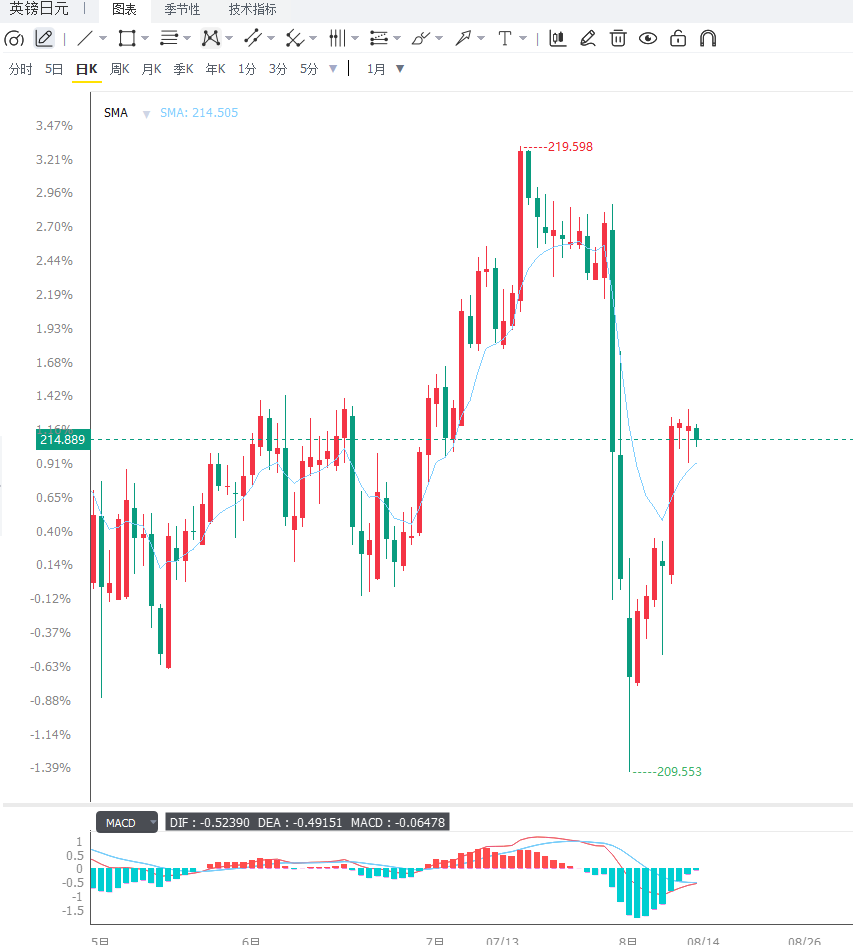
The pound strengthened slightly against the yen in European trading on Wednesday after the release of much better-than-expected UK second-quarter economic data. The UK economy maintained strong expansion momentum in the second quarter, with GDP growing by 0.6% quarter-on-quarter, exceeding market expectations of 0.4% and indicating that the growth momentum had not quickly faded after a strong first quarter. The better-than-expected data improved market assessments of the UK economy's resilience and provided short-term support for the pound.  Data released by the UK Office for National Statistics shows that UK GDP grew by approximately 1.2% year-on-year in the second quarter, higher than the market expectation of 1.1% and the previous figure of 0.9%. Meanwhile, June's GDP growth was 0.3%, significantly higher than the market's initial expectation of near flat growth. This improvement in monthly economic activity suggests that the UK's second-quarter economic growth was not entirely dependent on previous data, but rather maintained some expansionary momentum at the end of the quarter. Looking at the industry structure, the UK economic data also presents relatively positive signals. Manufacturing output grew by 0.5% month-on-month in June, significantly higher than the market expectation of a 0.2% decline; industrial production grew by 0.2%, also exceeding the market expectation of 0.1%. The simultaneous improvement in manufacturing and industrial activity indicates that the UK's economic growth is not entirely dependent on the service sector, and some sectors of the real economy have also shown some recovery. The significance of this data for the pound lies in its potential to change market perceptions of the Bank of England's future policy path. Previously, investors worried that a slowdown in UK economic growth might prompt the Bank of England to shift to easing more quickly, but the latest data has reduced such concerns. If economic growth remains resilient and inflation remains relatively high, the Bank of England will not need to quickly lower policy rates to stimulate the economy. However, strong GDP does not necessarily mean that the Bank of England will turn more hawkish. Monetary policy still needs to comprehensively consider factors such as wage growth, service sector inflation, and household consumption. If economic growth is mainly driven by certain sectors, while real household income and consumption remain weak, the Bank of England may still believe that the potential growth momentum of the economy is limited. Therefore, the market needs to observe whether the improvement in economic data can be sustained in the next stage, rather than just focusing on the performance of a single quarter's GDP. For GBP/JPY, the support for the pound from improved UK economic data contrasts sharply with the policy risks of the yen in Japan. The Japanese Ministry of Finance has previously taken measures to deal with the recent excessive volatility and disorderly movement of the yen. At the end of July, the US and Japan jointly intervened to alleviate the market pressure brought about by the rapid depreciation of the yen. Currently, the yen is generally maintaining a sideways trend, and the market is looking for whether the Japanese Ministry of Finance will release further intervention signals. If the yen continues to be under depreciation pressure, the Japanese authorities may increase their attention to exchange rate fluctuations. For GBP/JPY, this means that even if the improvement in UK fundamentals drives the pound higher, the potential policy support for the yen may limit the unilateral rise in the exchange rate. Another key driver of the yen remains the future policy path of the Bank of Japan. If Japanese inflation and wage data remain resilient, and the market rekindles expectations for further policy adjustments by the Bank of Japan, the yen may receive interest rate support, thus limiting the upside of GBP/JPY. Conversely, if Japanese economic data weakens, expectations of policy normalization decline, and the Ministry of Finance refrains from further intervention, the yen may come under renewed pressure, providing upward potential for GBP/JPY. From a global macroeconomic perspective, GBP/JPY is currently influenced by the UK-Japan interest rate differential, risk appetite, and expectations regarding exchange rate policy. Better-than-expected UK economic data could strengthen the pound, but if global market risk aversion intensifies, the yen, as a traditional safe-haven currency, may see inflows, offsetting some of the pound's gains. Therefore, a rise in GBP/JPY requires both a strong UK economy and stable global risk appetite. The market is currently particularly focused on whether UK economic growth can be sustained. If future UK manufacturing, service, and consumption data continue to improve, the Bank of England's policy space may be more limited than previously anticipated, providing relatively stable interest rate support for the pound. Conversely, if the strong Q2 GDP performance is primarily a temporary phenomenon and subsequent data weakens, the market may again bet on the Bank of England adopting a more accommodative policy, limiting the pound's upside potential. From a daily chart perspective, GBP/JPY received some buying support after the UK GDP data release, and the short-term trend has regained its strength. The market is currently focusing on the resistance area near the previous high. If the exchange rate can effectively break through and hold above this area, it is expected to continue its medium-term upward structure. Conversely, if the price encounters resistance near the previous high and experiences a significant pullback, it is necessary to be wary of increased profit-taking at higher levels. Support levels to watch are first the lower edge of the recent consolidation range, and then the dynamic support near the medium-term moving average. If the exchange rate can continue to trade above the major moving averages, the overall upward structure remains intact; if it breaks below key moving averages and forms consecutive daily closes, it means that the fundamental positive impact of the UK GDP data has been fully digested by the market, and a more significant correction phase may follow. On the 4-hour chart, the short-term rebound in GBP/JPY after the UK economic data release indicates that the bulls are attempting to regain the initiative. If the price breaks through the upper limit of the recent trading range and remains stable after the breakout, the short-term trend is expected to extend further upward; if the price returns to the inside of the range, it means the market is still in a range-bound pattern. Considering the possibility of signals from the Japanese Ministry of Finance regarding currency intervention, the GBP/JPY technical trend exhibits strong event-driven characteristics, and a pullback confirmation after a rapid breakout needs to be monitored.
  Editor's Summary: The UK's second-quarter GDP grew by 0.6%, significantly exceeding market expectations. Simultaneously, manufacturing and industrial production data improved, indicating that the UK economy's short-term resilience is stronger than previously assessed. This result helps alleviate market concerns about a rapid cooling of the UK economy and may extend the period for the Bank of England to maintain a relatively cautious policy stance, providing fundamental support for the pound. For GBP/JPY, the market is currently experiencing a dual game of **"improving UK economy benefits the pound, while Japanese policy risks support the yen"**. If subsequent UK economic data continues to be strong and the Japanese Ministry of Finance does not intervene further in the market, GBP/JPY still has further upside potential; however, if Japan releases stronger signals of currency intervention, or if expectations of Bank of Japan policy normalization rise, the yen may strengthen rapidly and suppress GBP/JPY. Therefore, short-term trading should focus on Bank of England policy expectations and Japanese Ministry of Finance exchange rate policy signals. The UK GDP data has already provided new fundamental support for the pound, but whether this can translate into a sustained upward trend still depends on whether subsequent UK data can maintain its strength and whether yen policy risks further escalate.
Data released by the UK Office for National Statistics shows that UK GDP grew by approximately 1.2% year-on-year in the second quarter, higher than the market expectation of 1.1% and the previous figure of 0.9%. Meanwhile, June's GDP growth was 0.3%, significantly higher than the market's initial expectation of near flat growth. This improvement in monthly economic activity suggests that the UK's second-quarter economic growth was not entirely dependent on previous data, but rather maintained some expansionary momentum at the end of the quarter. Looking at the industry structure, the UK economic data also presents relatively positive signals. Manufacturing output grew by 0.5% month-on-month in June, significantly higher than the market expectation of a 0.2% decline; industrial production grew by 0.2%, also exceeding the market expectation of 0.1%. The simultaneous improvement in manufacturing and industrial activity indicates that the UK's economic growth is not entirely dependent on the service sector, and some sectors of the real economy have also shown some recovery. The significance of this data for the pound lies in its potential to change market perceptions of the Bank of England's future policy path. Previously, investors worried that a slowdown in UK economic growth might prompt the Bank of England to shift to easing more quickly, but the latest data has reduced such concerns. If economic growth remains resilient and inflation remains relatively high, the Bank of England will not need to quickly lower policy rates to stimulate the economy. However, strong GDP does not necessarily mean that the Bank of England will turn more hawkish. Monetary policy still needs to comprehensively consider factors such as wage growth, service sector inflation, and household consumption. If economic growth is mainly driven by certain sectors, while real household income and consumption remain weak, the Bank of England may still believe that the potential growth momentum of the economy is limited. Therefore, the market needs to observe whether the improvement in economic data can be sustained in the next stage, rather than just focusing on the performance of a single quarter's GDP. For GBP/JPY, the support for the pound from improved UK economic data contrasts sharply with the policy risks of the yen in Japan. The Japanese Ministry of Finance has previously taken measures to deal with the recent excessive volatility and disorderly movement of the yen. At the end of July, the US and Japan jointly intervened to alleviate the market pressure brought about by the rapid depreciation of the yen. Currently, the yen is generally maintaining a sideways trend, and the market is looking for whether the Japanese Ministry of Finance will release further intervention signals. If the yen continues to be under depreciation pressure, the Japanese authorities may increase their attention to exchange rate fluctuations. For GBP/JPY, this means that even if the improvement in UK fundamentals drives the pound higher, the potential policy support for the yen may limit the unilateral rise in the exchange rate. Another key driver of the yen remains the future policy path of the Bank of Japan. If Japanese inflation and wage data remain resilient, and the market rekindles expectations for further policy adjustments by the Bank of Japan, the yen may receive interest rate support, thus limiting the upside of GBP/JPY. Conversely, if Japanese economic data weakens, expectations of policy normalization decline, and the Ministry of Finance refrains from further intervention, the yen may come under renewed pressure, providing upward potential for GBP/JPY. From a global macroeconomic perspective, GBP/JPY is currently influenced by the UK-Japan interest rate differential, risk appetite, and expectations regarding exchange rate policy. Better-than-expected UK economic data could strengthen the pound, but if global market risk aversion intensifies, the yen, as a traditional safe-haven currency, may see inflows, offsetting some of the pound's gains. Therefore, a rise in GBP/JPY requires both a strong UK economy and stable global risk appetite. The market is currently particularly focused on whether UK economic growth can be sustained. If future UK manufacturing, service, and consumption data continue to improve, the Bank of England's policy space may be more limited than previously anticipated, providing relatively stable interest rate support for the pound. Conversely, if the strong Q2 GDP performance is primarily a temporary phenomenon and subsequent data weakens, the market may again bet on the Bank of England adopting a more accommodative policy, limiting the pound's upside potential. From a daily chart perspective, GBP/JPY received some buying support after the UK GDP data release, and the short-term trend has regained its strength. The market is currently focusing on the resistance area near the previous high. If the exchange rate can effectively break through and hold above this area, it is expected to continue its medium-term upward structure. Conversely, if the price encounters resistance near the previous high and experiences a significant pullback, it is necessary to be wary of increased profit-taking at higher levels. Support levels to watch are first the lower edge of the recent consolidation range, and then the dynamic support near the medium-term moving average. If the exchange rate can continue to trade above the major moving averages, the overall upward structure remains intact; if it breaks below key moving averages and forms consecutive daily closes, it means that the fundamental positive impact of the UK GDP data has been fully digested by the market, and a more significant correction phase may follow. On the 4-hour chart, the short-term rebound in GBP/JPY after the UK economic data release indicates that the bulls are attempting to regain the initiative. If the price breaks through the upper limit of the recent trading range and remains stable after the breakout, the short-term trend is expected to extend further upward; if the price returns to the inside of the range, it means the market is still in a range-bound pattern. Considering the possibility of signals from the Japanese Ministry of Finance regarding currency intervention, the GBP/JPY technical trend exhibits strong event-driven characteristics, and a pullback confirmation after a rapid breakout needs to be monitored. Editor's Summary: The UK's second-quarter GDP grew by 0.6%, significantly exceeding market expectations. Simultaneously, manufacturing and industrial production data improved, indicating that the UK economy's short-term resilience is stronger than previously assessed. This result helps alleviate market concerns about a rapid cooling of the UK economy and may extend the period for the Bank of England to maintain a relatively cautious policy stance, providing fundamental support for the pound. For GBP/JPY, the market is currently experiencing a dual game of **"improving UK economy benefits the pound, while Japanese policy risks support the yen"**. If subsequent UK economic data continues to be strong and the Japanese Ministry of Finance does not intervene further in the market, GBP/JPY still has further upside potential; however, if Japan releases stronger signals of currency intervention, or if expectations of Bank of Japan policy normalization rise, the yen may strengthen rapidly and suppress GBP/JPY. Therefore, short-term trading should focus on Bank of England policy expectations and Japanese Ministry of Finance exchange rate policy signals. The UK GDP data has already provided new fundamental support for the pound, but whether this can translate into a sustained upward trend still depends on whether subsequent UK data can maintain its strength and whether yen policy risks further escalate.- Risk Warning and Disclaimer
- The market involves risk, and trading may not be suitable for all investors. This article is for reference only and does not constitute personal investment advice, nor does it take into account certain users’ specific investment objectives, financial situation, or other needs. Any investment decisions made based on this information are at your own risk.