Why has half of the gains from the largest yen intervention in history vanished?
2026-08-14 08:10:57
On Friday (August 14) in early Asian trading, the USD/JPY pair traded in a narrow range, currently hovering around 159.45, midway between the pre-intervention peak (slightly below 164.00) and the post-intervention low (slightly above 155.00). Since the Japanese and US governments launched the largest-ever yen-buying operation earlier this month, the exchange rate has given back half of its intervention gains in just seven trading days. The fact that the authorities bought price levels, not trend directions, is causing the market to reassess the effectiveness and sustainability of the intervention. 
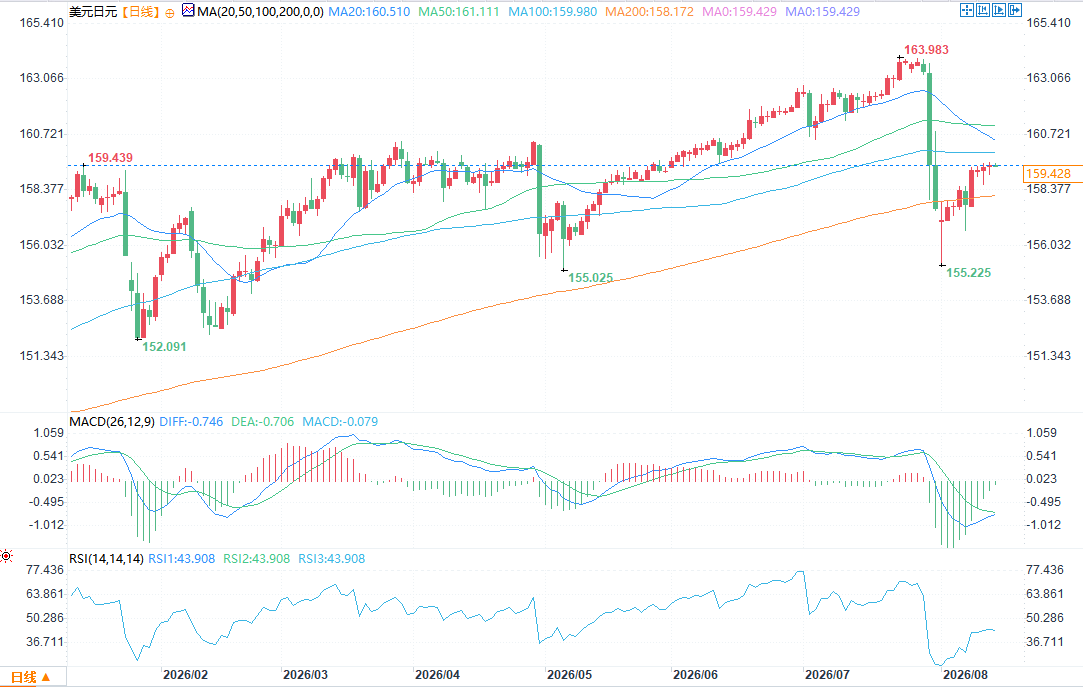 (USD/JPY daily chart, source: EasyTrade) At 8:04 AM Beijing time on August 14, the USD/JPY exchange rate was 159.43/44.
The most expensive "exchange rate floor" in history has already been half eaten up by the market.
It is estimated that Japan's first round of unilateral intervention involved purchasing approximately 8.45 trillion yen, setting a new single-day record. The following day, Japan, in conjunction with the US Treasury, added approximately 5.3 trillion yen, marking the first time since 1998 that the US and Japan have jointly purchased yen. These two rounds of intervention pushed the yen from near 164.00 to above 155.00, an appreciation of nearly 9 yen in two days. However, the current exchange rate has retreated to 159.50, meaning that approximately 4.5 yen of the gains have been wiped out by the market. The Japanese Ministry of Finance will announce the total monthly intervention amount at the end of August, at which time the market will assess the effectiveness of this expenditure by comparing it to the current exchange rate (closer to the start rather than the end of the intervention). It is noteworthy that Japan explicitly stated that it will finance future interventions through the Federal Reserve's foreign monetary authority repurchase facility, rather than selling US Treasury bonds, thus removing the previous upper limit on the scale of intervention. However, the fact that "money is not the issue" makes the current situation of half the gains being given back even more awkward—the intervention did not change the trend, but only temporarily suppressed volatility.A former senior foreign exchange official has explicitly warned that joint US-Japan intervention could "come at any time."
Former top foreign exchange official at Japan's Ministry of Finance, Mitsuhiro Furusawa, recently stated that the current yen exchange rate is "significantly too weak," and the US and Japan may intervene jointly again at any time, without being bound by a specific price level (such as 160 or 162). He specifically pointed out that if the yen exchange rate falls back to the level before last month's joint action, it could trigger a new round of intervention. Looking back to late July and early August, the coordinated buying of yen by the US and Japan pushed the exchange rate rapidly up from a 40-year low of 163.99 to approximately 155.20. However, as of this week, the yen has given back nearly half of its gains to around 159.50, raising market doubts about the effectiveness of the intervention. Furusawa emphasized that the intervention itself is merely a strategy to "buy time" and cannot fundamentally reverse the yen's weakness. Furusawa believes that for the yen to truly stabilize and rebound, it must rely on a faster pace of tightening by the Bank of Japan. He anticipates the central bank will raise interest rates at its September meeting, sending a more aggressive policy signal to the market. A further rate hike is possible in December or January, with the final policy rate target likely between 1.5% and 1.75% (referencing the central bank's estimate of a neutral rate of 1.1%-2.5%). Current market pricing already reflects a 76% probability of a September rate hike, significantly higher than the 24% at the end of July. Furthermore, Furusawa specifically points out that the Takaichi Sanae government should not hinder the central bank's rate hikes but should instead fulfill its commitment to fiscal sustainability. The ideal path is for monetary policy, fiscal discipline, and growth strategies to work in tandem, gradually moderateing the yen's growth over time.The logic of carry trade overrides everything.
Thursday's US economic data was generally bearish for the dollar: July PPI month-on-month was flat (expected +0.2%), the year-on-year rate fell from 5.5% to 4.7%, and core PPI month-on-month was +0.2% (expected +0.3%); initial jobless claims rose to 209,000 (expected 202,000, previous 200,000). Interest rate futures showed that the probability of the Fed maintaining interest rates in September rose to 65.2%, while the probability of a rate hike fell to 34.8%; the probability of maintaining the current interest rate range at the December meeting was 34.1%, and no rate cuts were priced in at any meeting in 2026. Even so, the yen continued to weaken. Carry trades do not depend on Fed rate hikes—the key is whether Japan's real policy rate remains negative. Currently, Japan's policy rate is 1.00%, while the latest inflation rate is 1.7%, meaning the real interest rate is still deeply negative. Even if Washington raises rates by 25 basis points, it will only change the size of the interest rate differential, not its direction. In addition, energy prices put extra pressure on the yen: negotiations on navigation through the Strait of Hormuz have stalled, with only eight oil tankers passing through on Tuesday, compared to an average of about 130 per day before the war; Japan relies almost entirely on imports for crude oil, and energy shocks are equivalent to trade conditions taxes for net importers, a structural negative factor that no official intervention can eliminate.Japan's GDP, inflation data, and the policy game between the US and Japan.
On Friday (August 14), attention will be focused on US July retail sales (expected monthly rate +0.1%, previous value +0.2%) and the preliminary reading of the University of Michigan Consumer Sentiment Index (expected 54.5, previous value 55.2), with the inflation expectations component receiving more attention than the overall data. In Japan, a series of important data releases are scheduled: August 16 (Sunday) 23:50 GMT: Q2 GDP preliminary reading, expected quarterly rate +0.5%, annualized +2.0% (previous value +1.8%); August 19: July trade data; August 20: National inflation data (previous value overall 1.7%, excluding fresh food 1.6%). The inflation reading will determine whether the Bank of Japan has sufficient reason to take further action after raising interest rates to 1.00% in June. If inflation remains around 1.7%, real interest rates will remain deeply negative, meaning the Ministry of Finance will be fighting alone in defending the exchange rate – the central bank cannot provide policy support. The minutes of the Federal Reserve's FOMC meeting will also be released at the same time (August 19), and the policy signals from the two central banks will resonate in a crucial way.Summarize
In summary, the yen is at an awkward crossroads: the largest intervention in history has only yielded a brief appreciation, with half of the gains already given back by the market. Meanwhile, carry trades, energy import costs, and the potential misalignment of policy objectives between the Bank of Japan and the Ministry of Finance continue to put pressure on the yen. In the coming week, Japan's GDP and inflation data will determine whether the central bank will follow suit with interest rate hikes, thus providing fundamental support for intervention; otherwise, official purchases alone will be insufficient to reverse the long-term trend determined by interest rate differentials and terms of trade. (USD/JPY daily chart, source: EasyTrade) At 8:04 AM Beijing time on August 14, the USD/JPY exchange rate was 159.43/44.
- Risk Warning and Disclaimer
- The market involves risk, and trading may not be suitable for all investors. This article is for reference only and does not constitute personal investment advice, nor does it take into account certain users’ specific investment objectives, financial situation, or other needs. Any investment decisions made based on this information are at your own risk.