Institutions: Gold prices still face short-term correction risks, but are expected to challenge the $5,000 mark in the first half of next year.
2026-08-14 10:30:57
Since 2026, the opportunity cost of holding gold due to high real interest rates has continuously suppressed gold prices, putting long-term downward pressure on them. However, UBS's latest assessment points out that negative market factors are gradually clearing up. With the combined positive effects of declining real interest rates, a weakening dollar, and continued gold purchases by global central banks, the medium- to long-term upside potential for gold has been fully unlocked. It is expected that gold prices will steadily climb to $5,000 per ounce in the first half of 2027, initiating a new round of upward movement.
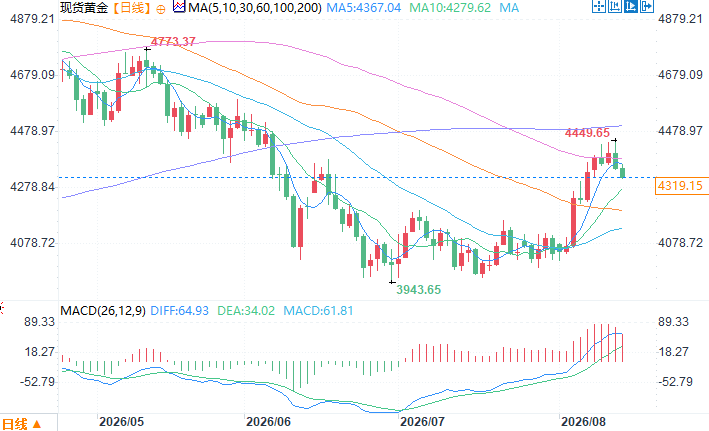 Spot gold daily chart source: EasyTrade. At 10:28 AM Beijing time on August 14, spot gold was trading at $4314.15 per ounce.
A short-term breakout from the trading range does not preclude market uncertainty and risk.
In its latest client research report, UBS pointed out that gold prices have successfully broken out of the recent narrow trading range, escaping the $100 fluctuation range and firmly establishing themselves above the $4,250 resistance level for the first time in two months. This round of gold price increases is mainly attributed to the continued entry of institutional investors from major Asian countries and the sustained inflow of funds into gold ETFs. Simultaneously, the joint yen stabilization policy implemented by the US and Japanese governments has effectively mitigated the risk of a concentrated sell-off in US Treasury bonds, creating a stable market environment for gold price increases. UBS strategists stated that short-term gold price movements still face volatility risks. If US economic data remains strong, high oil prices push up inflation expectations, or the market continues to anticipate the Federal Reserve maintaining a hawkish monetary policy, gold prices may experience a period of correction. However, short-term fluctuations will not change the long-term trend, and multiple robust positive factors will continue to support a steady upward trend in gold prices.Multiple positive factors converge to form a foundation for a medium- to long-term rise in gold prices.
The decline in real interest rates is the core driver of the gold price reversal . UBS analysts believe that US inflation will gradually slow down, the Federal Reserve will maintain interest rates unchanged in 2026, and plans to restart the rate-cutting cycle in 2027. Expectations of loose monetary policy will lower real yields, weaken the dollar, significantly reduce the cost of holding gold, and continuously boost market investment demand. A weaker dollar and global asset diversification provide sustained support for gold prices. While the dollar shows short-term resilience, the structural drawbacks of the US's large fiscal deficit, coupled with market saturation of dollar assets, suggest it is likely to weaken again. The global trend of countries continuously reducing their reliance on dollar assets and optimizing their asset structures will be beneficial to gold assets in the long term. Meanwhile, continuous gold purchases by global central banks have solidified the bottom support for gold prices. Even with lackluster private gold investment demand, central banks have maintained a large-scale gold purchase pace to diversify risk and reduce exposure to dollar assets. Global central bank gold purchases reached 289 tons in the second quarter of 2026, and the total purchase volume for the year is expected to remain between 750 and 1,000 tons, effectively offsetting the negative impact of weak jewelry consumption demand and stabilizing the overall gold market structure.Investment strategy adjustment highlights the value of long-term investment.
Looking back at market assessment adjustments, UBS lowered its year-end 2026 gold price forecast on May 26, reducing its target price from $5,900 per ounce to $5,500. At that time, UBS analysts Dominic Schnider and Wayne Gordon stated that high US Treasury yields were increasing the opportunity cost of holding gold, leading to a continuous outflow of funds from the gold market. However, with the changing market landscape, UBS advises investors to distinguish between the short-term trading risks and long-term investment value of gold, suggesting that a drop in gold prices to $4,000 per ounce or below presents excellent strategic investment opportunities. UBS also recommends that investors allocate a moderate amount of gold assets to their diversified portfolios to hedge against market volatility.Conclusion
Overall, the negative cycle in the gold market is nearing its end. The combined forces of interest rates, the US dollar, and central bank gold purchases are creating upward momentum for gold prices. Short-term fluctuations will not alter the medium- to long-term bullish trend, and 2027 may become a key year for gold prices to break through resistance levels. Spot gold daily chart source: EasyTrade. At 10:28 AM Beijing time on August 14, spot gold was trading at $4314.15 per ounce.
- Risk Warning and Disclaimer
- The market involves risk, and trading may not be suitable for all investors. This article is for reference only and does not constitute personal investment advice, nor does it take into account certain users’ specific investment objectives, financial situation, or other needs. Any investment decisions made based on this information are at your own risk.