With US PPI data falling short of expectations and the probability of a Fed rate hike dropping to 34.8%, how far can the euro's rebound go?
2026-08-14 10:58:55
On Friday (August 14) in early Asian trading, the euro continued its gains against the dollar from the previous day, currently trading around 1.1535. The US July Producer Price Index (PPI) rose 4.7% year-on-year, lower than market expectations, further confirming easing inflationary pressures and weakening expectations of a Fed rate hike in September, thus putting pressure on the dollar. Meanwhile, the market has largely priced in the European Central Bank's (ECB) expectation of a 25 basis point rate hike in September, providing additional support for the euro. However, geopolitical risks in the Strait of Hormuz continue to provide safe-haven buying for the dollar. With these two forces locked in a tug-of-war, the euro's short-term strength may be limited by geopolitical uncertainties. 
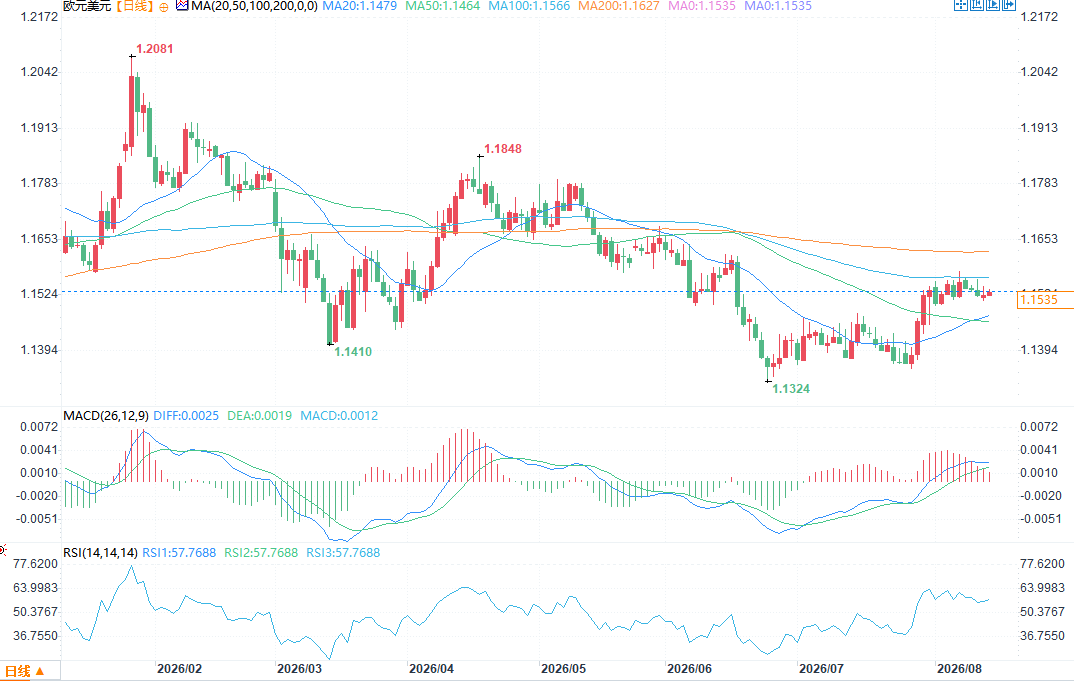 (Euro/USD daily chart, source: FX678) At 10:56 Beijing time on August 14, the euro was trading at 1.1534/35 against the US dollar.
US PPI fell across the board below expectations, further reducing the probability of a Fed rate hike.
Data released by the U.S. Bureau of Labor Statistics on Thursday showed that the Producer Price Index (PPI) was flat in July (0.0%), lower than the market expectation of a 0.2% increase, and the previous value was revised down from -0.1% to -0.2%. The core PPI, excluding food and energy, rose 0.2% month-on-month, also lower than the expected 0.3%. On an annual basis, the overall PPI rose 4.7% year-on-year in July, while the core PPI rose 4.2% year-on-year. This is further evidence of easing inflationary pressures in the U.S., following Wednesday's Consumer Price Index (CPI) data. After the data release, market expectations for a Federal Reserve rate hike in September further declined. According to the CME FedWatch tool, the probability of a rate hike at the September meeting has fallen from 40% before the PPI data release to 34.8%, while at the end of July, this probability was still around 50/50.A September rate hike by the European Central Bank is almost a certainty, but the situation in the Middle East poses an upside risk.
Across the Atlantic, the market has largely priced in the European Central Bank's (ECB) expectation of a 25-basis-point rate hike at its September monetary policy meeting. ECB President Christine Lagarde warned last month that a renewed escalation of conflict in the Middle East and the resulting rebound in oil prices pose upside risks to the eurozone's inflation outlook. This statement reinforced market expectations of further policy tightening by the ECB, providing fundamental support for the euro.The US dollar is caught between "cooling expectations of interest rate hikes" and "geopolitical safe-haven demand".
Rabobank strategists point out that the US dollar is currently facing two conflicting forces. On the one hand, if expectations of a Federal Reserve rate hike continue to weaken, the dollar will face downward pressure; on the other hand, the uncertainty surrounding the reopening of the Strait of Hormuz remains a factor supporting the dollar. The institution specifically notes that at the outset of the Iran-Iraq War, "the market was in a short dollar position," making the dollar particularly sensitive to changes in geopolitical risks and fluctuations in safe-haven demand.Summarize
In summary, the euro benefits in the short term from the downward revision of Fed rate hike expectations due to cooling US inflation, as well as the ECB's relatively hawkish policy stance. However, the dollar has not completely lost support—geopolitical risks in the Strait of Hormuz continue to provide safe-haven buying for the dollar, limiting the euro's upside potential. The US July retail sales data to be released Friday evening will be the next key catalyst. If the data is weaker than expected, it could further dampen Fed rate hike expectations, pushing the euro towards 1.1600; conversely, if the retail data is unexpectedly strong, the dollar may get a breather, and the euro's ability to hold above 1.1500 will be tested. The short-term euro-dominant trend remains unchanged, but caution is advised regarding the risks of chasing higher levels. (Euro/USD daily chart, source: FX678) At 10:56 Beijing time on August 14, the euro was trading at 1.1534/35 against the US dollar.
- Risk Warning and Disclaimer
- The market involves risk, and trading may not be suitable for all investors. This article is for reference only and does not constitute personal investment advice, nor does it take into account certain users’ specific investment objectives, financial situation, or other needs. Any investment decisions made based on this information are at your own risk.