Analysts warn that if the stalemate in the Strait of Hormuz continues, oil prices could reach as high as $140 per barrel by the end of September or the beginning of the fourth quarter.
2026-08-14 11:10:57
In recent months, the international crude oil market has been mired in a battle between bulls and bears, with market trading revolving around two core themes. On the one hand, the ongoing tensions in the Middle East have severely disrupted shipping in the Strait of Hormuz, causing a rigid shock to the global oil supply chain. On the other hand, the market has consistently held onto the expectation of a reconciliation agreement between the US and Iran, hoping to release the crude oil and refined oil resources stranded in the Persian Gulf. The five-and-a-half-month standoff has caused frequent and violent fluctuations in oil prices. With the current stalemate in strait navigation, coupled with continued global inventory reduction, the crude oil market is approaching a critical tipping point of supply-demand imbalance, and there is a risk of a significant price jump in the fourth quarter.
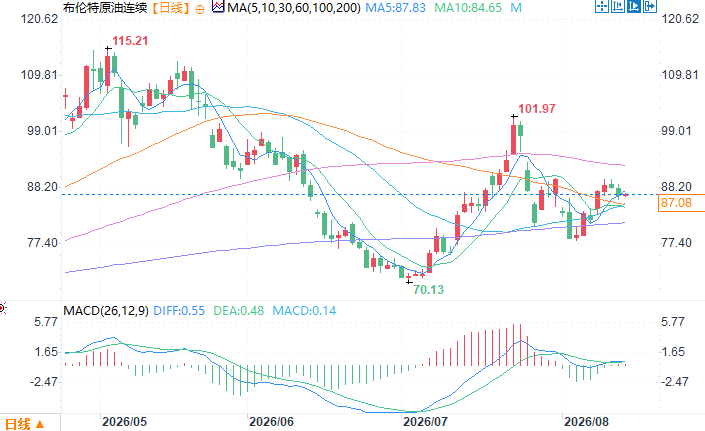 Brent crude oil daily chart source: EasyTrade. At 11:09 AM Beijing time on August 14th, Brent crude oil was trading at $87.03 per barrel.
The standoff between the US and Iran has reached a stalemate, leading to increased volatility in oil prices.
This round of tensions encompassed multiple rounds of negotiations and standoffs, tanker attacks, a US export blockade, and repeated hardline statements from both sides, resulting in record-breaking frequency of oil price fluctuations. Current traffic volume in the Strait of Hormuz has fallen to a two-month low, and the market remains tense. On Wednesday morning in Asian trading, conflicting statements from the US and Iran regarding control of the Strait directly pushed Brent crude oil prices briefly above $89 per barrel. Iran stated that the Strait of Hormuz would remain closed until the US ends the standoff and meets its demands. Previously, on Tuesday, US President Trump stated that the US had achieved complete control over the Strait of Hormuz. The contradictory statements from both sides exacerbated market uncertainty, and oil prices fell slightly in early Asian trading on Thursday due to concerns that high oil prices might suppress end-user demand. Current short-term market movements are primarily driven by geopolitical sentiment, ignoring the structural tightening trend in the physical market. Since the escalation of the situation on February 28, the market has repeatedly speculated on the positive expectation of the Strait reopening, but the actual supply and demand fundamentals have quietly reversed. The release of strategic petroleum reserves by various countries in the early stages, the low import levels of major Asian countries in the second quarter, and the ample floating oil reserves at sea at the beginning of the conflict temporarily offset the supply gap, preventing crude oil futures from reaching a record high. However, as the release of reserves nears its end, major Asian countries have returned to high levels of crude oil purchases, and the market's buffer space has significantly narrowed.The supply and demand imbalance of refined oil products is severe, far exceeding that in the crude oil market.
Compared to the crude oil market, the global refined product market faces a more severe tightness. Continued disruptions to refining facilities in the Middle East and Russia have pushed up crack spreads and refining margins, with refining profitability in the Atlantic Basin reaching record highs. Ole Hansen, head of commodity strategy at Saxo Bank, stated that while crude oil prices are currently volatile due to geopolitical news, the real supply squeeze is concentrated in middle distillates such as diesel, gas oil, and jet fuel. The supply-demand gap in refined products is far more pronounced than in the crude oil market. This week's oil market report from the International Energy Agency (IEA) confirms this trend. The report shows that while global crude oil refining volumes saw a slight month-on-month increase in July, they still declined significantly year-on-year, indicating that global spare capacity cannot compensate for the supply shortage in refined products. Although US refined product exports saw significant year-on-year growth in July, the sharp decline in refined product exports from the Middle East and Russia led to a substantial contraction in global seaborne refined product trade. The agency also warned that global inventory buffers are being rapidly depleted, and there is significant uncertainty regarding a return to oversupply by the end of the year, further increasing the urgency of reopening the Strait of Hormuz.Institutions warn of a potential surge in oil prices in the fourth quarter, with high volatility expected to continue.
Multiple authoritative institutions predict that if the stalemate in the Strait of Hormuz continues, the crude oil market will reach a supply-demand tipping point in early Q4. Kieran Tompkins, senior climate and commodities economist at Capital Economics, stated that the continued rapid depletion of OECD oil inventories, coupled with shipping restrictions in the Strait, will likely lead to a significant price increase in early Q4, potentially reaching $120-140 per barrel based on historical data. Amrita Sen, founder and research director of Energy Perspectives, stated that from a fundamental perspective, the bullish logic for crude oil is becoming increasingly solid. Ole Hansen further analyzed that until the Strait of Hormuz fully reopens to navigation and oil and gas production capacity recovers significantly, high price volatility will be the norm, and the price trends of distillate fuels and futures curves will continue to directly reflect the tightness of the global energy market.Conclusion
Overall, the current sentiment in the crude oil market is cautious, but the supply and demand fundamentals have continued to tighten, with the shortage of refined oil products being particularly prominent. The unresolved stalemate between the US and Iran, the depletion of inventory buffers, and limited refining capacity are all factors contributing to a continued increase in the risk of a significant oil price surge in the fourth quarter. Subsequent geopolitical developments will directly dominate international oil price trends. Brent crude oil daily chart source: EasyTrade. At 11:09 AM Beijing time on August 14th, Brent crude oil was trading at $87.03 per barrel.
- Risk Warning and Disclaimer
- The market involves risk, and trading may not be suitable for all investors. This article is for reference only and does not constitute personal investment advice, nor does it take into account certain users’ specific investment objectives, financial situation, or other needs. Any investment decisions made based on this information are at your own risk.