Why is the pound still stuck at 1.3500 despite the unexpected growth in UK GDP?
2026-08-14 08:26:55
On Friday (August 14) in early Asian trading, the pound rose slightly against the dollar, currently trading below 1.3500, with intraday fluctuations of only about 20 points. The market reacted mildly to the dual positive factors of stronger-than-expected UK economic growth and weaker-than-expected US PPI data. June GDP unexpectedly grew by 0.3%, but upon closer inspection, this "surprise" relied heavily on one-off factors such as the temporary ceasefire in the Gulf, the start of the World Cup, and favorable weather. The ceasefire agreement broke down in July, significantly diminishing the strength of the growth. Meanwhile, the dollar itself weakened due to cooling expectations of interest rate hikes, but pound cross rates were under pressure across the board, indicating that this round of gains was more driven by dollar selling than by active buying of the pound. In the coming week, a flurry of UK employment, inflation, and PMI data will be released, which will be the true litmus test for the strength of the pound's rebound. 
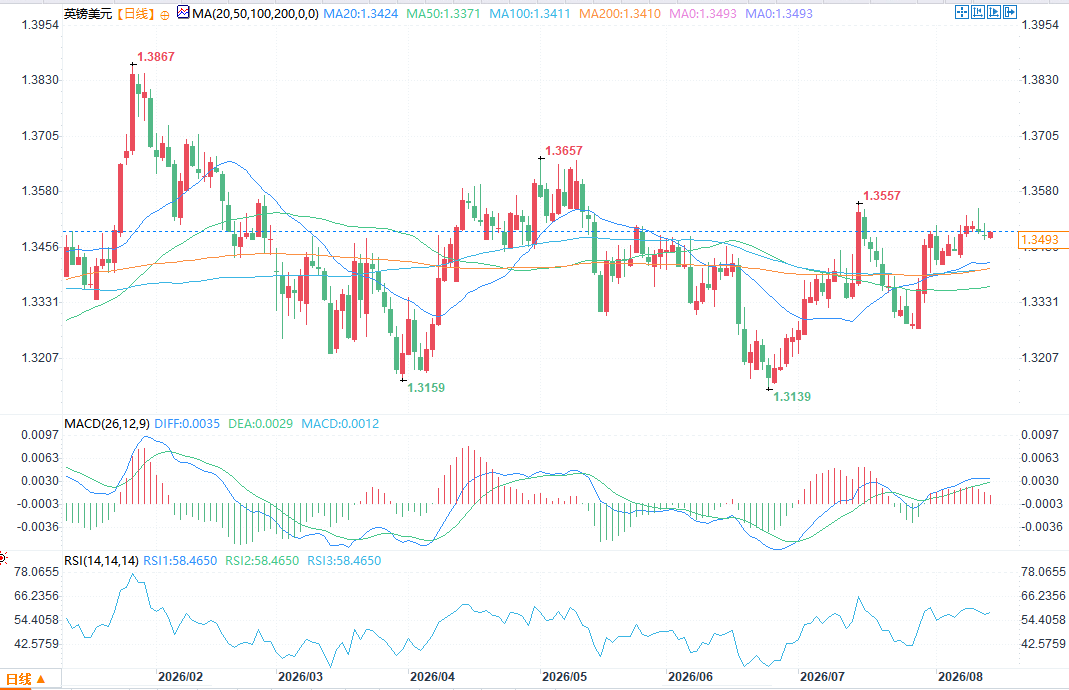 (GBP/USD daily chart, source: FX678) At 8:21 AM Beijing time on August 14, GBP/USD was trading at 1.3492/93.
Growth exceeded expectations, but the "good data" stemmed from a dead ceasefire agreement.
UK GDP grew 0.3% month-on-month in June, far exceeding the expected zero growth; second-quarter year-on-year growth was 1.2% (expected 1.1%), and the quarter-on-quarter growth met expectations at 0.4%, but slowed from the previous 0.6% – all the unexpected gains were concentrated in June alone. Detailed data shows that the service sector was the main engine of growth in June, with contributions attributed to three main factors: the temporary ceasefire in the Gulf region, the start of the World Cup, and favorable weather. Two of these are non-repeatable calendar events, and the third (the ceasefire) broke down in July. Negotiations to reopen the Strait of Hormuz have stalled, with Iran proposing six preconditions, while the US claims the waterway is under its control; only eight oil tankers passed through on Tuesday, far below the pre-war daily average of about 130. Growth supported by service sector consumption during the ceasefire is a fragile foundation for the pound. Meanwhile, industrial data weakened across the board: industrial output fell 0.2% month-on-month in June (expected slight increase), and manufacturing output fell 0.5% (expected decline of 0.2%).A weaker dollar is dominating exchange rates, while cross rates of the British pound reveal the true situation.
On Thursday, the US July PPI month-on-month rate was flat (expected +0.2%), the annual rate fell to 4.7% from 5.5%, and the core monthly rate rose 0.2% (expected +0.3%); initial jobless claims rose to 209,000 (expected 202,000, previous value 200,000). Interest rate futures show that the probability of a Fed rate hike in September has fallen from 50/50 on August 10 to 34.8%, while the probability of maintaining the rate has risen to 65.2%; the probability of the October meeting is nearly 50/50, and the probability of maintaining the current interest rate range in December is 34.1%; there is no rate cut pricing in any meeting in 2026—this is only a downward revision of rate hike expectations, not the start of an easing cycle. The speeches of two Fed officials were both hawkish (one of whom was one of the three regional Fed presidents who voted against the rate hike at the July meeting), but this did not prevent the market from repricing.Next week marks the first true "British Week" of the summer.
On Friday, attention will be focused on US July retail sales (expected month-on-month increase of 0.1%, previous value of 0.2%) and the preliminary reading of the University of Michigan Consumer Sentiment Index (expected 54.5, previous value of 55.2), with the inflation expectations component receiving more attention than the overall data. Next week's focus will return to the UK: August 18: Labor market data (unemployment claims, employment change, and unemployment rate, previous value 4.9%); August 19: July inflation data (previous value overall 2.6%, core 2.6%), and the release of the FOMC meeting minutes on the same day; August 21: Retail sales and the preliminary August PMI reading. These data will be the last batch of key domestic readings before the Bank of England meeting on September 17 – currently, three of the nine members are leaning towards a rate hike. The release of the FOMC minutes on August 19 will make the middle of next week the first "two-sided test" for this rebound.Summarize
In summary, the pound's recent rebound started below 1.3400, accumulating a gain of about 2 cents. However, the main driver of this rise was a pullback in interest rate expectations on the US dollar front, rather than a strengthening of the pound's own fundamentals. While June GDP exceeded expectations, the contributing factors were mostly one-off events, and the key support (the ceasefire) has disappeared, with industrial output showing signs of weakness. Next week's release of a flurry of UK employment, inflation, and PMI data, coupled with the simultaneous release of the Fed's FOMC minutes, will be the crucial window to see if the pound can hold its ground above 1.3500. (GBP/USD daily chart, source: FX678) At 8:21 AM Beijing time on August 14, GBP/USD was trading at 1.3492/93.
- Risk Warning and Disclaimer
- The market involves risk, and trading may not be suitable for all investors. This article is for reference only and does not constitute personal investment advice, nor does it take into account certain users’ specific investment objectives, financial situation, or other needs. Any investment decisions made based on this information are at your own risk.