Crude oil trading alert: Downward revision of demand forecasts and risks in the Strait of Hormuz have led to a three-day decline in oil prices; be wary of another breakout.
2026-08-14 09:46:55
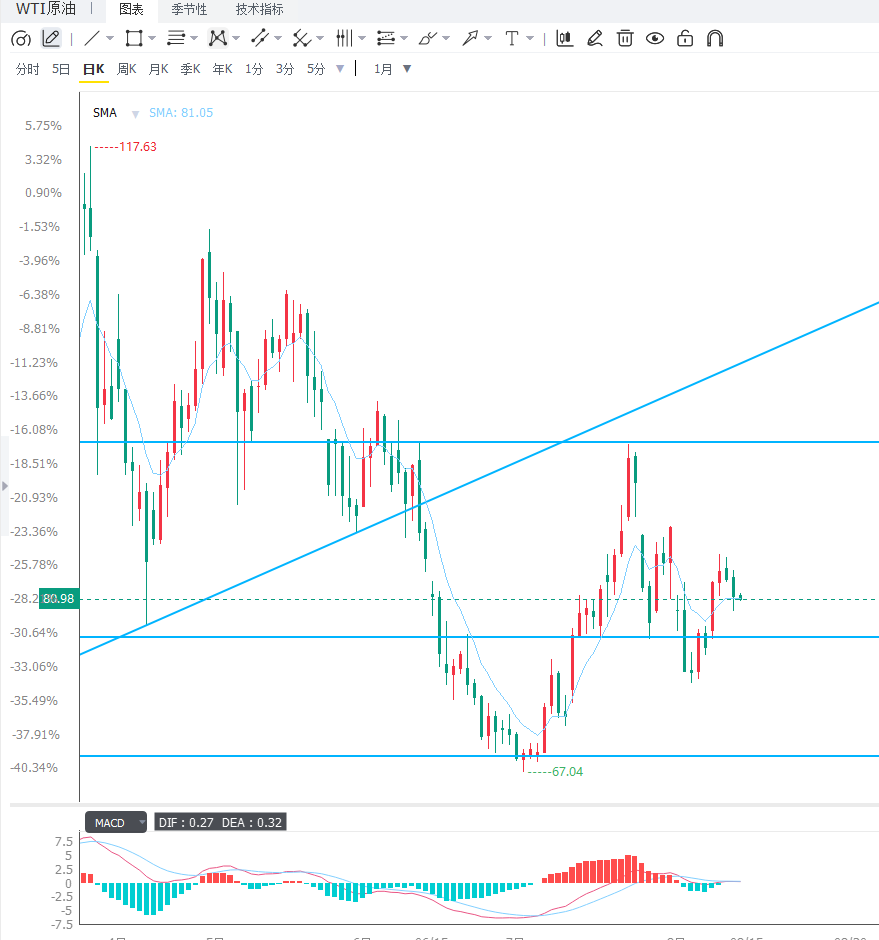
WTI crude oil continued its weakness in Asian trading on Friday, hovering around $80.90 per barrel, marking the third consecutive day of pressure. Oil prices had previously risen rapidly driven by geopolitical supply risks, but the recent upward momentum has clearly weakened as market sentiment has gradually shifted from simply focusing on supply disruptions to reassessing the demand outlook. On August 13, the WTI settlement price had fallen by more than 2% to $81.25 per barrel, while Brent crude fell to approximately $87.07 per barrel, indicating that profit-taking at higher levels and fundamental concerns are simultaneously intensifying.  The biggest variable in the current market remains the Strait of Hormuz. Although diplomatic efforts have yet to yield substantial breakthroughs, Persian Gulf oil transport has not completely ceased; some tankers continue to attempt to pass through the key waterway, while others have turned off their Automatic Identification Systems (AIS) to reduce exposure risk. The core market focus is not on whether oil flows have completely stopped, but on whether global energy transport can steadily return to normal levels. As long as shipping remains restricted, an additional risk premium will persist in the oil supply chain; however, if navigation conditions improve significantly, the previously accumulated geopolitical premium could be quickly reversed. From the supply side, the oil market remains relatively tight. The latest assessment from the International Energy Agency indicates that global oil supply may decrease by approximately 4.3 million barrels per day in 2026, a drop of about 4%, mainly due to continued disruptions to supply and transport in the Middle East. Meanwhile, global inventories have declined significantly, meaning that if the Strait of Hormuz remains inefficiently operated for an extended period, the market may still face further spot supply pressure. However, in stark contrast to supply-side risks, demand-side factors are becoming a new force suppressing oil prices. The International Energy Agency (IEA) recently forecasts that global oil demand may decrease by approximately 1.6 million barrels per day (bpd) in 2026, a further deterioration from its previous forecast, due to high oil prices, rising fuel costs, and pressure on economic activity. The agency also anticipates that demand may resume growth in 2027 as supply conditions improve and the economic environment recovers. While OPEC's assessment is not as pessimistic as the IEA's, it also signals a cooling demand. OPEC recently lowered its 2026 global oil demand growth forecast from 780,000 bpd to 580,000 bpd, marking the fourth consecutive downward revision. Simultaneously, the organization has raised its 2027 demand growth forecast, indicating that the current situation is more a temporary demand adjustment caused by high prices, supply shocks, and slowing economic activity, rather than a complete reversal of long-term energy consumption trends. US inventory data further reinforced short-term bearish sentiment. Data released by the US Energy Information Administration (EIA) shows that as of the latest reporting week, US commercial crude oil inventories increased by approximately 17.4 million barrels, the largest weekly increase since January 2023, significantly exceeding market expectations. This means that after a rapid rise in oil prices, the actual supply situation in the US market has not deteriorated accordingly, and the unexpected increase in inventories has weakened some of the supply tightness logic. Therefore, the current WTI market presents a typical bullish-bearish contradiction: on the one hand, restrictions on shipping through the Strait of Hormuz, declining global inventories, and hindered supply recovery in the Middle East mean that the fundamentals of crude oil spot prices still have strong support; on the other hand, continuous downward revisions in demand forecasts and a significant increase in US inventories are weakening the market's willingness to continue chasing higher prices. This fundamental divergence suggests that oil prices may shift from the previous unilateral rise to high-level fluctuations in the short term, and the market needs to wait for shipping recovery, inventory changes, and actual consumption data to provide a clearer direction. TD Securities believes that the recent upward momentum in crude oil is weakening, and some long positions are beginning to take profits. However, the institution also points out that the tight fundamentals in the crude oil and refined oil markets may still provide support for further price increases. This means that the current pullback does not necessarily mean the end of the upward cycle, but is more likely a rebalancing of positions after a rapid rise. If shipping through the Strait of Hormuz deteriorates further, or if the recovery of supply in the Middle East is hindered again, WTI may regain upward momentum. From a global market perspective, oil prices remaining above $80 will continue to influence inflation expectations through energy cost channels. For European and American economies, rising crude oil and refined product prices may increase transportation, manufacturing, and consumer costs, and impose new constraints on monetary policy. For economies heavily reliant on energy imports, persistently high oil prices may also exacerbate import cost pressures. Meanwhile, while falling oil prices can alleviate inflation, they may also reflect weakening global economic activity and energy consumption; therefore, a simple decline in oil prices should not be viewed as a purely positive factor. What the market should truly focus on now is the actual volume of traffic in the Strait of Hormuz, not merely diplomatic statements. If tanker traffic continues to recover, the supply risk premium may further contract, and WTI will be more easily dominated by inventory and demand factors. If shipping experiences significant disruptions again, the previously suppressed geopolitical risk premium may be quickly repriced. Furthermore, whether US crude oil inventories can resume their decline in the coming weeks will be a crucial indicator of whether the current surge in inventories is a short-term disturbance or a sign of weak demand. From a technical perspective, WTI crude oil prices surged after breaking through $80, but have since retreated to around $80, meaning that $80 has shifted from a psychological level to a short-term battleground between bulls and bears. Looking at the medium-term structure, oil prices have broken through important moving averages and the resistance of the recent downtrend, showing a significant improvement in the technical pattern. However, the recent continuous decline indicates weakening upward momentum. If the daily chart can regain a foothold around $82.50, the next potential test is $85 and $87. A decisive break above $85 could open up further upside potential in the medium term. Conversely, if the daily chart continues to close below $80, caution is warranted as this rebound may enter a deeper correction, with the next support level to watch being the $77.30-$77.00 area. The technical improvement following WTI's break above the 200-day moving average was a crucial foundation for this upward move. From a daily momentum perspective, oil prices are currently in a consolidation phase after the previous rapid rise. Short-term momentum indicators are starting to cool down, but as long as the price remains around $80 without a significant breakout, the overall structure cannot be simply defined as a shift to a bear market. The first resistance zone is $82.50-$85.00, while $80.00 is the most important short-term psychological support. If this level is breached, the area around $77 will become the next area to watch. If the price breaks through $85 again, accompanied by a simultaneous improvement in trading volume and momentum indicators, it means that the bulls may regain control. On the 4-hour chart, WTI has shifted from a rapid upward trend to a consolidation and pullback, with prices fluctuating around $80. The upward structure formed after the previous breakout above the 200-period moving average on the 4-hour chart still has some continuity; therefore, the current pullback is more of a reconfirmation of the breakout area. If significant buying interest emerges around $80, the price may first rebound to test $82.50, then further challenge the $84-$85 area. However, if the price breaks below $80 on the 4-hour chart, the short-term trend will weaken, and it may seek support around $77.30. Looking at momentum indicators, the recent upward movement has shown signs of cooling, making chasing the rally significantly riskier than before. Waiting for a pullback to confirm the direction is a more prudent approach. Previous technical models also indicated that after breaking through $80, WTI faces significant Fibonacci resistance around $82.47, while $87 represents a higher-level target area.
  The editor summarizes that WTI is currently not facing a purely bullish or bearish environment, but rather a direct struggle between tight supply and cooling demand. The Strait of Hormuz remains the core variable determining the risk premium for oil prices. Declining global inventories and hindered supply recovery provide a floor for oil prices. At the same time, the IEA's significant downward revision of demand forecasts, OPEC's fourth consecutive downward revision of demand growth forecasts, and the unexpected increase in US crude oil inventories all limit the potential for further rapid price increases. In the short term, $80 is the most important watershed for WTI. Holding this level, the market still has a chance to retest the $82.50-$85 range, and if supply risks escalate further, it could even extend to the $87 area; however, if $80 is effectively breached, oil prices may enter a more significant technical correction. Going forward, investors should focus on monitoring the actual recovery of shipping in the Strait of Hormuz, changes in US inventories, global refined product consumption, and subsequent demand forecasts from the IEA and OPEC. With supply risks yet to be eliminated, the downside potential for WTI is limited. However, the continued deterioration in demand means that the closer oil prices get to above $85, the more vigilant the pressure from demand-damaging effects will be.
The biggest variable in the current market remains the Strait of Hormuz. Although diplomatic efforts have yet to yield substantial breakthroughs, Persian Gulf oil transport has not completely ceased; some tankers continue to attempt to pass through the key waterway, while others have turned off their Automatic Identification Systems (AIS) to reduce exposure risk. The core market focus is not on whether oil flows have completely stopped, but on whether global energy transport can steadily return to normal levels. As long as shipping remains restricted, an additional risk premium will persist in the oil supply chain; however, if navigation conditions improve significantly, the previously accumulated geopolitical premium could be quickly reversed. From the supply side, the oil market remains relatively tight. The latest assessment from the International Energy Agency indicates that global oil supply may decrease by approximately 4.3 million barrels per day in 2026, a drop of about 4%, mainly due to continued disruptions to supply and transport in the Middle East. Meanwhile, global inventories have declined significantly, meaning that if the Strait of Hormuz remains inefficiently operated for an extended period, the market may still face further spot supply pressure. However, in stark contrast to supply-side risks, demand-side factors are becoming a new force suppressing oil prices. The International Energy Agency (IEA) recently forecasts that global oil demand may decrease by approximately 1.6 million barrels per day (bpd) in 2026, a further deterioration from its previous forecast, due to high oil prices, rising fuel costs, and pressure on economic activity. The agency also anticipates that demand may resume growth in 2027 as supply conditions improve and the economic environment recovers. While OPEC's assessment is not as pessimistic as the IEA's, it also signals a cooling demand. OPEC recently lowered its 2026 global oil demand growth forecast from 780,000 bpd to 580,000 bpd, marking the fourth consecutive downward revision. Simultaneously, the organization has raised its 2027 demand growth forecast, indicating that the current situation is more a temporary demand adjustment caused by high prices, supply shocks, and slowing economic activity, rather than a complete reversal of long-term energy consumption trends. US inventory data further reinforced short-term bearish sentiment. Data released by the US Energy Information Administration (EIA) shows that as of the latest reporting week, US commercial crude oil inventories increased by approximately 17.4 million barrels, the largest weekly increase since January 2023, significantly exceeding market expectations. This means that after a rapid rise in oil prices, the actual supply situation in the US market has not deteriorated accordingly, and the unexpected increase in inventories has weakened some of the supply tightness logic. Therefore, the current WTI market presents a typical bullish-bearish contradiction: on the one hand, restrictions on shipping through the Strait of Hormuz, declining global inventories, and hindered supply recovery in the Middle East mean that the fundamentals of crude oil spot prices still have strong support; on the other hand, continuous downward revisions in demand forecasts and a significant increase in US inventories are weakening the market's willingness to continue chasing higher prices. This fundamental divergence suggests that oil prices may shift from the previous unilateral rise to high-level fluctuations in the short term, and the market needs to wait for shipping recovery, inventory changes, and actual consumption data to provide a clearer direction. TD Securities believes that the recent upward momentum in crude oil is weakening, and some long positions are beginning to take profits. However, the institution also points out that the tight fundamentals in the crude oil and refined oil markets may still provide support for further price increases. This means that the current pullback does not necessarily mean the end of the upward cycle, but is more likely a rebalancing of positions after a rapid rise. If shipping through the Strait of Hormuz deteriorates further, or if the recovery of supply in the Middle East is hindered again, WTI may regain upward momentum. From a global market perspective, oil prices remaining above $80 will continue to influence inflation expectations through energy cost channels. For European and American economies, rising crude oil and refined product prices may increase transportation, manufacturing, and consumer costs, and impose new constraints on monetary policy. For economies heavily reliant on energy imports, persistently high oil prices may also exacerbate import cost pressures. Meanwhile, while falling oil prices can alleviate inflation, they may also reflect weakening global economic activity and energy consumption; therefore, a simple decline in oil prices should not be viewed as a purely positive factor. What the market should truly focus on now is the actual volume of traffic in the Strait of Hormuz, not merely diplomatic statements. If tanker traffic continues to recover, the supply risk premium may further contract, and WTI will be more easily dominated by inventory and demand factors. If shipping experiences significant disruptions again, the previously suppressed geopolitical risk premium may be quickly repriced. Furthermore, whether US crude oil inventories can resume their decline in the coming weeks will be a crucial indicator of whether the current surge in inventories is a short-term disturbance or a sign of weak demand. From a technical perspective, WTI crude oil prices surged after breaking through $80, but have since retreated to around $80, meaning that $80 has shifted from a psychological level to a short-term battleground between bulls and bears. Looking at the medium-term structure, oil prices have broken through important moving averages and the resistance of the recent downtrend, showing a significant improvement in the technical pattern. However, the recent continuous decline indicates weakening upward momentum. If the daily chart can regain a foothold around $82.50, the next potential test is $85 and $87. A decisive break above $85 could open up further upside potential in the medium term. Conversely, if the daily chart continues to close below $80, caution is warranted as this rebound may enter a deeper correction, with the next support level to watch being the $77.30-$77.00 area. The technical improvement following WTI's break above the 200-day moving average was a crucial foundation for this upward move. From a daily momentum perspective, oil prices are currently in a consolidation phase after the previous rapid rise. Short-term momentum indicators are starting to cool down, but as long as the price remains around $80 without a significant breakout, the overall structure cannot be simply defined as a shift to a bear market. The first resistance zone is $82.50-$85.00, while $80.00 is the most important short-term psychological support. If this level is breached, the area around $77 will become the next area to watch. If the price breaks through $85 again, accompanied by a simultaneous improvement in trading volume and momentum indicators, it means that the bulls may regain control. On the 4-hour chart, WTI has shifted from a rapid upward trend to a consolidation and pullback, with prices fluctuating around $80. The upward structure formed after the previous breakout above the 200-period moving average on the 4-hour chart still has some continuity; therefore, the current pullback is more of a reconfirmation of the breakout area. If significant buying interest emerges around $80, the price may first rebound to test $82.50, then further challenge the $84-$85 area. However, if the price breaks below $80 on the 4-hour chart, the short-term trend will weaken, and it may seek support around $77.30. Looking at momentum indicators, the recent upward movement has shown signs of cooling, making chasing the rally significantly riskier than before. Waiting for a pullback to confirm the direction is a more prudent approach. Previous technical models also indicated that after breaking through $80, WTI faces significant Fibonacci resistance around $82.47, while $87 represents a higher-level target area. The editor summarizes that WTI is currently not facing a purely bullish or bearish environment, but rather a direct struggle between tight supply and cooling demand. The Strait of Hormuz remains the core variable determining the risk premium for oil prices. Declining global inventories and hindered supply recovery provide a floor for oil prices. At the same time, the IEA's significant downward revision of demand forecasts, OPEC's fourth consecutive downward revision of demand growth forecasts, and the unexpected increase in US crude oil inventories all limit the potential for further rapid price increases. In the short term, $80 is the most important watershed for WTI. Holding this level, the market still has a chance to retest the $82.50-$85 range, and if supply risks escalate further, it could even extend to the $87 area; however, if $80 is effectively breached, oil prices may enter a more significant technical correction. Going forward, investors should focus on monitoring the actual recovery of shipping in the Strait of Hormuz, changes in US inventories, global refined product consumption, and subsequent demand forecasts from the IEA and OPEC. With supply risks yet to be eliminated, the downside potential for WTI is limited. However, the continued deterioration in demand means that the closer oil prices get to above $85, the more vigilant the pressure from demand-damaging effects will be.
- Risk Warning and Disclaimer
- The market involves risk, and trading may not be suitable for all investors. This article is for reference only and does not constitute personal investment advice, nor does it take into account certain users’ specific investment objectives, financial situation, or other needs. Any investment decisions made based on this information are at your own risk.