Warnings of potential yen intervention have resurfaced, with a former senior foreign exchange official warning of "intervention at any time," and the probability of a September rate hike has surged to 76%.
2026-08-14 10:10:56
On Friday (August 14) during the Asian session, the USD/JPY pair fluctuated narrowly, currently trading around 159.45, almost precisely at the 50% retracement level of the previous high of 164.00 and the low of the joint intervention at 155.00, indicating that the battle between bulls and bears has entered a critical area. Mitsuhiro Furusawa, former top foreign exchange official at the Japanese Ministry of Finance, issued a clear warning in an interview on Thursday: the current yen exchange rate is "significantly too weak," and the US and Japan may intervene jointly again "at any time," without being bound by specific price levels such as 160 or 162. He also predicted that the Bank of Japan will raise interest rates in September and act again in December or January, with the final policy rate target likely between 1.5% and 1.75%. Furusawa's statement essentially confirms the logic that the market had gradually digested—whether it's verbal warnings or actual intervention, they can only buy time; the key to truly reversing the yen's decline lies in the pace of interest rate hikes by the central bank. This stance upgrades the yen narrative from a "single intervention event" to a "tightening cycle with multiple interest rate hikes," providing the market with a more sustainable trading framework. 
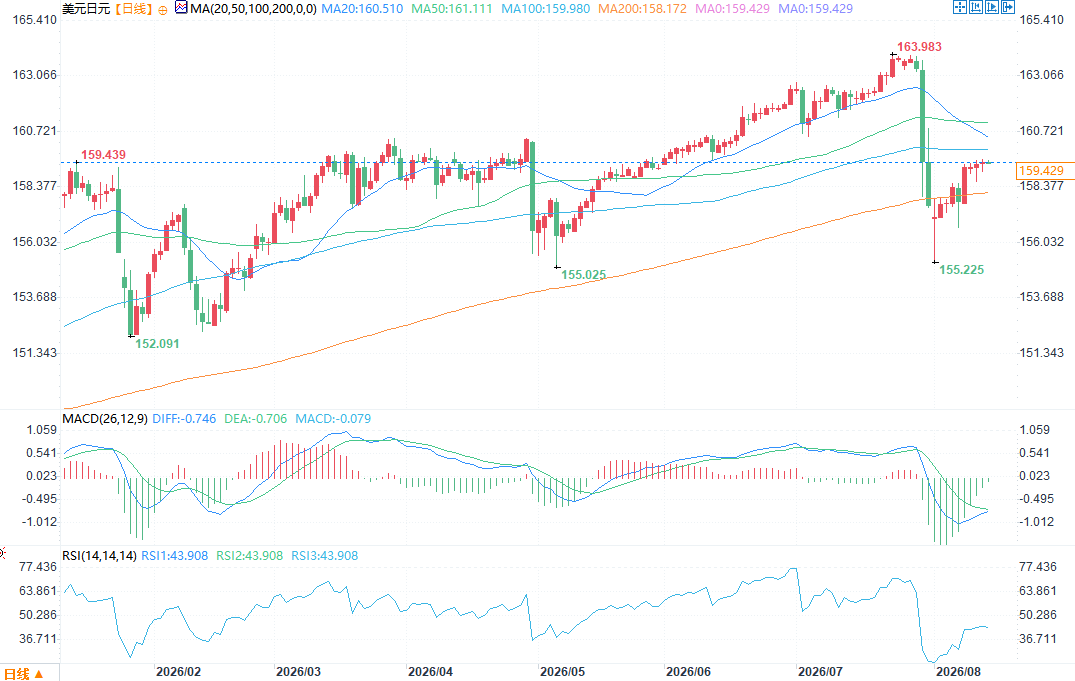 (USD/JPY daily chart, source: FX678) At 10:08 Beijing time on August 14, the USD/JPY exchange rate was 159.43/44.
Intervention could be implemented "at any time," with no fixed price ceiling set.
Mitsuhiro Furusawa, currently the head of the Global Financial Affairs Research Institute at Sumitomo Mitsui Banking Corporation, previously represented Japan's Ministry of Finance in foreign exchange affairs and later served as Deputy Managing Director of the International Monetary Fund (IMF). In an interview, he stated that the current yen exchange rate is "significantly too weak," harming the Japanese economy by pushing up import costs. He pointed out that if the yen exchange rate falls back to levels before last month's joint intervention, Tokyo and Washington could act again at any time, but emphasized that there is no fixed trigger level. He stated, "Intervention may not be specifically targeted at levels like 160 or 162 yen per dollar, but it could happen again at any time, including in conjunction with the United States." Last month, the coordinated US-Japan intervention pushed the yen sharply higher from a 40-year low of 163.99 to approximately 155.20, but as of this week, the exchange rate has retreated to around 159.45, almost erasing half of its previous gains, reigniting the market pressure that initially prompted the two countries to intervene.Intervention can only "buy time"; the fundamental solution lies in the central bank accelerating interest rate hikes.
Furusawa emphasized that intervention alone can only buy time; a sustained reversal of the yen's downward trend requires more fundamental measures—the core of which is a faster pace of interest rate hikes by the Bank of Japan. He stated that most market participants already expect the central bank to raise rates in September, and the central bank should do so; however, he believes that more important than the September rate hike itself is that the central bank needs to signal that the pace of future rate hikes may accelerate. Since exiting its decade-long stimulus program in 2024, the Bank of Japan has raised rates roughly twice a year, including raising the policy rate to 1% in June, a 31-year high. Looking further ahead, Furusawa estimates that the central bank ultimately hopes to raise rates to between 1.5% and 1.75%, a judgment based on the central bank's own estimate of Japan's neutral interest rate (a level that neither cools nor overheats the economy) to be between 1.1% and 2.5%. He anticipates the next rate hike after September may occur in December or January, and if the economy does not stall, further rate hikes are possible in fiscal year 2027 (beginning in April).The market has significantly repriced, and the probability of a September rate hike has jumped to 76%.
Market pricing has quickly converged on this expectation. Fueled by U.S. Treasury Secretary Bessant and a series of hawkish communications from the Bank of Japan, a September rate hike is essentially "locked in" by the market. According to data from Tokyo Tanshi, the market's implied probability of a September rate hike has jumped from only 24% on July 30 to 76%.The government should not hinder austerity measures; the ideal path is policy coordination and gradual appreciation.
Furusawa also specifically pointed out that the Sanae Takaichi government should not obstruct the central bank's interest rate hikes, but rather fulfill its commitment to fiscal sustainability. He stated, "The ideal outcome is to use monetary and fiscal policies to extricate the yen from excessive selling, while growth strategies begin to take effect and strengthen the Japanese economy." He added that such a combination would allow the yen to appreciate gradually over time, rather than through sudden intervention.Summarize
In summary, Mitsuhiro Furusawa's statements have outlined a clear roadmap for the yen's future: intervention is a "tool readily available" but not a fundamental solution; the core driver is the central bank's accelerated interest rate hikes. A policy path starting in September, followed by increases in December/January, and ultimately reaching 1.5%-1.75% is gradually becoming market consensus. For traders, this means the yen narrative has shifted from "defending a certain price level" to "tracking the tightening cycle"—the latter being a more sustainable and tradable logic. In the short term, the increased probability of a September rate hike and the potential threat of joint US-Japan intervention will jointly put downward pressure on the USD/JPY exchange rate. However, whether the yen can truly appreciate in a trend still depends on the fundamentals of the Japanese economy and the actual pace of the central bank's subsequent actions. (USD/JPY daily chart, source: FX678) At 10:08 Beijing time on August 14, the USD/JPY exchange rate was 159.43/44.
- Risk Warning and Disclaimer
- The market involves risk, and trading may not be suitable for all investors. This article is for reference only and does not constitute personal investment advice, nor does it take into account certain users’ specific investment objectives, financial situation, or other needs. Any investment decisions made based on this information are at your own risk.