Energy supply disruptions are driving up inflation expectations, while the probability of a Fed rate hike has plummeted. Who will prevail in the silver market – bulls or bears?
2026-08-14 13:40:58
On Friday (August 14) during the Asian session, spot silver (XAG/USD) continued its pullback, falling approximately 1% to around $63.80 per ounce. Concerns about energy supply disruptions continued to weigh on the market – traffic through the Strait of Hormuz and the Bab el-Mandeb Strait was virtually halted; these two key waterways together account for about 27% of global energy supply. High energy prices have pushed up inflation expectations, triggering market concerns about further interest rate hikes by central banks, which puts direct pressure on non-interest-bearing assets such as silver. Meanwhile, the probability of a Fed rate hike in September has plummeted from 75% (expecting two rate hikes) a month ago to 34.8%, while the probability of maintaining the current interest rate has risen to about 65%. This shift in policy expectations has limited the downside potential for silver to some extent. 
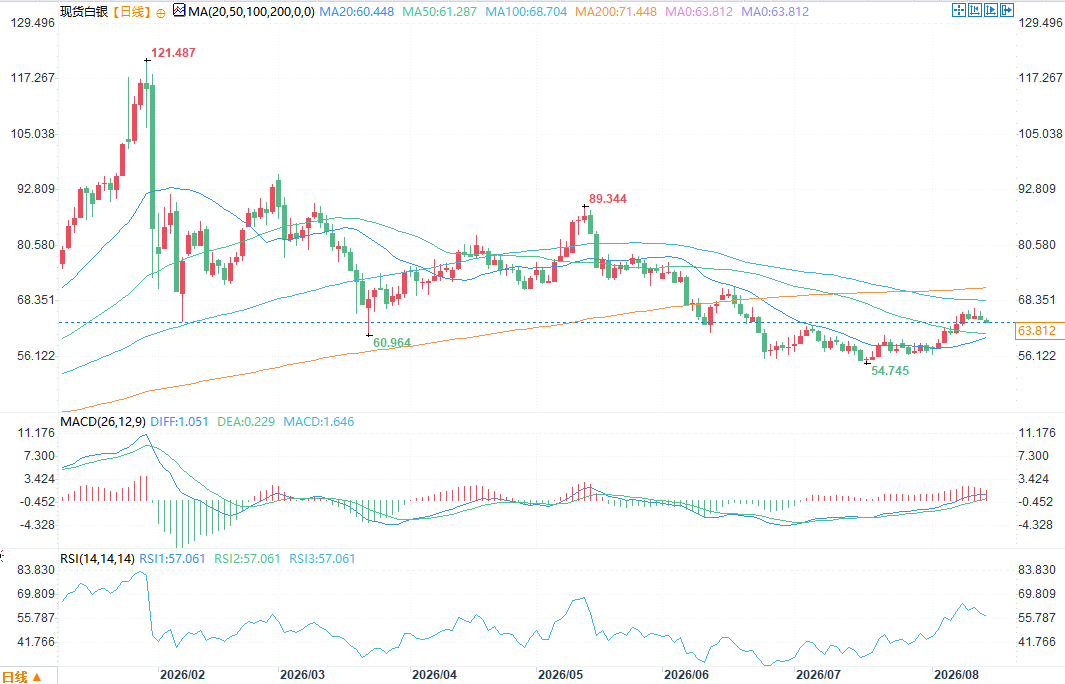 (Spot silver daily chart, source: EasyTrade) At 13:39 Beijing time on August 14, spot silver was trading at $63.81 per ounce.
Continued concerns about energy supply disruptions and inflation expectations supported the resilience of silver prices.
Traffic in the Strait of Hormuz and the Bab el-Mandeb Strait is virtually at a standstill; these two key waterways together account for approximately 27% of global energy supply. Against this backdrop, crude oil prices remain high—WTI crude is currently trading around $80.45 per barrel. While facing slight selling pressure in recent trading days, supply-side concerns are expected to limit further downside for oil prices. The commodity strategy team at TD Securities points out that the recent upward momentum in oil prices has weakened, catalyzing a certain amount of selling in WTI crude. However, the firm "continues to emphasize that the tight fundamentals in the crude oil and refined product markets should ultimately support further price increases," indicating that the recent sell-off is seen as a temporary pullback within a medium-term bullish trend. As long as concerns about energy supply disruptions persist, inflation expectations are unlikely to fall significantly, thus providing a floor for silver, which also serves as an inflation hedge.The expectation of a Fed rate hike has cooled, and the pressure on non-interest-bearing assets has eased marginally.
This week's US CPI and PPI data released signaled a cooling of inflation, coupled with rising concerns about the labor market, leading to a significant decline in market expectations for a September rate hike by the Federal Reserve. The CME FedWatch tool shows that the probability of keeping interest rates unchanged in September has risen to approximately 65%, a stark contrast to the 75% probability (expecting two rate hikes) priced in by the market a month ago. This rapid fading of rate hike expectations means that the pressure of rising opportunity costs for holding non-interest-bearing assets such as silver is easing marginally. For the precious metals market, if the Federal Reserve further confirms its "hold steady" policy stance, it will provide short- to medium-term support for silver prices.Silver is under short-term pressure but has limited downside potential; the interplay between inflation and interest rates continues.
Silver is currently caught in a tug-of-war between two forces: "energy inflation" and "cooling interest rate hike expectations." On the one hand, the continued disruption of passage through the Strait of Hormuz and the Bab el-Mandeb Strait continues to push up energy prices and inflation expectations, reinforcing concerns about central bank interest rate hikes and putting downward pressure on non-interest-bearing assets. On the other hand, slowing US domestic inflation data is prompting the Federal Reserve to reassess its policy path, and the safe-haven demand brought about by geopolitical risks is providing a floor for silver. In the short term, silver prices face a directional choice in the $63.50-$64.00 range. If energy supply disruptions continue and inflation expectations rise further, silver prices may face more downward pressure; however, if expectations of a Fed rate hike further subside, a weaker dollar will provide an opportunity for a silver price rebound.Summarize
In summary, the main drivers of silver's short-term pullback are inflation concerns and interest rate hike expectations stemming from global energy supply disruptions, but this pressure is being offset by a moderate shift in the Federal Reserve's policy expectations. The structural tensions in the energy sector and the marginal easing of monetary policy constitute the core contradiction in silver prices. In the short term, silver prices are consolidating within the $63.50-$64.00 range, with the direction depending on which of two factors prevails: if energy prices continue to rise due to geopolitical risks, silver prices will face further downward pressure; if the Federal Reserve's policy signals become more dovish, a weaker dollar will drive silver prices to stabilize and rebound. Until the energy geopolitical situation and Federal Reserve policy expectations become clearer, silver is more likely to maintain a range-bound trading pattern. (Spot silver daily chart, source: EasyTrade) At 13:39 Beijing time on August 14, spot silver was trading at $63.81 per ounce.
- Risk Warning and Disclaimer
- The market involves risk, and trading may not be suitable for all investors. This article is for reference only and does not constitute personal investment advice, nor does it take into account certain users’ specific investment objectives, financial situation, or other needs. Any investment decisions made based on this information are at your own risk.