Why did the yen rise instead of fall despite Japan's GDP falling short of expectations?
2026-08-17 10:36:59
On Monday (August 17) during the Asian session, the USD/JPY pair continued its decline from the previous trading day, currently trading around 159.00. Despite Japan's second-quarter GDP data falling short of expectations across the board (annualized growth of only 1.1%, far below the expected 2.0%), the yen was not significantly dragged down. The main market driver came from the US side—traders are further postponing their expectations for a Fed rate hike this year, with federal funds rate futures showing a 66.9% probability of keeping rates unchanged in September. This repricing of policy expectations is narrowing the USD/JPY interest rate differential, its impact outweighing the weak domestic data in Japan. For the yen, the key narrative remains the policy divergence between a "cautious Fed" and a "still hawkish Bank of Japan," a pattern likely to continue providing support for the yen in the medium term. 
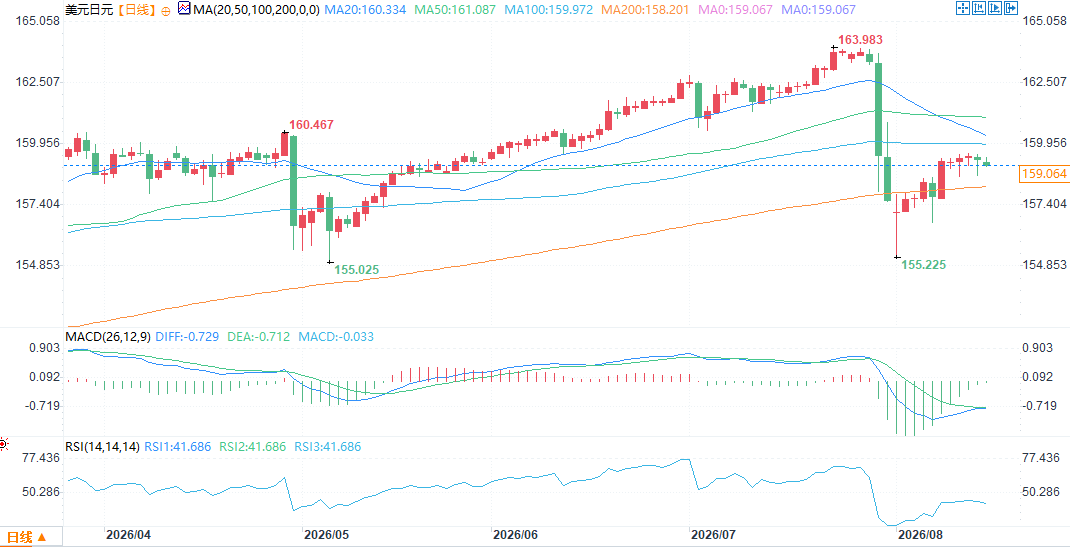 (USD/JPY daily chart, source: EasyForex) At 10:34 Beijing time on August 17, the USD/JPY exchange rate was 159.03/04.
GDP fell short of expectations across the board, but the market reaction was muted.
Japan's preliminary Q2 GDP figures showed real GDP grew by only 0.3% quarter-on-quarter (expected 0.5%), with an annualized growth rate of 1.1% (expected 2.0%). Capital expenditure fell 1.2% quarter-on-quarter, a stark contrast to the expected 0.4% growth; private consumption remained flat, far below the expected 0.5% growth, with high prices continuing to suppress household spending. External demand was the only bright spot, with net exports contributing 0.5 percentage points (higher than the expected 0.3), thanks to the yen remaining at a historically weak level, providing support for exporters. Analysts at Capital Economics noted that the GDP details were mixed—the government has so far limited the transmission of rising energy costs to the broader economy, while the jump in government consumption indicates that the expansionary fiscal policies of the Sanae Takaichi administration are beginning to take effect. Despite the overall disappointing data, the GDP deflator remained stable at 2.6%, well above the Bank of Japan's 2% inflation target, a factor still seen by the market as supporting a September interest rate hike by the central bank.The market is paying more attention to the Fed's expectations than domestic data.
The yen's strength despite significantly weaker-than-expected Japanese GDP data clearly reveals the dominant force driving the current exchange rate trend: changes in Federal Reserve expectations are more influential than domestic Japanese data. Federal funds rate futures indicate that the market's implied probability of the Fed keeping rates unchanged in September has risen to 66.9%, with traders further postponing their expectations for any rate hikes this year. This repricing has played a greater role in narrowing the USD/JPY interest rate differential than Monday's GDP report. Domestic fundamentals in Japan are not entirely negative. The GDP deflator remains at 2.6%, well above the central bank's target, meaning inflationary pressures have not subsided. The Bank of Japan is still seen as inclined towards further tightening, while the Federal Reserve is becoming more cautious—this continued policy divergence provides medium-term structural support for the yen.The yen's short-term rise remains limited by a range; a directional breakout requires a new catalyst.
Despite the yen's two-day strengthening, the gains have been modest—the USD/JPY pair remains within its trading range of the past week (158.50-160.00) without a clear trend breakout. The yen's rise is primarily driven by US factors (cooling expectations of a Fed rate hike) rather than improvements in Japan's own fundamentals. If expectations of a September rate hike decline further, USD/JPY may test the 158.50 support level; conversely, if there is any hawkish revision in Fed policy expectations, or if the Middle East situation triggers new safe-haven demand, USD/JPY may rebound towards the 160 level.Summarize
In summary, the yen's strength despite significantly weaker-than-expected GDP data clearly indicates that the primary driver of the current exchange rate is shifting expectations regarding Federal Reserve policy, rather than domestic Japanese data. The repricing of US interest rate expectations is narrowing the USD/JPY interest rate differential, while the Bank of Japan remains inclined towards further tightening—this policy divergence is likely to continue supporting the yen in the medium term. In the short term, USD/JPY is consolidating within the 158.50-160.00 range, and a directional breakout requires a new catalyst: US August employment and inflation data, Japan's August CPI (to be released on August 21), and developments in the Middle East will be key variables determining whether the yen can break out of its current range. (USD/JPY daily chart, source: EasyForex) At 10:34 Beijing time on August 17, the USD/JPY exchange rate was 159.03/04.
- Risk Warning and Disclaimer
- The market involves risk, and trading may not be suitable for all investors. This article is for reference only and does not constitute personal investment advice, nor does it take into account certain users’ specific investment objectives, financial situation, or other needs. Any investment decisions made based on this information are at your own risk.