A dramatic reversal in US and European data: The dollar weakens under pressure, while the euro sees a chance to break out.
2026-08-17 13:42:57
The US economy, which has maintained resilience for most of the year, has recently seen a series of data fall short of market expectations, a rare shift that has directly put downward pressure on the US dollar. Conversely, the Eurozone's economic indicators continue to improve, revealing a clear divergence in economic fundamentals between the US and Europe, prompting the market to reassess the upside potential of the euro against the dollar. This week, major economic data releases are relatively scarce, making it difficult to quickly overturn the macroeconomic narrative. Exchange rate movements will be more driven by technical factors, and key technical levels for both currencies will face significant challenges. From a quantitative perspective, the Citi US Economic Surprise Index and the US Dollar Index (DXY) show a high positive correlation, with a correlation coefficient of 0.85 over the past 20 trading days. This high correlation confirms that unexpected changes in economic data have become a core variable influencing the dollar's trajectory. While correlation does not equate to causation, the continued weakening of data has undeniably suppressed the dollar's performance. Technically, the dollar index approached its 2026 high at the end of July, but subsequently fell below the 50-day moving average due to yen intervention, ending its previous short-term upward trend. Following the release of retail sales data last Friday, the dollar index further broke below the medium-to-long-term upward channel that began from the lows of January this year. The overall market trend is weak, with the 99.50 support level temporarily breached, the RSI indicator falling back to 37, and the MACD remaining negative, indicating that short-term downside risks dominate. The key support levels below are the 200-day moving average and 98.75. If 98.75 is effectively broken, the US dollar index will open up more downside potential. The 100 level above forms a significant resistance. Only by holding above this level can the bulls regain upward momentum.
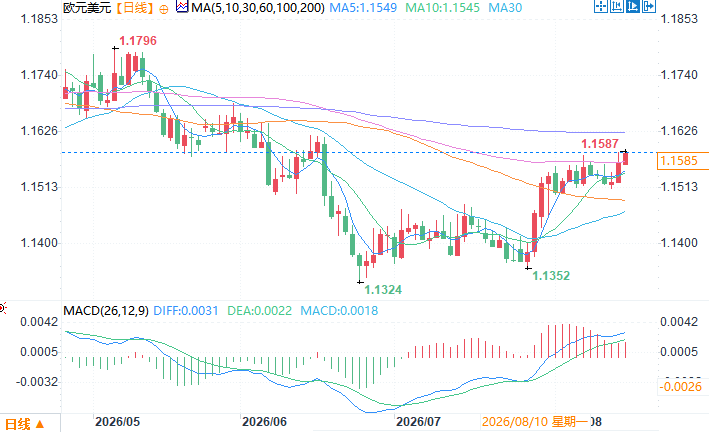 Euro/Dollar daily chart source: EasyTrade. At 13:40 Beijing time on August 17, the euro/dollar exchange rate was 1.1585/86.
Weak US economic data dragged down the dollar index.
U.S. retail sales data for July, released Friday evening (August 14), significantly missed expectations, with sales falling 0.6% month-over-month, ending nine consecutive months of growth. The retail sales control group, directly linked to GDP, also recorded a 0.4% month-over-month decline, with previous historical data being revised downwards in tandem. Prior to this, U.S. CPI and PPI inflation data had already shown signs of weakness, and coupled with the unexpectedly weak July non-farm payroll data, the market began to reassess whether the U.S. economic advantages supporting a strong dollar were waning. From a quantitative perspective, the Citi US Economic Surprise Index and the US Dollar Index (DXY) show a high positive correlation, with a correlation coefficient of 0.85 over the past 20 trading days. This high correlation confirms that unexpected changes in economic data have become a core variable influencing the dollar's trajectory. While correlation does not equate to causation, the continued weakening of data has undeniably suppressed the dollar's performance. Technically, the dollar index approached its 2026 high at the end of July, but subsequently fell below the 50-day moving average due to yen intervention, ending its previous short-term upward trend. Following the release of retail sales data last Friday, the dollar index further broke below the medium-to-long-term upward channel that began from the lows of January this year. The overall market trend is weak, with the 99.50 support level temporarily breached, the RSI indicator falling back to 37, and the MACD remaining negative, indicating that short-term downside risks dominate. The key support levels below are the 200-day moving average and 98.75. If 98.75 is effectively broken, the US dollar index will open up more downside potential. The 100 level above forms a significant resistance. Only by holding above this level can the bulls regain upward momentum.The divergence between the US and European economies is widening, and the euro awaits a breakout.
As the surprises from the US economy fade, Eurozone economic data continues to deliver positive surprises. The Citi Economic Surprise Index shows that the Eurozone's data advantage relative to the US has widened to +55.5 points, the largest level since February 2023. Over the past month, the correlation coefficient between this data difference and the euro/dollar exchange rate has remained between 0.8 and 0.9, indicating that the Eurozone's relative economic advantage tends to drive up the euro's exchange rate. This week, there are few major data releases in the US and European markets; only the preliminary PMI figures and the July FOMC meeting minutes have significant impact. Unless there is a significant revision to the final July Eurozone CPI, it is unlikely to shake the market. The existing logic of a "strong Eurozone economy and a weak US economy" is unlikely to be quickly overturned. Technically, the euro/dollar exchange rate and the dollar index are almost mirror images. After the Fed's policy implementation and yen intervention, the exchange rate broke upwards, rising above the 50-day moving average and breaking the downward trend since the January high. The price has now broken through the 1.1577 resistance level, and closed slightly above the 100-day moving average on Friday. The RSI indicator has rebounded to 63, and the MACD has formed a golden cross and remains positive, indicating that bullish momentum is accumulating. If it can effectively hold above 1.1577, it will challenge important resistance levels such as the 200-day moving average. On pullbacks, there is buying support at the 23.6% Fibonacci retracement level, while 1.1480 is the next level of support.Conclusion
Overall, the balance of power in the US and European economies has shifted. The US dollar is under pressure from weak data and its technical outlook has weakened, while the euro's fundamentals and technicals are improving simultaneously. In an environment of scarce major data releases, technical signals will become the core guide for short-term exchange rate movements, and 1.1577 has become a crucial level for the euro/dollar exchange rate to determine whether it can initiate a new round of upward movement. Euro/Dollar daily chart source: EasyTrade. At 13:40 Beijing time on August 17, the euro/dollar exchange rate was 1.1585/86.
- Risk Warning and Disclaimer
- The market involves risk, and trading may not be suitable for all investors. This article is for reference only and does not constitute personal investment advice, nor does it take into account certain users’ specific investment objectives, financial situation, or other needs. Any investment decisions made based on this information are at your own risk.