With three consecutive negative US data releases and the probability of an interest rate hike dropping to only 33%, where is the bottom for the US dollar?
2026-08-17 13:46:58
On Monday (August 17) during the Asian session, the US dollar index (DXY) continued its weakness, currently trading around 99.50, still hovering near its lowest level in nearly two months. US retail sales unexpectedly fell 0.6% (month-on-month) in July, far below the expected 0.1% growth. Coupled with previously released CPI and PPI data, a series of weak economic indicators are prompting traders to significantly reduce their bets on a Federal Reserve rate hike. The CME FedWatch tool shows that the market's implied probability of a September rate hike has fallen to 33%. Meanwhile, US-Iran negotiations remain deadlocked, with the Iranian Foreign Minister clearly stating that "there are currently no negotiations with Washington." While geopolitical risks provide some safe-haven support for the dollar, they have failed to reverse the overall weakness of the dollar. 
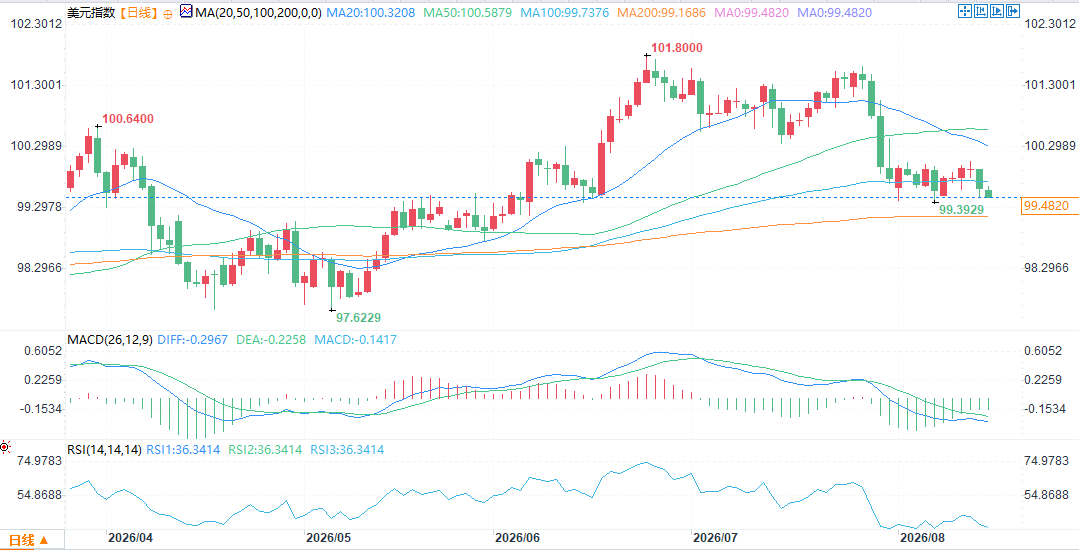 (US Dollar Index Daily Chart, Source: EasyForex) At 13:44 Beijing time on August 17, the US Dollar Index was at 99.48.
Retail sales fell short of expectations across the board, reducing the probability of a Federal Reserve rate hike to 33%.
Data released by the U.S. Census Bureau on Friday showed that retail sales fell 0.6% month-on-month in July, reversing the 0.2% increase in June and falling far short of market expectations of a 0.1% increase. On an annualized basis, retail sales rose 5.0% year-on-year in July, a significant slowdown from the previous 6.8%. This is the second time U.S. economic data has signaled weakness following last week's CPI and PPI data – consumer spending is losing momentum, further confirming the pattern of simultaneous cooling in economic growth and inflation. According to CME's "FedWatch," the probability of the Federal Reserve maintaining interest rates unchanged by September is 66.9%, and the probability of a cumulative 25 basis point rate hike is 33.1%. Analysts at BNY Mellon (BNY) pointed out: "Recent softer U.S. data has reduced expectations of a rate hike, and the market is currently pricing in less than a full rate hike in December." The bank also noted that long-term U.S. Treasury yields remain high, which some commentators attribute to "credibility concerns."The ongoing stalemate in US-Iran negotiations is providing limited support for the US dollar due to geopolitical risks.
Geopolitically, US-Iran negotiations remain deadlocked. Iranian Foreign Minister Abbas Araghchi stated on Friday that "no negotiations are currently taking place between Tehran and Washington," further noting that the US must agree to Iran's conditions before shipping through the Strait of Hormuz can resume. This statement indicates that tensions in the Middle East are unlikely to ease in the short term, and the risk of energy supply disruptions persists. However, geopolitical risks appear to offer limited safe-haven support for the US dollar. Scotiabank strategists observed that the dollar's attempt to rebound after the midweek CPI data release "quickly lost momentum," and the rally stalled immediately after the PPI data release, with the market "again leaning towards a broad-based short position in the dollar." The institution believes this renewed bearish bias reflects investors' growing confidence that the Federal Reserve is unlikely to tighten policy again in the near term.Institutional Views
In its August report, Kit Juckes, Chief FX Strategist at Societe Generale, noted that the US dollar may consolidate sideways during the summer, but is relatively bullish towards the end of the year, predicting the US Dollar Index (DXY) will rise by about 4% from current levels by year-end. In the long term, however, it will be pressured by potential slowdowns in US growth and improvements in the European economy. The recent dollar level is largely in line with market-priced interest rate expectations (one Fed rate hike), thus neutral in the short term. Crowded positions could make the path uneven. The interest rate market supports a neutral-to-bullish trend for the dollar, with further upside potential before the end of the year. The report emphasizes that short-term attention should be paid to positioning and data, but interest rate differentials and fundamentals still favor a stronger dollar until the end of the year; in the longer term, the pressure from narrowing growth differentials should be watched closely. State Street Global Advisors, in its August currency commentary, stated that the dollar has softened somewhat, creating selective opportunities among G10 currencies, but the resilience of US fundamentals, high yields, and geopolitical uncertainty mean that it is too early to conclude that a sustained bear market has begun. The US dollar faces pressure in August from weaker-than-expected employment, inflation, and Q2 GDP (1.5% annualized quarter-on-quarter growth), as well as the perceived dovish stance of the July FOMC meeting. However, strong domestic final demand (3.9% annualized), low unemployment, leading yields among G10 countries, and support from risks related to Iran provide stability. Unless employment and inflation weaken significantly further, only tactical short positions are recommended. The institution maintains a pessimistic view on the US dollar in the medium to long term (fiscal deficit, current account, policy risks, etc.), but the risk of a prolonged bear market is not imminent.Summarize
In summary, the US dollar index has weakened to around 99.50, primarily driven by weak US economic data – an unexpected decline in retail sales coupled with cooling CPI and PPI, prompting the market to reduce the probability of a September rate hike to 31%. While the stalemate in US-Iran negotiations provided some safe-haven support, it failed to reverse the dollar's weakness. Scotiabank points out that the market is "once again fully favoring short positions in the dollar." If subsequent US data weakens further, the dollar index may fall below the 99 level; conversely, if geopolitical risks escalate significantly or US data unexpectedly improves, the dollar may experience a short-covering rebound. (US Dollar Index Daily Chart, Source: EasyForex) At 13:44 Beijing time on August 17, the US Dollar Index was at 99.48.
- Risk Warning and Disclaimer
- The market involves risk, and trading may not be suitable for all investors. This article is for reference only and does not constitute personal investment advice, nor does it take into account certain users’ specific investment objectives, financial situation, or other needs. Any investment decisions made based on this information are at your own risk.