Gold Trading Alert: Fed Rate Hike Expectations Plunge, Gold Prices Surpass $4400! With the Middle East turmoil continuing, can the bulls continue their upward momentum?
2026-08-18 07:54:57
On Monday (August 17), spot gold rose 0.93%, firmly establishing itself above the $4,400 mark, closing at $4,416.43 per ounce, after briefly touching $4,428.87 during the session; US gold futures for December delivery also rose 0.8%, closing at $4,473.70. Since the unexpectedly weak US non-farm payroll data in early August, gold prices have surged from the $4,000 mark, with the sharp rise attracting market attention. Intuitively, a weaker dollar and a cooling of expectations for a Fed rate hike constitute the most direct dual drivers. However, at the same time, the expiration of the US-Iran memorandum of understanding, Iran's threat to shift to a full-scale offensive posture, the US ruling out extending the ceasefire agreement, Trump's threat to bomb Oman, and oil prices surging more than 3% on Monday have made bulls hesitant. The recent surge in oil prices and the resulting inflation fears are quietly becoming a sword of Damocles hanging over gold prices. Geopolitical conflicts, traditionally seen as a safe-haven asset, may now be suppressing gold's upside potential by pushing up energy prices. On Tuesday (August 18) in early Asian trading, spot gold fluctuated slightly higher, currently trading around $4420 per ounce. 
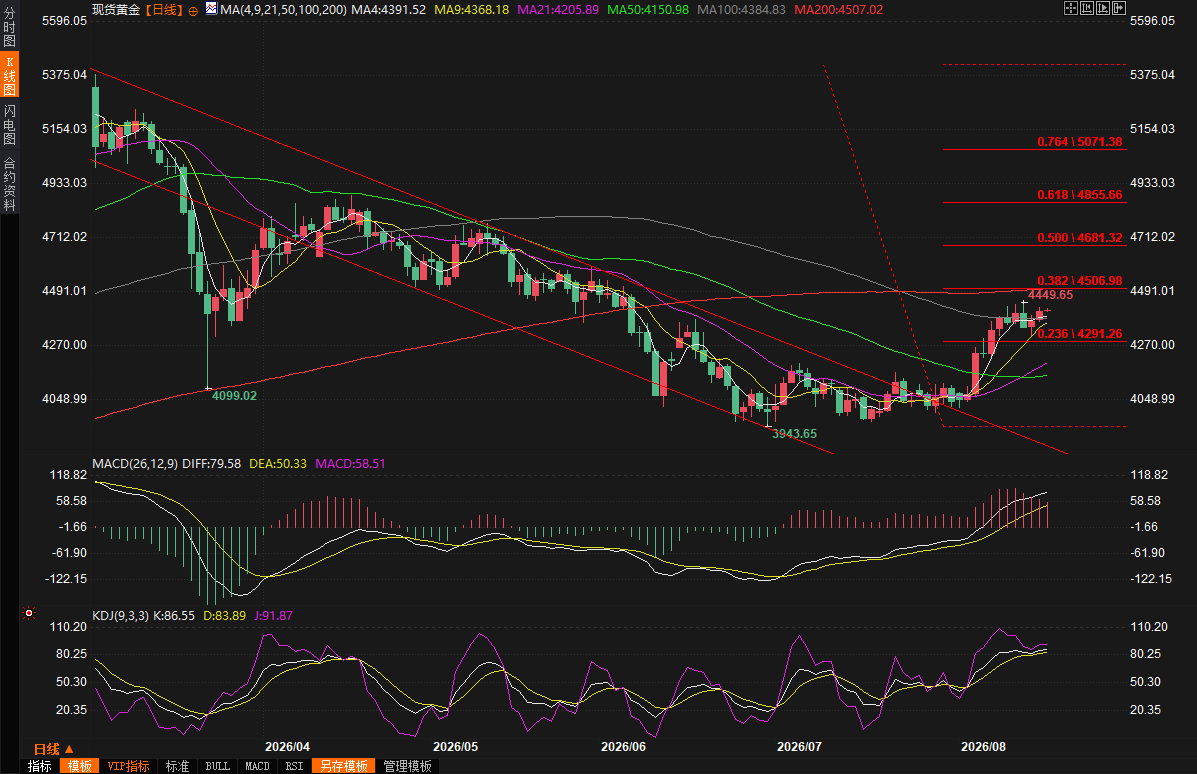 (Spot gold daily chart, source: FX678) At 07:50 Beijing time, spot gold is currently trading at $4423.33 per ounce.
Dollar collapses: A series of disappointing economic data provides the strongest support for gold.
The classic negative correlation between gold and the US dollar has been vividly demonstrated in this round of market movements. The US dollar index, which measures the dollar against a basket of major currencies, fell to its lowest point since early June at 99.28 during Monday's trading session. Although it recovered slightly to close at 99.57, breaking below the psychologically important 100 mark is a strong signal in itself. Why is the dollar so weak? The root cause lies in the "series of disappointing" US macroeconomic data. July retail sales data showed a decline for the first time in nine months, forming a triple blow with the unexpected decrease in non-farm payrolls last month and moderate inflation data. Kit Juckes, chief foreign exchange strategist at Societe Generale, bluntly stated: "The US has released a series of weak data, with both non-farm payrolls and retail sales performing poorly. This will, to some extent, readjust market expectations for the extent of the Fed's policy tightening." He further pointed out that this "conditioned reflex reaction" is part of the reason for the dollar's weakness. Even more intriguing is the position structure. Juckes added that CFTC data showed net long positions in the US dollar were "very, very, very large," and these positions were highly vulnerable to squeeze during the seasonally thin trading in late August, forcing a large number of speculative dollar longs to close their positions, further accelerating the dollar's decline. For gold, a weaker dollar means increased purchasing power from buyers denominated in other currencies, which undoubtedly provides a strong boost to gold buying globally.Interest rate hike expectations plummet: The market is beginning to believe the Federal Reserve is "tolerating inflation".
If the weakening dollar was the "catalyst" for gold's rise, then the sharp cooling of expectations for a Federal Reserve rate hike was the real "igniter." The CME Group's FedWatch tool shows that traders' expectations for a September rate hike have plummeted from 51.2% a month ago to 33%, and by August 18, this figure had further dropped to the 30% to 35% range, while the probability of maintaining the current rate was over 65%. In just one month, the market's perception of the Fed's policy path has almost undergone a 180-degree turn. The core driver of this shift is the weak employment and inflation data. Non-farm payrolls fell short of expectations, and the consumer price index remained moderate, leading the market to reassess the Fed's tightening options. Bart Melek, Global Head of Commodity Strategy at TD Securities, summarized this as: "The gold market seems to be digesting a stagflationary environment due to weak employment data and market expectations that the Fed will tolerate the current level of inflation." "Tolerating inflation" means that even if prices remain above the target, policymakers may choose to remain on hold due to weak growth—an expectation that is extremely favorable for gold because real interest rates are unlikely to rise significantly, thus lowering the opportunity cost of holding gold. Investors are eagerly awaiting the release of the Federal Reserve's July meeting minutes on Wednesday, hoping to glean insights into policymakers' true interpretation of recent data. Lou Brien, market strategist at DRW Trading, cautioned that the bond market reacted uneasily after Fed Chairman Warsh's first press conference last month, and the minutes will undoubtedly be closely watched because "Warsh hasn't completely dispelled the market's perception that he's Trump's man at the Fed, rather than someone with independent judgment." Any minor tweaks to the wording in the minutes could trigger a repricing of the probability of interest rate hikes in the market.The Middle East powder keg: Soaring oil prices ignite inflation, and the "invisible killer" of gold is approaching.
In stark contrast to the two clearly bullish factors mentioned above, the impact of Middle East geopolitical conflicts on gold is becoming exceptionally complex, even harboring hidden bearish implications. Monday was originally the deadline for the US and Iran to reach a final peace agreement based on the June 17 memorandum of understanding, but in reality, peace seems a distant prospect, and the threat of war has escalated further. A senior Iranian official stated that if diplomatic efforts fail, Tehran will adopt a "full-scale offensive" military posture, escalating tensions in the Strait of Hormuz and the wider region. US President Trump's response was equally tough—he bluntly stated that Iran "should raise the white flag and surrender," and threatened that "if Oman interferes, we will bomb them to pieces." The direct consequence of this escalating tensions was a surge in international oil prices. Brent crude futures closed up $2.35, or 2.65%, at $90.87 per barrel on Monday; US crude futures closed up $2.10, or 2.55%, at $84.50. Shipping data from the Strait of Hormuz directly reflects supply concerns—Kpler data shows a significant slowdown in shipping over the weekend, with only five commodity carriers passing through on Saturday and no ships registering to pass through on Sunday, compared to 31 the previous weekend. The rise in oil prices is precisely the biggest concern for gold bulls. While the traditional safe-haven logic for gold remains—the threat of war can trigger some safe-haven buying—this buying can easily be offset by a more powerful force: soaring oil prices push up overall inflation, thereby strengthening market expectations for further interest rate hikes by the Federal Reserve. As the US interest rate futures market shows, although the probability of a September rate hike is currently only 33%, this figure is not static, and any signal of higher-than-expected inflation could push this probability up again. Looking back at history, during the stagflation of the 1970s, gold surged because inflation was out of control and the Federal Reserve was unable to raise interest rates; however, the current environment is very different—the Federal Reserve is still in a tightening cycle, and policy rates have not yet peaked. If rising oil prices force the Federal Reserve to reconsider raising interest rates, the resulting increase in real interest rates will directly suppress gold prices. In other words, the Middle East conflict, through the transmission chain of "oil prices → inflation → interest rate hike expectations → stronger dollar (relatively) → pressure on gold prices," is becoming the most dangerous "hidden danger" on the road to gold price increases. Phil Flynn, senior analyst at Price Futures Group, acknowledged that as rhetoric escalated and oil prices rose, the uncertainty surrounding the passage of ships through the Strait of Hormuz exacerbated market concerns. However, Bjorn Hildrop of SEB Research calmly pointed out that unless nighttime oil shipments through the Strait of Hormuz cease and/or the Bab el-Mandeb Strait is blocked, oil prices are unlikely to rise significantly. Currently, oil prices are trading around $90, and the market is weighing the possibility of further supply disruptions against the reopening of the Strait of Hormuz. Furthermore, US Energy Secretary Wright bluntly stated that Iran's current inability to export oil is part of an "economic strangulation" strategy, and that "the world does not need Iranian oil"—a statement suggesting that the US has no intention of compromising in the short term, and the geopolitical tensions are likely to continue.Market dynamics: Three forces are shifting, and the fragility of gold price increases cannot be ignored.
Examining these three dimensions side-by-side, we can clearly see that the current gold market is in a delicate game of strategy. Positive forces come from a weakening dollar and easing expectations of interest rate hikes, both of which lower the opportunity cost of holding gold, providing solid support for prices. Negative forces come from rising oil prices triggered by the Middle East conflict and the resulting inflationary fears, which could reignite the Federal Reserve's determination to raise interest rates, thus reversing the current favorable situation. So, which side is the market currently leaning towards? Looking at the actual price movement of gold, positive forces have the upper hand in the short term—because weak economic data is a "fait accompli," while inflationary concerns triggered by rising oil prices remain at the "expectation" level. However, investors must be wary that this balance is extremely fragile. If Wednesday's Fed meeting minutes show any cautionary wording regarding inflation, or if oil prices continue to rise, the probability of an interest rate hike could rebound rapidly. At that time, gold will face dual pressures: on the one hand, a negative reaction to the interest rate hike itself, and on the other hand, a potential strengthening of the dollar due to rising expectations of an interest rate hike. Lou Brien of DRW Trading noted that the market has become "somewhat numb" to the threat of a US-Iran conflict, but this numbness itself indicates that geopolitical risks have already been priced in, and a new escalation could trigger unexpected and sharp fluctuations. Meanwhile, signals from the US Treasury yield curve are also worth noting—the 10-year yield is at 4.728%, and the 30-year yield is at 5.314%, a near 20-year high. The continued rise in long-term yields reflects the market's deep anxiety about long-term inflation and fiscal deficits, an anxiety that underpins the long-term value of gold. However, if short-term yields follow suit due to rising expectations of interest rate hikes, the short-term pressure on gold will be significant.Conclusion: How long can gold's "sweet spot" last? The key lies in the race between inflation and interest rate hikes.
In summary, the current gold price above $4,400 is a temporary result of the interplay of multiple forces. Weak economic data provides ample justification for the Federal Reserve to pause interest rate hikes, while a weak dollar offers direct pricing support for gold. These two core bullish factors are unlikely to be disproven in the short term, meaning the bottom for gold prices is relatively solid. Technically, short-term bullish signals have also strengthened significantly, with key attention focused on the slight resistance around the 200-day moving average at $4,507/ounce. However, the Middle East geopolitical conflict, a double-edged sword, is becoming increasingly sharp—while it can provide some residual support for gold prices from a safe-haven perspective, more importantly, it exacerbates inflationary pressures by pushing up oil prices, potentially shaking market confidence in the Fed's "tolerance of inflation." The key lies in a race between two threads: first, whether US economic data will further deteriorate, thus solidifying expectations of no rate hikes; and second, whether oil prices will continue to rise, eroding the space for no rate hikes. If the Fed's July meeting minutes reveal greater concern about downside risks to the economy, the probability of a rate hike may further decrease, and gold prices could continue to rise. Conversely, if the minutes or subsequent speeches by officials emphasize inflation risks, or if a sharp deterioration in the Strait of Hormuz causes oil prices to break through $95 or even $100, a resurgence in rate hike expectations would quickly reverse the current favorable situation. Gold investors are currently enjoying a feast brought by a weak dollar and dovish expectations, but they must remain constantly vigilant against the potential detonation of an "inflation bomb" in the Middle East. Whether this feast can continue may be revealed in Wednesday's Fed meeting minutes. Before that, every surge in gold prices has been accompanied by increasing fragility. (Spot gold daily chart, source: FX678) At 07:50 Beijing time, spot gold is currently trading at $4423.33 per ounce.
- Risk Warning and Disclaimer
- The market involves risk, and trading may not be suitable for all investors. This article is for reference only and does not constitute personal investment advice, nor does it take into account certain users’ specific investment objectives, financial situation, or other needs. Any investment decisions made based on this information are at your own risk.