How much substance is behind the pound's three-month high? This week's data will provide the answer.
2026-08-18 08:28:57
On Tuesday (August 18) in early Asian trading, the pound rose slightly against the dollar, currently trading around 1.3550. The pound touched 1.3570 on Monday, a three-month high, but quickly gave back all gains, with a net increase of less than 10 points for the day. This surge was not due to the pound's own strength, but rather a result of a broad-based weakening of the dollar – the dollar index fell below its 200-day exponential moving average to its lowest level since June, while assets such as the euro and gold rose in tandem, confirming that this was a dollar sell-off rather than pound buying. This week, the UK will see a flurry of data releases, with inflation, employment, and retail sales figures putting the pound's strength to the test. 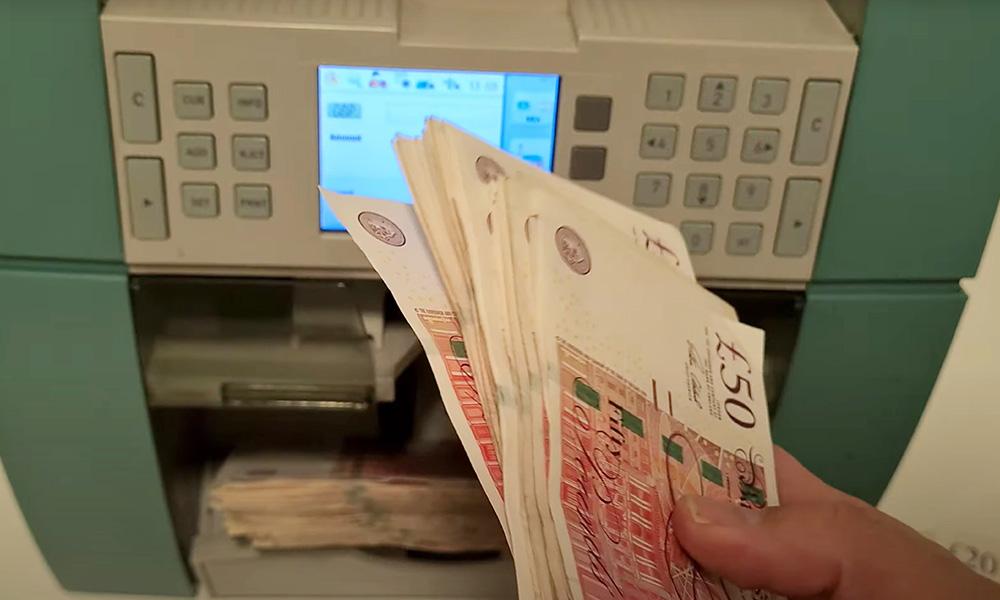
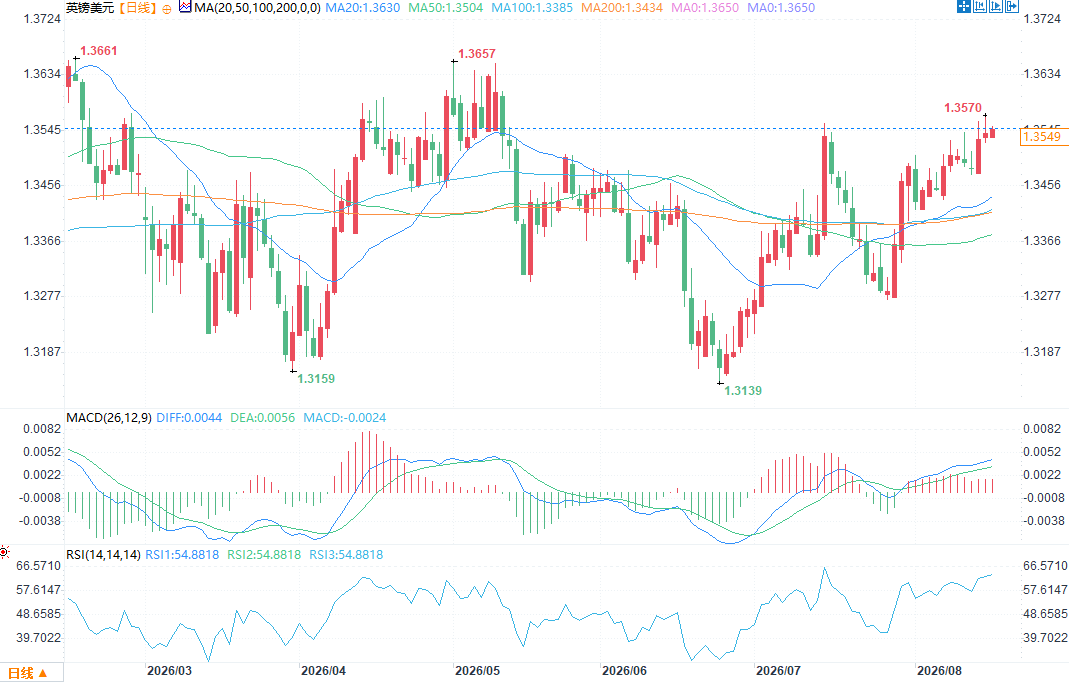 (GBP/USD daily chart, source: FX678) At 8:24 AM Beijing time on August 18, GBP/USD was trading at 1.3549/50.
Monday's market movements were driven by the US dollar, not the British pound.
The breadth of Monday's market activity speaks volumes. The euro rose to a two-month high, gold saw strong buying, and the pound hit a three-month peak—all in the same afternoon. This is typical of a single currency being sold off, rather than four currencies being simultaneously sought after. By last week, the futures market had reduced the probability of a Fed rate hike in September from 50/50 to about one-third, and Monday's movements further priced in the remaining expectations. Monday's incremental driver was geopolitics. The 60-day consultation framework aimed at ending the Strait of Hormuz dispute expired without an agreement, oil prices rose by about 3%, and the 30-year US Treasury yield broke through 5.31%, reaching a new high since June 2007. Meanwhile, the pound had not had any major data releases since July 30th, contributing nothing to domestic fundamentals during this period.Tuesday: Labor force data released, internal signals diverge.
UK labor market data will be released at 2:00 PM Beijing time on Tuesday, but internal readings are inconsistent. The unemployment rate for the three months to June is expected to improve slightly to 4.8% from 4.9%, while the change in jobless claims for July is expected to rise sharply to 11.2K from 6.7K, nearly doubling, with the claim rate previously at 4.4%. The previous figure was 147K. Wage data will directly impact Wednesday's inflation forecast. Regular wage growth is expected to remain flat at 3.4%, while total wages are expected to slow to 4.1% from 4.3%. With overall inflation approaching 2.9%, real wage growth is only about 0.5 percentage points – meaning that household pressure stems from energy prices rather than wages, a typical characteristic of this cycle.Wednesday: Inflation data sets the tone for the September interest rate vote.
The CPI data released at 2:00 PM Beijing time on Wednesday is the most decisive release of the week. The overall CPI is expected to rise 0.3% month-on-month and 2.9% year-on-year from 2.6%; the core CPI is expected to fall slightly to 2.5% from 2.6%; and the producer output price index (PPI) is expected to rise 0.3% month-on-month, reversing from flat. The overall CPI increase while the core CPI decrease is a typical characteristic of imported inflation—and imported inflation is precisely the type of inflation that central banks find difficult to address through interest rate hikes, as that would impose an additional tax on an already slowing economy. The Bank of England's July decision to maintain interest rates was passed 6-3 (previously 7-2 in June and 8-1 in April), marking the third consecutive meeting in which the hawkish minority has grown stronger. The market is pricing in about a one-in-four chance of a rate hike on September 17th. A 2.9% overall inflation rate will provide support for dissenters, while a 2.5% core inflation rate will provide grounds for rebuttal from the majority—therefore, the pound's reaction on the day of the data release is unlikely to last throughout the week.Friday: Retail Sales and PMI to close
At 14:00 Beijing time on Friday, retail sales are expected to contract month-on-month to -0.3% from 1%, with excluding fuel retail sales expected to fall to -0.4% from 1.1%, and the year-on-year rate halved from 4.2% to 2.3%. The consumer confidence index will be released Thursday evening, expected to fall to -18 from -17 – meaning the household sector will receive two readings within 12 hours, with consensus forecasts pointing to deterioration. At 16:30 Beijing time on Friday, the preliminary August PMI figures will be released, with the composite PMI expected to fall to 51.5 from 52.2, manufacturing to 51.5 from 51.9, and services to 51.8 from 52.1. This week, the consensus forecast for all UK economic data points to a downward trend – except for inflation. This pattern makes the pound difficult to hold and also means that interest rate arbitrage buying from the UK is unlikely.The narrative dominated by the US dollar
The Federal Reserve will release the minutes of its July 29 FOMC meeting at 02:00 Beijing time on Thursday. This is the only event this week that could potentially rebuild the interest rate premium the dollar has lost over the past two weeks. The market's focus is on how closely the remaining members align with the three dissenters who support a 25 basis point rate hike. It's worth noting that the minutes are released well before recent weak US inflation data. The preliminary US PMI readings will be released at 21:45 Beijing time on Friday, with manufacturing expected at 53.8 and services at 54, both slightly lower than July. Looking further ahead, the Jackson Hole Economic Symposium will be held from August 27-29, with the Fed Chair delivering a keynote speech on Friday—this is the more likely risk event to trigger a reversal for anyone shorting the dollar, implying that any upward movement in the currency pair is more of a "borrowed" position than "own." (GBP/USD daily chart, source: FX678) At 8:24 AM Beijing time on August 18, GBP/USD was trading at 1.3549/50.
- Risk Warning and Disclaimer
- The market involves risk, and trading may not be suitable for all investors. This article is for reference only and does not constitute personal investment advice, nor does it take into account certain users’ specific investment objectives, financial situation, or other needs. Any investment decisions made based on this information are at your own risk.