Stalled around 159: Why is the yen "unmoved" by the weakness of the dollar?
2026-08-18 08:20:57
On Tuesday (August 18) in early Asian trading, the USD/JPY pair traded in a narrow range, currently hovering around 159.30. The decline in the US dollar index did not translate into upward momentum for the yen, and the USD/JPY pair remained resilient at higher levels. The USD/JPY pair closed at around 159.45 on Monday, a slight increase of 0.08% on the day. On the same day, the US dollar index briefly touched its lowest level since June. 
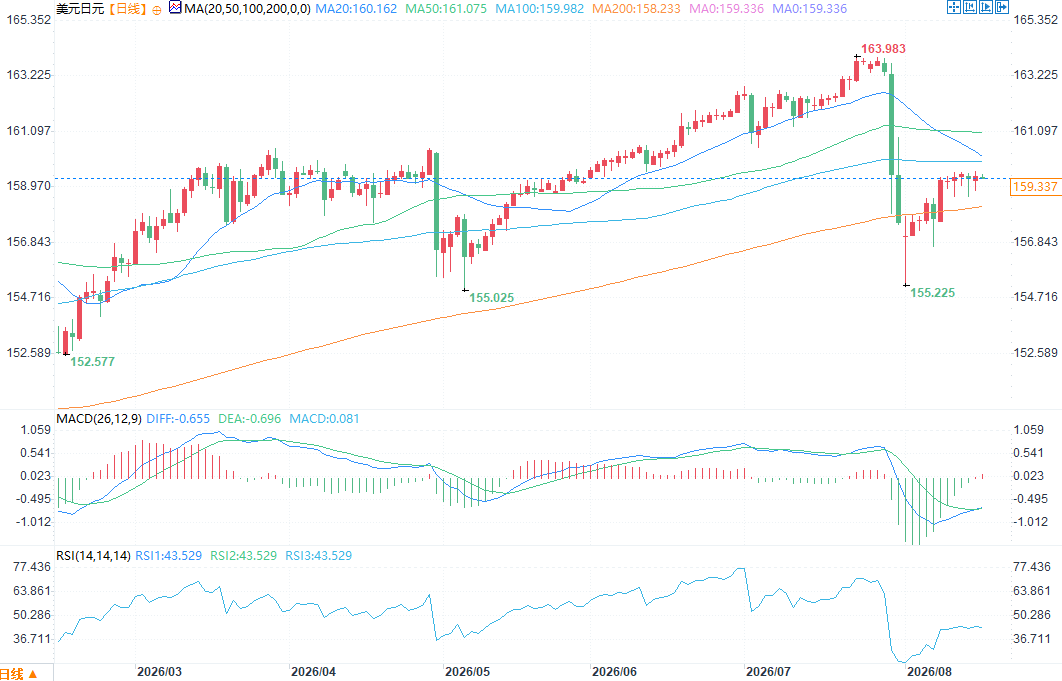 (USD/JPY daily chart, source: FX678) At 8:16 AM Beijing time on August 18, the USD/JPY exchange rate was 159.36/37.
Geopolitics replaces data as the main theme of the day.
Monday's market driver was not economic data, but geopolitical tensions. The 60-day consultation framework aimed at easing the Strait of Hormuz dispute expired without any agreement, and Iran adopted an aggressive stance, causing crude oil prices to rise by about 3%, and the 30-year US Treasury yield to break through 5.31%, reaching a new high since June 2007. For Japan, which is highly dependent on overseas energy and has a very high dependence on crude oil imports, the surge in oil prices coupled with rising long-term US Treasury yields will directly push up its imported inflation and financing costs, squeezing corporate profits and increasing the burden on people's livelihoods. The market volatility caused by geopolitical instability will ultimately translate into a real cost bill impacting the domestic economy.The Japanese yen already has all the necessary conditions in place.
The Bank of Japan kept its policy rate at 1.00% after raising it in June, and held it steady at its July 31 meeting, although some members disagreed and advocated for further tightening rather than easing. Overnight swap market pricing indicated an approximately 80% probability of a rate hike at next month's meeting, and this expectation did not subside after the release of weak growth data, but rather continued—Japanese government bond yields rose that day, with neither the Ministry of Finance nor the Bank of Japan making any official statements to suppress it. Beyond interest rates, there is also official buying pressure. The end of the month saw the largest single-day yen buying in history, followed by the first joint intervention with the US Treasury since 1998, with Washington explicitly stating that the yen was "significantly undervalued" and urging Tokyo to accelerate its tightening pace. With a rate hike in sight, friendly US relations, and the looming threat of intervention—yet the spot exchange rate, starting slightly above 155.00, has rebounded by about half in less than three weeks, approaching its July high.The second quarter GDP data explains some weaknesses.
Japan's preliminary second-quarter GDP figures were released on Monday, falling short of expectations across the board: quarter-on-quarter growth was 0.3%, lower than the expected 0.5% and the previous reading of 0.5%; annualized quarter-on-quarter growth was 1.1%, lower than the expected 2% and the previous reading of 1.8%. Weak domestic demand was the main drag, with both capital expenditure and household consumption falling short of forecasts. Of particular note is the GDP deflator – which rose 2.6% year-on-year, higher than the expected 2.4%, indicating stronger-than-expected price pressures while output fell short of expectations. This combination of stagflation makes a 25 basis point interest rate hike more costly. Against this backdrop, further tightening is more of a policy choice at the exchange rate level than an objective necessity based on economic fundamentals.Wednesday's trade data will be the real litmus test for the yen's direction.
The key variable for this currency pair this week is the trade data released at 07:50 Beijing time on Wednesday. The market expects imports to grow by 26.5% year-on-year and exports by 19.9%, widening the merchandise trade deficit from 406.9 billion yen to 680 billion yen, compared to a seasonally adjusted deficit of 881.9 billion yen previously. This deficit gap directly reflects the situation in the Strait of Hormuz in Japanese national accounts. An energy-importing country, with its exchange rate at a near 40-year low, buying oil at a war premium—essentially engaging in a continuous, structural sell-off of its own currency every month. A 25 basis point interest rate hike is far from sufficient to repair the losses caused by the trade terms shock. The national inflation data released at 07:30 Beijing time on Thursday will further reinforce this situation: the core CPI, excluding fresh food, is expected to be 1.8% (previous value 1.6%), still below the central bank's policy target, which is supposed to be maintained by tightening policies. Current price pressures stem more from import bills than from areas where policy can be attributed.The US dollar also has its own narrative.
The Federal Reserve will release the minutes of its July 29 FOMC meeting at 02:00 Beijing time on Thursday, followed by the preliminary readings of the US manufacturing and services PMIs at 21:45 Beijing time on Friday. The manufacturing PMI is expected to be 53.8, and the services PMI is expected to be 54. Looking further ahead, the Jackson Hole Economic Symposium will be held from August 27 to 29, with the Fed Chair's keynote speech just 19 days before the September interest rate decision.Summarize
The USD/JPY pair is unusually moving in opposite directions simultaneously: the dollar's loss of its interest rate premium is pushing the exchange rate down, while the yen's trade account weakness is pushing it up. This is the fundamental reason for the current sideways movement, and it also means that breaking the deadlock is more likely to come from official actions than from a single economic data point. (USD/JPY daily chart, source: FX678) At 8:16 AM Beijing time on August 18, the USD/JPY exchange rate was 159.36/37.
- Risk Warning and Disclaimer
- The market involves risk, and trading may not be suitable for all investors. This article is for reference only and does not constitute personal investment advice, nor does it take into account certain users’ specific investment objectives, financial situation, or other needs. Any investment decisions made based on this information are at your own risk.