US Treasury bonds surpass $40 trillion mark, signaling a major shift in the global financial landscape.
2026-08-18 14:16:59
According to official daily real-time debt ledger data from the U.S. Treasury Department, the total size of the U.S. federal debt has officially reached the $40 trillion mark, setting a new historical record. It is worth noting that the U.S. Treasury Department did not issue a special official announcement regarding this milestone; the data comes from publicly available real-time statistics and is considered authoritative. A debt of $40 trillion means that the U.S. debt far exceeds its annual GDP, with a debt ratio exceeding 120%, significantly surpassing the internationally accepted 60% sovereign debt safety threshold. This figure is the inevitable result of decades of fiscal imbalances, policy imbalances, and crisis-induced stimulus in the United States, and it also signifies that the U.S. fiscal system and the global financial system have entered a new high-risk phase. 
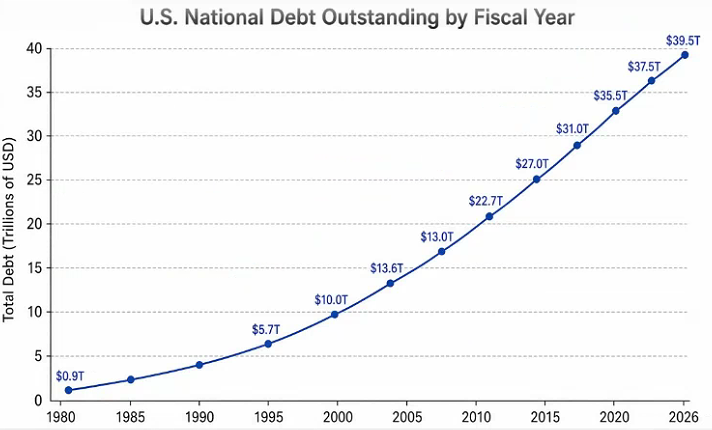 Chart: US Treasury Debt Progression by Fiscal Year Source: USTreasury / FRED
Multiple underlying reasons have led to a massive debt of 40 trillion yuan.
The snowballing US debt continues to grow, its core root cause being a long-term structural imbalance in fiscal revenue and expenditure. This imbalance stems from rigid expansion of spending and sluggish revenue growth, resulting in persistently large fiscal deficits that can only be filled by continuously issuing more national debt. On the expenditure side, the aging population in the US continues to worsen, with statutory welfare expenditures such as Social Security and Medicare rising year by year. These social welfare expenditures are widespread and face significant political resistance, making them difficult for successive administrations to effectively reduce. Simultaneously, the US maintains high defense spending for many years, coupled with various public finance investments, further amplifying fiscal pressure and creating a rigid expenditure base that is difficult to compress. On the revenue side, the US has implemented large-scale tax cuts multiple times, significantly reducing tax revenue sources, causing government revenue growth to lag behind expenditure growth for a long time. Various unforeseen crises have become key catalysts for the debt surge. During the 2008 financial crisis and the 2020 public health crisis, the US launched massive fiscal relief and economic stimulus plans, temporarily increasing the debt level. More importantly, after the crises, the temporary fiscal spending created momentum and did not gradually withdraw, resulting in the total debt only increasing. Furthermore, in the current high-interest-rate environment, the massive existing debt generates enormous interest payments. Fiscal funds must prioritize repaying principal and interest, forcing a continuous cycle of borrowing new money to repay old debts, creating a vicious cycle of snowballing debt. Relying on the US dollar's status as the global reserve currency, US Treasury bonds have a global market for absorption, providing the foundation for the US to borrow without limit. Chart: US Treasury Debt Progression by Fiscal Year Source: USTreasury / FREDBehind the $40 trillion debt, multiple hidden dangers lurk within the United States.
With US debt exceeding $40 trillion, the most direct pressure is reflected in the fiscal burden. Currently, annual interest payments on US Treasury bonds have surpassed the defense budget, becoming the largest rigid expenditure in federal finances. A large amount of tax revenue is consumed by debt interest, severely squeezing public investment in infrastructure, people's livelihoods, and technology, thus constraining the long-term economic development potential of the US. At the same time, the continuous large-scale issuance of debt has led to a surge in the supply of US Treasury bonds, easily pushing up medium- and long-term yields, raising overall financing costs, directly impacting corporate investment and financing, residential mortgages, and consumer credit, and exerting sustained pressure on the real economy. Politically, the massive debt has made the US debt ceiling debate a regular occurrence. Whenever the debt approaches a critical point, the two parties engage in fierce wrangling, with repeated government shutdowns and soaring policy uncertainty, continuously disrupting market expectations and financial stability. As the debt continues to expand, the willingness of overseas central banks and institutions to allocate US Treasury bonds has gradually cooled, and the proportion of foreign holdings in US Treasury bonds has continued to decline, slowly eroding the global credit foundation of US Treasury bonds. However, in the short term, relying on the dollar's hegemonic status, there is no substantial risk of default for US Treasury bonds; the risk lies more in the weakening of long-term credit and the decline in fiscal resilience.The profound impact of super debt on global financial markets
As the anchor for global asset pricing, the impact of US Treasury bonds exceeding $40 trillion will spill over into global markets. The massive supply of US Treasury bonds continues to push up yields, suppressing valuations of global stock markets, commodities, and non-US currencies, and exacerbating volatility in global financial markets. Simultaneously, the long-term weakening of US Treasury bond credit is forcing the global foreign exchange reserve system to diversify rapidly. Central banks are continuously increasing their holdings of safe-haven assets such as gold and non-US bonds, gradually reducing their dependence on the US dollar and US Treasury bonds, and continuously impacting the dollar-based financial system that has been in use for decades.Conclusion
Overall, the massive US$40 trillion debt is the result of long-term fiscal imbalances, short-sighted policies, and crisis-induced stimulus. While there is no immediate risk of default, the long-term reality is that fiscal policy will be negatively impacted by interest payments, financing costs will remain high, and the credibility of the US dollar will weaken. Given the significant political resistance to both tax increases and spending cuts in the US, the debt snowball is unlikely to reverse and will continue to expand, becoming a core variable influencing the global macroeconomy, asset prices, and financial landscape in the long term.- Risk Warning and Disclaimer
- The market involves risk, and trading may not be suitable for all investors. This article is for reference only and does not constitute personal investment advice, nor does it take into account certain users’ specific investment objectives, financial situation, or other needs. Any investment decisions made based on this information are at your own risk.