The global bond market is experiencing severe volatility and is in a state of extreme upheaval.
2026-08-19 01:10:57
A week ago, I clearly warned that investment sentiment and trading logic in the global bond market were undergoing a fundamental shift, and the previously stable market structure had been completely shattered. Since the outbreak of the COVID-19 pandemic, the fiscal policies of the vast majority of G10 economies have completely deviated from a prudent path and have been in a state of imbalance for a long time. The scale of fiscal deficits and government bond financing in various countries have far exceeded the normal and reasonable range in non-crisis cycles. After years of continuous accumulation, the public debt of major global economies is already at a historical high, and the market's tolerance for high-debt models has continued to decline. It was only a matter of time before they completely lost patience. Judging from the current market trend, this prediction has already come true, and the concentrated outbreak of risks in the global bond market has officially begun.  Over the past year, my core research focus has been on the trends and movements of long-term bond yields. Fluctuations in long-term yields are the most realistic and direct pricing feedback from the market regarding the debt sustainability and macroeconomic risks of various countries, accurately reflecting the core sentiment of the capital markets. The short-term interest rates on the yield curve are mainly driven by expectations of monetary policy from central banks, essentially reflecting the market's prediction of the tightness of short-term monetary policy and the pace of interest rate adjustments. However, what truly determines long-term market risk and drives this round of market upheaval is the long-term interest rate on the yield curve. The long-term interest rate fully incorporates various risk premiums such as country risk, inflation risk, and debt default risk, and is also the core battleground for this round of global bond market turmoil. The 10-year forward 10-year bond yield, i.e., the market's forward pricing of the 10-year government bond yield ten years from now, is a core indicator for measuring global long-term macroeconomic and fiscal risks. Currently, this indicator is rising sharply globally. Among them, economies with high public debt levels, inefficient government governance, and severe political infighting have seen yield increases far exceeding those of other economies, indicating significantly higher risk exposure. In my analysis last week, I pointed out that the Japanese bond market was deeply mired in difficulties, with risks fully erupting. Market trends have completely confirmed this judgment: in the past ten trading days, the increase in the yield on the Japanese 10-year forward 10-year bond was the highest in the world, followed by the UK, France, and Italy, with highly indebted European economies collectively under pressure. The capital market no longer views the global market in a general way, but rather accurately identifies and prices the differences in the fundamentals of various countries, focusing its attacks on vulnerable economies with weak fundamentals and prominent debt risks. The market is generally concerned about the core reasons for this round of concentrated selling of global bonds and soaring yields. Multiple external factors have combined to trigger this round of risky market conditions in the bond market. Since the latest interest rate meeting of the year by the Federal Reserve on July 29, the US Treasury yield curve has shown a very significant bear market steepening trend. As the core global capital market, the rapid rise in the long-term yields of the US has generated a strong spillover effect, directly driving up the long-term bond yields of all economies around the world. At the same time, the recent surge in international oil prices has further exacerbated market anxiety about inflation and risk aversion, putting continuous pressure on the bond market. The bond market is extremely averse to macroeconomic uncertainties and geopolitical instability. The ongoing and unresolved Persian Gulf geopolitical conflict has further amplified the instability of global energy and financial markets, leading to a continued decline in market risk appetite. However, in my view, attributing this round of bond market turmoil to short-term external shocks such as oil price fluctuations and geopolitical conflicts completely misses the mark. These external shocks are merely triggers, not the core root cause. When an economy carries excessive debt and maintains unsustainable massive fiscal deficits for a long period, it becomes extremely vulnerable, and any small external shock can trigger systemic risk exposure. Ultimately, this global bond market crisis is not a short-term fluctuation caused by a sudden shock, but rather the inevitable result of the long-term accumulation of disordered and unbalanced fiscal policies by countries around the world.
 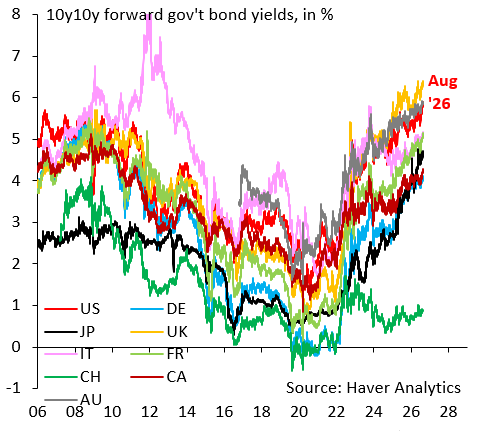 (Image: Chart showing the trend of 10-year forward 10-year yields, including data from nine core developed economies: the US (red), Germany (blue), Japan (black), the UK (orange), Italy (pink), France (light green), Switzerland (dark green), Canada (brown), and Australia (grey).) Based on the chart data, three key conclusions deserve the attention of all market participants and policymakers: First, the upward cycle of global long-term bond yields began in 2022, when central banks around the world initiated a series of interest rate hikes, primarily aimed at suppressing the high inflation caused by the COVID-19 pandemic-related easing policies. In the early stages of this yield increase, it was mainly driven by short-term interest rates, a passive market reaction resulting from monetary policy adjustments; however, after several years of evolution, the market logic has completely shifted, with long-term yields beginning to decouple from the influence of monetary policy and exhibiting an independent upward trend. The current market volatility is fundamentally driven by the rise in long-term risk premiums and term premiums, and is almost unrelated to short-term monetary policy expectations, meaning the market is beginning to fully price in long-term fiscal risks. Second, the initial fundamental conditions of an economy determine the intensity of this round of risk shocks. Countries with large debts, long-term fiscal imbalances, and obvious defects in political governance are more likely to experience bond market shocks and yield increases than economies with sound governance and manageable debt. Japan, the UK, and France are the most typical examples, where fundamental weaknesses are magnified by the market.
 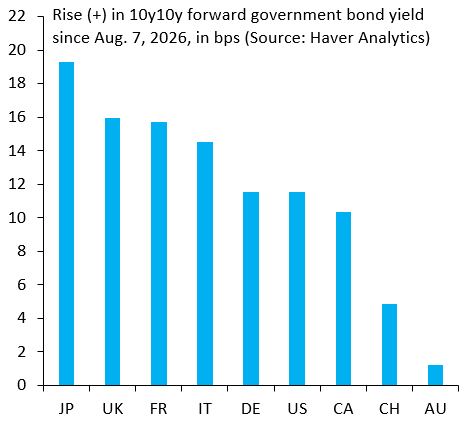 Third, amidst widespread pressure on global bond markets, Switzerland and a few other economies that have maintained low debt and sound fiscal policies have become unique safe havens, exhibiting independent and stable performance. This phenomenon fully demonstrates the long-term value of sound fiscal policies. While Germany's once-proud debt-bracing mechanism, used to curb disorderly fiscal expansion, has weakened significantly in recent years, its ability to constrain debt remains considerably less effective. Nevertheless, it still makes the German bond market significantly more resilient than most European countries, highlighting the full benefits of sound fiscal policy.
Over the past year, my core research focus has been on the trends and movements of long-term bond yields. Fluctuations in long-term yields are the most realistic and direct pricing feedback from the market regarding the debt sustainability and macroeconomic risks of various countries, accurately reflecting the core sentiment of the capital markets. The short-term interest rates on the yield curve are mainly driven by expectations of monetary policy from central banks, essentially reflecting the market's prediction of the tightness of short-term monetary policy and the pace of interest rate adjustments. However, what truly determines long-term market risk and drives this round of market upheaval is the long-term interest rate on the yield curve. The long-term interest rate fully incorporates various risk premiums such as country risk, inflation risk, and debt default risk, and is also the core battleground for this round of global bond market turmoil. The 10-year forward 10-year bond yield, i.e., the market's forward pricing of the 10-year government bond yield ten years from now, is a core indicator for measuring global long-term macroeconomic and fiscal risks. Currently, this indicator is rising sharply globally. Among them, economies with high public debt levels, inefficient government governance, and severe political infighting have seen yield increases far exceeding those of other economies, indicating significantly higher risk exposure. In my analysis last week, I pointed out that the Japanese bond market was deeply mired in difficulties, with risks fully erupting. Market trends have completely confirmed this judgment: in the past ten trading days, the increase in the yield on the Japanese 10-year forward 10-year bond was the highest in the world, followed by the UK, France, and Italy, with highly indebted European economies collectively under pressure. The capital market no longer views the global market in a general way, but rather accurately identifies and prices the differences in the fundamentals of various countries, focusing its attacks on vulnerable economies with weak fundamentals and prominent debt risks. The market is generally concerned about the core reasons for this round of concentrated selling of global bonds and soaring yields. Multiple external factors have combined to trigger this round of risky market conditions in the bond market. Since the latest interest rate meeting of the year by the Federal Reserve on July 29, the US Treasury yield curve has shown a very significant bear market steepening trend. As the core global capital market, the rapid rise in the long-term yields of the US has generated a strong spillover effect, directly driving up the long-term bond yields of all economies around the world. At the same time, the recent surge in international oil prices has further exacerbated market anxiety about inflation and risk aversion, putting continuous pressure on the bond market. The bond market is extremely averse to macroeconomic uncertainties and geopolitical instability. The ongoing and unresolved Persian Gulf geopolitical conflict has further amplified the instability of global energy and financial markets, leading to a continued decline in market risk appetite. However, in my view, attributing this round of bond market turmoil to short-term external shocks such as oil price fluctuations and geopolitical conflicts completely misses the mark. These external shocks are merely triggers, not the core root cause. When an economy carries excessive debt and maintains unsustainable massive fiscal deficits for a long period, it becomes extremely vulnerable, and any small external shock can trigger systemic risk exposure. Ultimately, this global bond market crisis is not a short-term fluctuation caused by a sudden shock, but rather the inevitable result of the long-term accumulation of disordered and unbalanced fiscal policies by countries around the world. (Image: Chart showing the trend of 10-year forward 10-year yields, including data from nine core developed economies: the US (red), Germany (blue), Japan (black), the UK (orange), Italy (pink), France (light green), Switzerland (dark green), Canada (brown), and Australia (grey).) Based on the chart data, three key conclusions deserve the attention of all market participants and policymakers: First, the upward cycle of global long-term bond yields began in 2022, when central banks around the world initiated a series of interest rate hikes, primarily aimed at suppressing the high inflation caused by the COVID-19 pandemic-related easing policies. In the early stages of this yield increase, it was mainly driven by short-term interest rates, a passive market reaction resulting from monetary policy adjustments; however, after several years of evolution, the market logic has completely shifted, with long-term yields beginning to decouple from the influence of monetary policy and exhibiting an independent upward trend. The current market volatility is fundamentally driven by the rise in long-term risk premiums and term premiums, and is almost unrelated to short-term monetary policy expectations, meaning the market is beginning to fully price in long-term fiscal risks. Second, the initial fundamental conditions of an economy determine the intensity of this round of risk shocks. Countries with large debts, long-term fiscal imbalances, and obvious defects in political governance are more likely to experience bond market shocks and yield increases than economies with sound governance and manageable debt. Japan, the UK, and France are the most typical examples, where fundamental weaknesses are magnified by the market. Third, amidst widespread pressure on global bond markets, Switzerland and a few other economies that have maintained low debt and sound fiscal policies have become unique safe havens, exhibiting independent and stable performance. This phenomenon fully demonstrates the long-term value of sound fiscal policies. While Germany's once-proud debt-bracing mechanism, used to curb disorderly fiscal expansion, has weakened significantly in recent years, its ability to constrain debt remains considerably less effective. Nevertheless, it still makes the German bond market significantly more resilient than most European countries, highlighting the full benefits of sound fiscal policy.- Risk Warning and Disclaimer
- The market involves risk, and trading may not be suitable for all investors. This article is for reference only and does not constitute personal investment advice, nor does it take into account certain users’ specific investment objectives, financial situation, or other needs. Any investment decisions made based on this information are at your own risk.