Crude oil trading alert: Supply concerns are spreading, and oil prices have risen for four consecutive days. A test of the upper resistance level of the trading range is possible in the short term.
2026-08-19 09:38:58
WTI crude oil extended its gains in Asian trading on Wednesday, trading near $84.80 per barrel, marking its fourth consecutive day of increases. The core driver of the current price rise remains supply-side risks. Growing concerns about the delayed resumption of normal shipping activity along key maritime routes are causing traders to continue pricing in additional supply risk premiums in crude oil prices.  Currently, while key shipping lanes are officially described as open, the number of commercial vessels passing through remains significantly low, with some shipping companies continuing to employ detours or delays. Given the region's crucial role in global energy transportation, any sustained shipping disruptions could prolong the transit time of crude oil from production areas to consumer markets, increasing insurance, freight, and inventory management costs. Recent security risks in these waters have again drawn market attention, with several merchant ships facing increased uncertainty when passing through key shipping lanes. For the crude oil market, the real concern is not just a single incident, but whether shipping activity can sustainably recover. If major shipping companies remain unwilling to resume normal passage, the market may continue to reflect potential supply losses by increasing crude oil risk premiums. Recent statements from the United States have also made it difficult for the market to form clear expectations of supply recovery. There has been no clear progress sufficient to drive a full recovery in shipping activity, therefore investors tend to adopt more cautious inventory and risk management strategies. BNY strategists point out that shipping activity in the region remains severely disrupted, and new security incidents near key shipping lanes have further reinforced market concerns about supply risks. From a supply and demand perspective, changes in US crude oil inventories have also provided some support for the recent oil price increase. US industry data shows that as of last week, US crude oil inventories decreased by approximately 328,000 barrels, a significant reversal from the previous week's substantial increase of approximately 9.07 million barrels. Although the decrease was not large, the shift from a large accumulation to a small reduction in inventories helps alleviate previous market concerns about a US crude oil oversupply. However, a single week's inventory decline is insufficient to confirm that the US oil market has re-entered a destocking cycle. The previous inventory increase of over 9 million barrels remains significant, therefore the market needs to continue observing inventory changes in the coming weeks. If US commercial crude oil inventories continue to decline, while refinery utilization rates and refined product demand remain stable, the oil market's supply and demand balance will further improve, potentially providing fundamental support for WTI to break through recent highs. On the other hand, oil prices have risen for four consecutive days, increasing the risk of short-term profit-taking. After WTI's rapid rebound from recent lows, the market risk premium has increased significantly. If key shipping routes experience a substantial recovery, or the market reassesses the scale of supply disruptions, the previously accumulated geopolitical risk premium could be quickly reversed, leading to a significant technical correction in oil prices. Simultaneously, the crude oil market needs to pay attention to changes in global demand. High oil prices themselves can suppress oil demand by increasing transportation costs, compressing consumers' actual purchasing power, and raising industrial production costs. If WTI crude oil approaches $90 per barrel further, and supply-side risks do not worsen, slowing demand and high inventories may once again become the focus of market trading. Therefore, the current rise in oil prices does not necessarily indicate a complete shift to a tight supply-demand fundamentals, but rather reflects a renewed expansion of the supply risk premium. From a global market perspective, continued high crude oil prices will increase cost pressures on energy-importing economies and may re-influence global inflation expectations. If the rise in oil prices persists for a long time, the transmission of energy prices to transportation, manufacturing, and consumption may make major central banks more cautious in adjusting monetary policy. At the same time, the dollar's performance, global bond yields, and the performance of risk assets may also be affected by changes in oil prices, making crude oil a crucial asset connecting geopolitical risks and global macroeconomic policies once again. From a technical perspective, WTI's daily chart shows a clear strengthening trend, with prices rising for the fourth consecutive trading day and regaining the $84 mark, forming a relatively clear bullish pattern in the short term. After finding support at lower levels, prices rebounded continuously, and current market momentum leans towards the bulls. However, after the continuous rise, short-term indicators have gradually entered a bullish zone, and further upward movement should be approached with caution due to profit-taking pressure. The first resistance level to watch is the $86.00-$87.00 area. If this level can be effectively broken and held, the next target may be around $89.00-$90.00; if geopolitical risks escalate further, a move towards $92 cannot be ruled out. On the support side, the key level to watch is around $82.00, followed by the $80 mark. If WTI falls below $80 again, it means that the recent risk premium may begin to shrink significantly. The 4-hour chart shows that WTI maintains a relatively clear short-term upward structure, with prices gradually rising along short-term moving averages and relatively limited pullbacks, indicating that the bulls still hold the short-term initiative. The area above $84 has become a crucial dividing line between bullish and bearish sentiment. If the price can consolidate above $84 and effectively break through $86, the upward trend is likely to continue. Conversely, if WTI encounters continuous resistance in the $85-$86 area and falls below $82, a short-term period of high-level consolidation or even a technical pullback may occur, with the next support level pointing to the $80-$81 area. Therefore, in the coming trading days, it is crucial to observe whether the price can transform the area around $84 from resistance into effective support.
 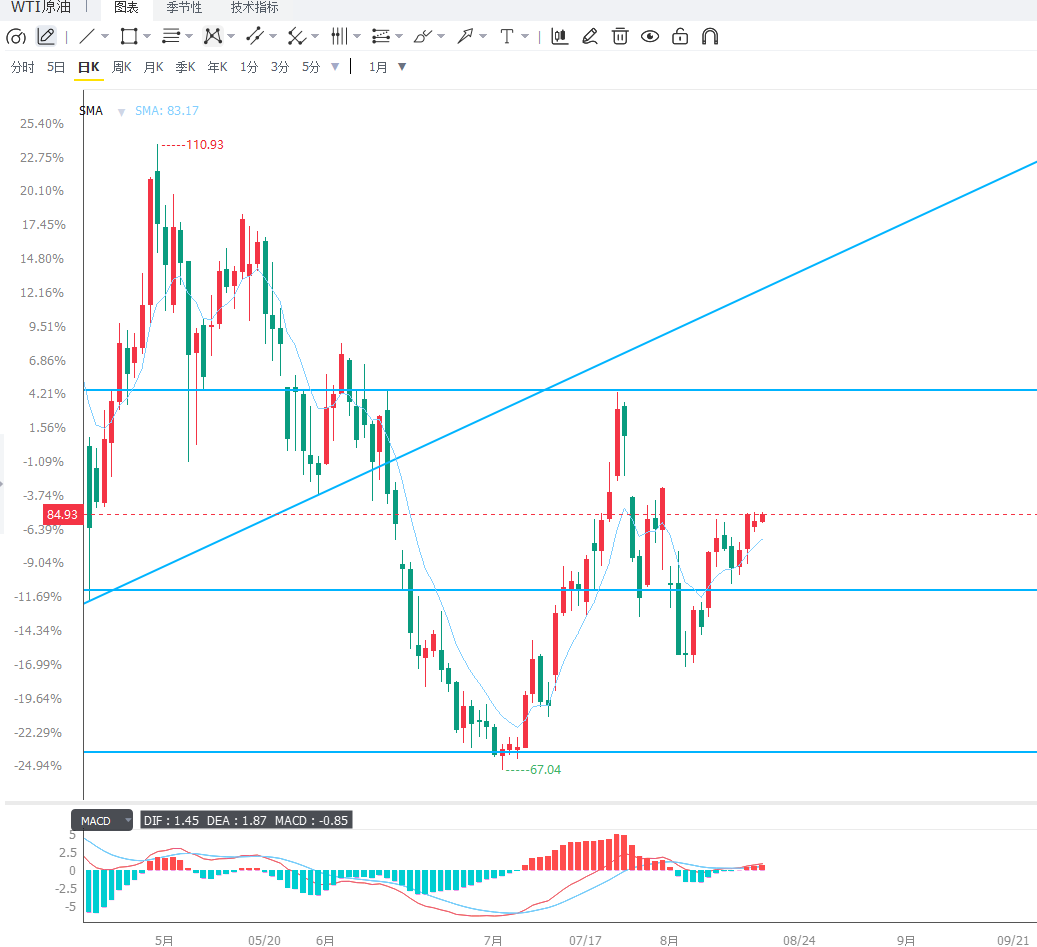 The editor summarizes that WTI crude oil rose for the fourth consecutive day, primarily due to the supply risk premium resulting from restrictions on key shipping routes. A slight decrease in US crude oil inventories further improved short-term fundamentals. The biggest variable in the market currently is not weekly inventory changes, but whether shipping activity can recover and whether supply risks will escalate further. In the short term, WTI has entered a strong trading phase, with $86 as the next important resistance level; a break above this level could lead to a test of the $90 mark. However, if related shipping risks ease, a retracement of the risk premium could cause a rapid price correction. Investors should focus on US inventories, the recovery of shipping, crude oil demand, and the impact of oil prices on global inflation expectations.
Currently, while key shipping lanes are officially described as open, the number of commercial vessels passing through remains significantly low, with some shipping companies continuing to employ detours or delays. Given the region's crucial role in global energy transportation, any sustained shipping disruptions could prolong the transit time of crude oil from production areas to consumer markets, increasing insurance, freight, and inventory management costs. Recent security risks in these waters have again drawn market attention, with several merchant ships facing increased uncertainty when passing through key shipping lanes. For the crude oil market, the real concern is not just a single incident, but whether shipping activity can sustainably recover. If major shipping companies remain unwilling to resume normal passage, the market may continue to reflect potential supply losses by increasing crude oil risk premiums. Recent statements from the United States have also made it difficult for the market to form clear expectations of supply recovery. There has been no clear progress sufficient to drive a full recovery in shipping activity, therefore investors tend to adopt more cautious inventory and risk management strategies. BNY strategists point out that shipping activity in the region remains severely disrupted, and new security incidents near key shipping lanes have further reinforced market concerns about supply risks. From a supply and demand perspective, changes in US crude oil inventories have also provided some support for the recent oil price increase. US industry data shows that as of last week, US crude oil inventories decreased by approximately 328,000 barrels, a significant reversal from the previous week's substantial increase of approximately 9.07 million barrels. Although the decrease was not large, the shift from a large accumulation to a small reduction in inventories helps alleviate previous market concerns about a US crude oil oversupply. However, a single week's inventory decline is insufficient to confirm that the US oil market has re-entered a destocking cycle. The previous inventory increase of over 9 million barrels remains significant, therefore the market needs to continue observing inventory changes in the coming weeks. If US commercial crude oil inventories continue to decline, while refinery utilization rates and refined product demand remain stable, the oil market's supply and demand balance will further improve, potentially providing fundamental support for WTI to break through recent highs. On the other hand, oil prices have risen for four consecutive days, increasing the risk of short-term profit-taking. After WTI's rapid rebound from recent lows, the market risk premium has increased significantly. If key shipping routes experience a substantial recovery, or the market reassesses the scale of supply disruptions, the previously accumulated geopolitical risk premium could be quickly reversed, leading to a significant technical correction in oil prices. Simultaneously, the crude oil market needs to pay attention to changes in global demand. High oil prices themselves can suppress oil demand by increasing transportation costs, compressing consumers' actual purchasing power, and raising industrial production costs. If WTI crude oil approaches $90 per barrel further, and supply-side risks do not worsen, slowing demand and high inventories may once again become the focus of market trading. Therefore, the current rise in oil prices does not necessarily indicate a complete shift to a tight supply-demand fundamentals, but rather reflects a renewed expansion of the supply risk premium. From a global market perspective, continued high crude oil prices will increase cost pressures on energy-importing economies and may re-influence global inflation expectations. If the rise in oil prices persists for a long time, the transmission of energy prices to transportation, manufacturing, and consumption may make major central banks more cautious in adjusting monetary policy. At the same time, the dollar's performance, global bond yields, and the performance of risk assets may also be affected by changes in oil prices, making crude oil a crucial asset connecting geopolitical risks and global macroeconomic policies once again. From a technical perspective, WTI's daily chart shows a clear strengthening trend, with prices rising for the fourth consecutive trading day and regaining the $84 mark, forming a relatively clear bullish pattern in the short term. After finding support at lower levels, prices rebounded continuously, and current market momentum leans towards the bulls. However, after the continuous rise, short-term indicators have gradually entered a bullish zone, and further upward movement should be approached with caution due to profit-taking pressure. The first resistance level to watch is the $86.00-$87.00 area. If this level can be effectively broken and held, the next target may be around $89.00-$90.00; if geopolitical risks escalate further, a move towards $92 cannot be ruled out. On the support side, the key level to watch is around $82.00, followed by the $80 mark. If WTI falls below $80 again, it means that the recent risk premium may begin to shrink significantly. The 4-hour chart shows that WTI maintains a relatively clear short-term upward structure, with prices gradually rising along short-term moving averages and relatively limited pullbacks, indicating that the bulls still hold the short-term initiative. The area above $84 has become a crucial dividing line between bullish and bearish sentiment. If the price can consolidate above $84 and effectively break through $86, the upward trend is likely to continue. Conversely, if WTI encounters continuous resistance in the $85-$86 area and falls below $82, a short-term period of high-level consolidation or even a technical pullback may occur, with the next support level pointing to the $80-$81 area. Therefore, in the coming trading days, it is crucial to observe whether the price can transform the area around $84 from resistance into effective support. The editor summarizes that WTI crude oil rose for the fourth consecutive day, primarily due to the supply risk premium resulting from restrictions on key shipping routes. A slight decrease in US crude oil inventories further improved short-term fundamentals. The biggest variable in the market currently is not weekly inventory changes, but whether shipping activity can recover and whether supply risks will escalate further. In the short term, WTI has entered a strong trading phase, with $86 as the next important resistance level; a break above this level could lead to a test of the $90 mark. However, if related shipping risks ease, a retracement of the risk premium could cause a rapid price correction. Investors should focus on US inventories, the recovery of shipping, crude oil demand, and the impact of oil prices on global inflation expectations.
- Risk Warning and Disclaimer
- The market involves risk, and trading may not be suitable for all investors. This article is for reference only and does not constitute personal investment advice, nor does it take into account certain users’ specific investment objectives, financial situation, or other needs. Any investment decisions made based on this information are at your own risk.