The US stimulus package eased pressure on long-term bond yields, prompting a reversal and upward movement in gold prices.
2026-08-19 21:16:59
The global government bond market has recently undergone a significant adjustment, with yields on sovereign bonds in many countries climbing to multi-decade highs. The global interest rate center has continued to rise, significantly increasing overall market financing costs. In response to the sharp rise in US Treasury yields, the US Treasury announced it would at least double the size of its liquidity support repurchase operations for long-term nominal coupon securities. US repurchases are similar to China's reverse repurchase agreements, a process where the central bank releases liquidity by purchasing government bonds in the secondary market. Ample liquidity benefits various asset classes, including real estate, equities, and gold. Simultaneously, the large-scale purchase of government bonds drives up bond prices, ultimately leading to a significant drop in bond yields, which indirectly lowers market interest rates and significantly reduces the cost of holding gold. This global bond market sell-off is not caused by a single factor, but rather by the combined effects of geopolitical conflicts, rising inflation expectations, expanding government debt, and large-scale financing for the artificial intelligence industry, completely reshaping the pricing logic and operating center of global government bond interest rates. As an "anchor" for global asset pricing, government bond yields move inversely to bond prices. Rising yields are essentially a direct reflection of bond market selling and a tightening supply-demand balance. Generally, the central level of government bond interest rates is determined by four core factors: macroeconomic inflation levels, monetary policy cycles, market supply and demand, and risk premiums. This round of global interest rate increases was initially triggered by the geopolitical stalemate between the US and Iran, subsequently leading to synchronized adjustments in global markets. 
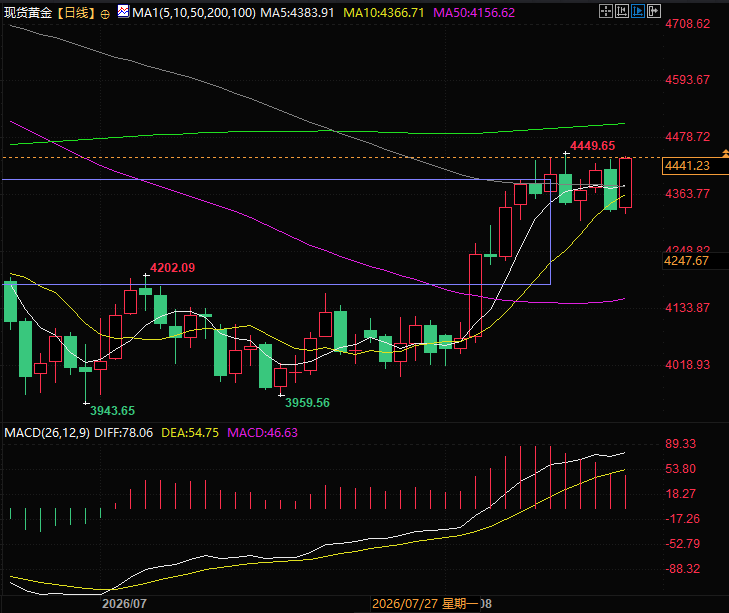 (Spot gold daily chart, source: EasyTrade) At 21:02 Beijing time, spot gold is currently trading at $4434 per ounce.
The escalating geopolitical stalemate in the Middle East is pushing up inflation and interest rate expectations.
The breakdown of diplomatic negotiations between the US and Iran and the continued tension in the Middle East were the direct triggers for the recent surge in global government bond yields. Previously, the market had hoped for a new reconciliation agreement between the US and Iran to ease regional conflict, but the negotiation window ultimately closed, with both sides refusing to continue peace talks, further escalating the situation. US President Trump explicitly refused to extend the US-Iran ceasefire agreement, and Iran also made strong statements about military escalation, significantly increasing regional uncertainty. As a core global energy corridor, the shipping security crisis in the Strait of Hormuz further amplified market concerns about inflation. Nearly six months of regional conflict has left this crucial shipping route almost semi-closed. A recent attack on a cargo ship while passing through the strait exacerbated market panic about a disruption in the global energy supply chain. As a result, international oil prices continued to strengthen, with global benchmark Brent crude futures prices stabilizing above $90 per barrel. The continued high oil prices have completely reversed market expectations of easing inflation, and medium- to long-term inflationary pressures have resurfaced. Rising inflation expectations have directly pushed up the risk premium of government bonds in various countries, forcing interest rates to rise. The market generally anticipates that high energy prices will prolong the global high inflation cycle, further compressing the room for monetary policy easing by major central banks. Expectations of interest rate hikes and maintaining high interest rates continue to rise, leading to a large-scale sell-off of government bonds and pushing yields higher.US Treasury yields surged, triggering a global bond market rally.
The recent surge in US Treasury yields has been particularly significant, becoming a bellwether for global bond market adjustments. Data shows that the yield on the 30-year US Treasury note climbed to 5.335%, a new high since 2002; the yield on the 20-year US Treasury note reached its peak since 2006; and the core 10-year US Treasury yield rose in tandem to 4.748%, the highest level since 2007. This sharp rise in long-term US Treasury yields reflects not only inflation and monetary policy expectations but also the market's pricing of the risks associated with the US government's high debt financing. The market believes that the continuously expanding US fiscal deficit and massive supply of US Treasury bonds require higher yields to attract funds, further raising the central level of long-term interest rates. The rise in US Treasury yields has created a strong spillover effect, driving bond yields in many countries around the world to multi-decade highs, resulting in an overall upward trend in global interest rates. In European markets, the yield on German 10-year government bonds hit a 15-year high, while the yield on French bonds of the same maturity climbed to its highest level since 2008. In Asian markets, the yield on Japanese 10-year government bonds rose to 2.941%, breaking through the spring high and setting a new 30-year record. Furthermore, yields on government bonds of various maturities in the UK, Italy, Switzerland, Canada, and many other countries surged across the board, establishing a clear global bond market correction.Large-scale financing for AI has become a new core variable driving up interest rates.
Beyond traditional geopolitical and inflationary factors, the massive financing boom in the artificial intelligence industry has become a new core variable driving up the global interest rate center, and is also the most distinctive and unique driving factor in this round of bond market adjustments. Carl Weinberg, founder of High Frequency Economics, points out that the construction of AI infrastructure, the iteration of technological industries, and the upgrading of supporting public facilities have generated massive financing demands. In the past year, related lending reached $600 billion, with another $200 billion in financing, bond issuance, and IPO projects currently underway, significantly expanding market demand for funds. From the underlying logic of supply and demand, the massive financing in the AI industry and government debt financing in various countries have created a clear crowding-out effect on funds. The total amount of existing savings in the market is limited. In the traditional pattern, the government is the core "super financing entity" of the market, prioritizing the use of market funds, with the remaining liquidity flowing to small and medium-sized enterprises (SMEs). However, the emerging sector represented by the AI industry has now grown into a new super financing entity, competing with governments for global existing savings. This dual demand for massive funds has thoroughly tightened global liquidity, not only squeezing the financing space for SMEs but also directly pushing up overall market financing costs, leading to a systemic upward shift in the central level of government bond interest rates. Meanwhile, global AI industry financing is highly concentrated in the United States, with funds from various countries continuously flowing into the US market to absorb related assets, further draining market savings from other countries and ultimately leading to a trend of simultaneous increases in the yields of government bonds in various countries around the world.Institutional Analysis: Multiple factors combined to keep long-term interest rates under pressure
Multiple institutions have analyzed that the current rise in government bond yields is the result of multiple converging factors, not a single short-term event. Dan Cotsworth, Head of Markets at AJ Bell, stated that while geopolitical conflicts leading to inflation concerns and expectations of central bank interest rate hikes are superficial triggers, the deeper core reasons for the continued rise in long-term government bond yields are high levels of government debt financing and increased investor demand for risk compensation in long-term bonds. Jim Reid, an analyst at Deutsche Bank, added that the US-Iran stalemate has led the market to fully price in expectations of a prolonged blockade of the Strait of Hormuz and continued high oil prices. This, coupled with the capital-draining effect of massive financing in the AI industry, has created dual pressures that have driven a continued adjustment in the global fixed-income market, with longer-term sovereign bonds experiencing the most significant pressure.Market Outlook: Global interest rates are entering a long-term upward trend.
Overall, the current global government bond yield level has moved away from its low range and entered a phase of systemic increase. In the short term, the uncertainty of the Middle East geopolitical situation and the stickiness of inflation brought about by high oil prices will continue to support the high volatility of government bond yields, with limited downside potential. In the medium to long term, the continued high debt cycle of global governments and the massive financing demand released by emerging industries such as AI will fundamentally change the global market's supply and demand pattern of funds, becoming the core supporting factor for the future global interest rate level. Overall, the era of low global interest rates and low government bond yields may be coming to a complete end, and a high interest rate level will become the new normal in the global financial market. In the long run, this round of interest rate increases is not simply due to economic overheating, but more so to rising fiscal debt risks, rising term premiums, and the large-scale crowding out of savings by the AI industry. This will weaken the traditional negative correlation between US Treasury yields and gold. The debt and sovereign credit logic is strengthening, the scale of global government debt is expanding, and the US fiscal deficit and interest payments are continuing to rise. Long-term yields are increasingly reflecting debt risk compensation rather than solely economic improvement. As a sovereign credit hedging asset, gold's value will gradually emerge, offsetting the suppression of high interest rates. The initial negative news for gold was not particularly significant, and coupled with the intervention of the Federal Reserve, it caused the price of gold to break upwards instantly. This morning and in recent articles, I have described at length the opportunities in the decline of gold, which just happened to coincide with the intervention of the US Treasury. (Spot gold daily chart, source: EasyTrade) At 21:02 Beijing time, spot gold is currently trading at $4434 per ounce.
- Risk Warning and Disclaimer
- The market involves risk, and trading may not be suitable for all investors. This article is for reference only and does not constitute personal investment advice, nor does it take into account certain users’ specific investment objectives, financial situation, or other needs. Any investment decisions made based on this information are at your own risk.