The pound continued to rise against the dollar, but the momentum was limited; a pullback should be anticipated.
2026-08-20 16:38:59
The pound maintained its gains against the dollar in early European trading on Thursday, trading around 1.3630, as the dollar continued to be pressured by changes in interest rate expectations. Recent weak US economic data, coupled with signs of easing inflationary pressures, has significantly reduced market bets on further tightening by the Federal Reserve. Meanwhile, the expansion of long-term Treasury repurchase operations by the US Treasury Department has put some pressure on US Treasury yields, further weakening the short-term attractiveness of dollar assets.  The latest US economic data is prompting the market to reassess the Federal Reserve's policy path. Weaker-than-expected employment data, coupled with a slight easing in inflation, has led investors to reduce their bets on further tightening of US monetary policy. Current market pricing indicates a 32.7% probability of a Fed rate hike in September, a significant decrease from 47% a month ago. This rapid cooling of interest rate expectations suggests that the previous policy premium for the dollar is diminishing, providing significant external support for the pound against the dollar. However, the minutes of the Fed's July meeting still released a relatively hawkish signal. The minutes showed that several policymakers believed that if inflation does not decline further, future rate hikes may still be a necessary option. The Fed maintained the target range for the federal funds rate at 3.50% to 3.75% at its July meeting. Therefore, the current bearish sentiment towards the dollar is not based on the Fed having completely shifted to easing, but rather on recent data reducing the urgency of a short-term rate hike. The US Treasury's bond repurchase operations are also an important variable affecting the dollar. With the expansion of long-term Treasury repurchase operations, liquidity in the bond market has been supported to some extent, easing the previous upward pressure on long-term yields. If US Treasury yields continue to decline, the US dollar may face further pressure, while the pound sterling may gain additional upside potential against the dollar. In the UK, market sentiment regarding the Bank of England's future policy path is relatively complex. Wednesday's UK consumer price data did not show any significant surprises, while previously released employment data indicated a gradual cooling in the labor market. This means that while the Bank of England still needs to monitor inflation, persistent price pressures from the labor market may be easing. The money market currently expects the Bank of England to raise interest rates once more this year, with the policy rate potentially rising from 3.75% to 4.00%. This expectation still provides interest rate differential support for the pound, but its sustainability depends on future UK inflation and wage data. If the labor market continues to cool and basic wage pressures further decline, the necessity for further interest rate hikes by the Bank of England may decrease, thus limiting the pound's medium-term upside potential. Muffer's analysis suggests that while the latest UK labor market data shows a slight increase in overall wage growth, the growth rate of private sector wages excluding bonuses has slowed from 2.9% to 2.8%. Meanwhile, PAYE employment decreased by approximately 13,000, indicating that corporate hiring demand remains weak. This combination suggests that inflation risks from the UK labor market are slowly easing. Therefore, the pound currently faces a relatively delicate policy environment. On the one hand, declining expectations of US interest rate hikes and lower US Treasury yields are significantly weakening the dollar; on the other hand, UK economic data shows that inflation risks are easing, which limits the Bank of England's room for further tightening. Whether the pound can continue to rise largely depends on whether the dollar's weakness can continue. The focus will be on US initial jobless claims data and subsequent speeches by Federal Reserve officials. If the US job market continues to perform weakly, the market may further lower the probability of a Fed rate hike, and the dollar is expected to continue to be under pressure; conversely, if initial jobless claims data is significantly stronger than expected, US Treasury yields may rise again, thus limiting the pound's rise against the dollar. Meanwhile, geopolitical tensions may still affect inflation expectations in Europe and the US through energy prices. If energy prices remain high, both the UK and the US may face greater inflationary pressures, but the policy responses of the two central banks may not be entirely synchronized. Therefore, the correlation between energy prices, inflation data, and central bank interest rate expectations will remain an important factor influencing the direction of the pound against the dollar. From a daily chart perspective, the GBP/USD pair maintains a clear bullish bias, currently trading above the 20-period Bollinger Band middle line and the 100-day moving average, indicating that the medium-term trend remains intact. The current RSI is around 68.7, approaching overbought territory, suggesting strong bullish momentum, but the short-term gains are also appearing somewhat excessive. The first resistance level to watch is the upper Bollinger Band around 1.3645. A decisive break above this level could target the psychological level of 1.3700, with further resistance at the January 27 high around 1.3869. Initial support lies around 1.3519, the August 18 low. A break below this level could lead to a pullback towards the Bollinger Band middle line around 1.3465 and the 100-day moving average around 1.3425. A deeper correction would target the lower Bollinger Band around 1.3290. From the 4-hour chart, the GBP/USD pair remains in a short-term upward trend, with the price consistently trading in the upper half of its recent upward range, indicating that bulls are currently in control. However, as the price approaches the resistance zone of 1.3645, short-term profit-taking may increase. If the price effectively breaks through and holds above 1.3645, the short-term trend is expected to strengthen further, with 1.3700 becoming the next important target. If multiple attempts to break through fail, a technical pullback may occur. During this pullback, 1.3519 is a key short-term support level. As long as this level holds, the market can still be considered to be consolidating strongly. If it breaks below this level, a pullback towards the 1.3465 to 1.3425 area should be anticipated.
 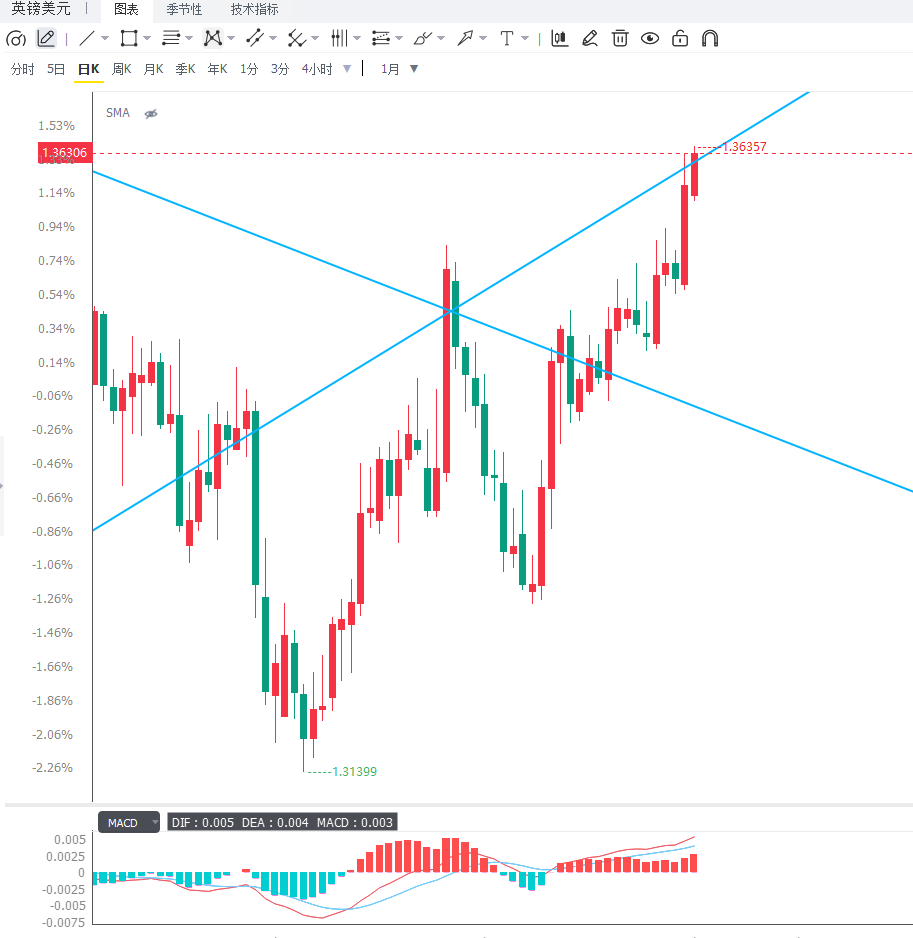 Editor's Summary: The current rise in the pound against the dollar is mainly driven by a weaker dollar and the repricing of interest rate expectations in Europe and the US. **The probability of a Fed rate hike in September has fallen to 32.7%, while expectations of another 25 basis point rate hike by the Bank of England this year continue to support the pound.** However, slowing wage growth and declining employment in the UK suggest that inflation risks are easing, and the pound's policy interest rate advantage is not without limitations. In the short term, 1.3645 is a key level for the bulls; a successful breakout could lead to a further challenge of 1.3700; a failed attempt to break higher could result in a pullback to around 1.3519 or even 1.3465. Subsequent US employment data, US Treasury yields, and policy expectations from the two major central banks will continue to determine the next direction of the exchange rate.
The latest US economic data is prompting the market to reassess the Federal Reserve's policy path. Weaker-than-expected employment data, coupled with a slight easing in inflation, has led investors to reduce their bets on further tightening of US monetary policy. Current market pricing indicates a 32.7% probability of a Fed rate hike in September, a significant decrease from 47% a month ago. This rapid cooling of interest rate expectations suggests that the previous policy premium for the dollar is diminishing, providing significant external support for the pound against the dollar. However, the minutes of the Fed's July meeting still released a relatively hawkish signal. The minutes showed that several policymakers believed that if inflation does not decline further, future rate hikes may still be a necessary option. The Fed maintained the target range for the federal funds rate at 3.50% to 3.75% at its July meeting. Therefore, the current bearish sentiment towards the dollar is not based on the Fed having completely shifted to easing, but rather on recent data reducing the urgency of a short-term rate hike. The US Treasury's bond repurchase operations are also an important variable affecting the dollar. With the expansion of long-term Treasury repurchase operations, liquidity in the bond market has been supported to some extent, easing the previous upward pressure on long-term yields. If US Treasury yields continue to decline, the US dollar may face further pressure, while the pound sterling may gain additional upside potential against the dollar. In the UK, market sentiment regarding the Bank of England's future policy path is relatively complex. Wednesday's UK consumer price data did not show any significant surprises, while previously released employment data indicated a gradual cooling in the labor market. This means that while the Bank of England still needs to monitor inflation, persistent price pressures from the labor market may be easing. The money market currently expects the Bank of England to raise interest rates once more this year, with the policy rate potentially rising from 3.75% to 4.00%. This expectation still provides interest rate differential support for the pound, but its sustainability depends on future UK inflation and wage data. If the labor market continues to cool and basic wage pressures further decline, the necessity for further interest rate hikes by the Bank of England may decrease, thus limiting the pound's medium-term upside potential. Muffer's analysis suggests that while the latest UK labor market data shows a slight increase in overall wage growth, the growth rate of private sector wages excluding bonuses has slowed from 2.9% to 2.8%. Meanwhile, PAYE employment decreased by approximately 13,000, indicating that corporate hiring demand remains weak. This combination suggests that inflation risks from the UK labor market are slowly easing. Therefore, the pound currently faces a relatively delicate policy environment. On the one hand, declining expectations of US interest rate hikes and lower US Treasury yields are significantly weakening the dollar; on the other hand, UK economic data shows that inflation risks are easing, which limits the Bank of England's room for further tightening. Whether the pound can continue to rise largely depends on whether the dollar's weakness can continue. The focus will be on US initial jobless claims data and subsequent speeches by Federal Reserve officials. If the US job market continues to perform weakly, the market may further lower the probability of a Fed rate hike, and the dollar is expected to continue to be under pressure; conversely, if initial jobless claims data is significantly stronger than expected, US Treasury yields may rise again, thus limiting the pound's rise against the dollar. Meanwhile, geopolitical tensions may still affect inflation expectations in Europe and the US through energy prices. If energy prices remain high, both the UK and the US may face greater inflationary pressures, but the policy responses of the two central banks may not be entirely synchronized. Therefore, the correlation between energy prices, inflation data, and central bank interest rate expectations will remain an important factor influencing the direction of the pound against the dollar. From a daily chart perspective, the GBP/USD pair maintains a clear bullish bias, currently trading above the 20-period Bollinger Band middle line and the 100-day moving average, indicating that the medium-term trend remains intact. The current RSI is around 68.7, approaching overbought territory, suggesting strong bullish momentum, but the short-term gains are also appearing somewhat excessive. The first resistance level to watch is the upper Bollinger Band around 1.3645. A decisive break above this level could target the psychological level of 1.3700, with further resistance at the January 27 high around 1.3869. Initial support lies around 1.3519, the August 18 low. A break below this level could lead to a pullback towards the Bollinger Band middle line around 1.3465 and the 100-day moving average around 1.3425. A deeper correction would target the lower Bollinger Band around 1.3290. From the 4-hour chart, the GBP/USD pair remains in a short-term upward trend, with the price consistently trading in the upper half of its recent upward range, indicating that bulls are currently in control. However, as the price approaches the resistance zone of 1.3645, short-term profit-taking may increase. If the price effectively breaks through and holds above 1.3645, the short-term trend is expected to strengthen further, with 1.3700 becoming the next important target. If multiple attempts to break through fail, a technical pullback may occur. During this pullback, 1.3519 is a key short-term support level. As long as this level holds, the market can still be considered to be consolidating strongly. If it breaks below this level, a pullback towards the 1.3465 to 1.3425 area should be anticipated. Editor's Summary: The current rise in the pound against the dollar is mainly driven by a weaker dollar and the repricing of interest rate expectations in Europe and the US. **The probability of a Fed rate hike in September has fallen to 32.7%, while expectations of another 25 basis point rate hike by the Bank of England this year continue to support the pound.** However, slowing wage growth and declining employment in the UK suggest that inflation risks are easing, and the pound's policy interest rate advantage is not without limitations. In the short term, 1.3645 is a key level for the bulls; a successful breakout could lead to a further challenge of 1.3700; a failed attempt to break higher could result in a pullback to around 1.3519 or even 1.3465. Subsequent US employment data, US Treasury yields, and policy expectations from the two major central banks will continue to determine the next direction of the exchange rate.
- Risk Warning and Disclaimer
- The market involves risk, and trading may not be suitable for all investors. This article is for reference only and does not constitute personal investment advice, nor does it take into account certain users’ specific investment objectives, financial situation, or other needs. Any investment decisions made based on this information are at your own risk.